Showing posts with label book review. Show all posts

Tuesday, 24 November 2020

Book Review: Fundamentals of Creature Design

This is not the first book review in this blog (there were at least nine previous ones) and it is also not the first post about creature design. You could say that speculative evolution, the focus of this blog inasmuch it has one, is mostly about creature design, so is there in fact much difference between the two? 

Click to enlarge; copyright 'individual artists'

The book ‘Fundamentals of creature design’ starts with a section 'How to use this book', stating that the book is aimed at those who wish 'to create believable fictional beasts'. Again, that should include those interested in speculative evolution. Still, reading this book made me think that there are differences between the worlds of speculative evolution and creature design. 

But first, the book itself. It has a soft cover and has no less than 286 pages. It is published by 3dtotalpublishing, a company I think consistently combines high production standards with high quality illustrations. The cover mentions four artists whose work is included, but the work of many more is included, whose work is also good to excellent. The book is divided into 7 chapters: research and imagination, functionality and adaptations, anatomy, general design principles, creature design in the industry, design processes and a gallery. 

Click to enlarge; copyright Alex Ries

The chapter on research and imagination is written by Alex Ries, whose work on the Birrin should be well-known. If not, have a look here. The Birrin-project is a long-standing one; I wrote about his work in this blog back in 2009. In the present book, Alex Ries makes the excellent point that nature on Earth provides an endless array of examples that help inspire new creations. He is not the only author in this volume making that point, but I would say that he does something else with it than the others do. He extrapolates, as do the others, but he departs much farther from Earth life than the other authors. In doing so he succeeds in designing alien lifeforms. He alters the Bauplan of his creatures so they are not at all close to that of Earth reptiles, mammals or other vertebrates. The four-jawed and four-eyed heads shown above are a good example of that. (In fact, Furahan hexapods and the Birrin were given a similar head arrangement by coincidence -although the four hexapod jaws evolved from an original six jaws.) Most of the others artists stayed closer to Earth schemes, so their creatures are largely alternate mammals or reptiles rather than alien species. 

Click to enlarge; copyright Brynn Metheney

The next chapter, on form and adaptability, is by Brynn Metheney, whose work has also appeared previously on this blog, in 2011 this time. She makes the point that form should follow function, asking where animals live, what they eat and whether they are male or female. I like her flowing lines and sense of shape as much as I did in 2011. There is an occasional animal with six limbs in here (see above), but most are regular tetrapods, whose legs in particular could easily belong to some real Earth animals: successive segments bend forwards and backwards in the ‘zigzag’ pattern of mammalian legs. Also front and hind legs are easily recognisable as such. 

I do not think think there is an animal with a truly alien leg design in this book; see the last post on zigzag legs here. Admittedly, I am still struggling with the finalisation of just that aspect of Furahan hexapods, and have been doing so for quite some time. And if you do manage to draw unearthly legs, the animal will tend to look ‘wrong’ (but alien). 

This pattern of sticking close to the design of Earth animals is a common theme in the rest of the book. The chapter on anatomy, by Dominique Vassie, makes that point expressly, containing muscle sketches of groups such as primates, dogs, cats, horses, whales, but also myriapods and insects. There was something here that surprised me, and that was advice on how to blend anatomies of different animal groups. I had noticed that tendency in creature design before (see here and here). I was surprised then and now about that, because biological evolution simply cannot mix birds with mammals, for instance, to produce new species. Of course, there is convergent evolution, and that results in similar solutions to similar problems; but evolution does not stitch the front end of a badger to the hind end of a boar, as was done here. Or does that simply mean that creature design is not all that committed to biological evolution? 

The chapter on general design principles focuses on the artistic side of matters, and that is welcome, although one chapter cannot obviously do justice to all the various artistic styles. The chapter gives advice on matters such as a sense of scale and the use of detail at some parts of a painting but not others. The points made here are all valid. Overall, the design principles are not so much aimed at producing the most biologically plausible animal, but more at evoking associations in the humans watching the images. Soft and round shapes help evoke cuddliness, and sharp jagged edges give a more aggressive appearance. There may be a biological truth in that, in that animals with lots of teeth and claws are probably more dangerous than those without. But in biology such messages can be tricky: a cat, or tiger, for that matter, may look all soft and fuzzy at rest, but when it gets angry even a house cat suddenly has more teeth and claws than you thought possible. Such deceiving appearances are absent here: if an animal is to look dangerous, you can tell. Mind you, I have also altered the shape of some Furahan animals to convey a message to human observers. 

This is where my review becomes a bit critical, but please realise that the observations that follow only hold from my peculiar point of view. I am a scientist who happens to be able to draw a bit, and what I like to see are biologically plausible organisms, with a form that makes biomechanical, evolutionary and ecological sense. If the speculation takes place on another planet, the results can indeed resemble Earth life because of convergent evolution, but it is unlikely that the resulting animals could ever be mistaken for Earth mammals or birds. The discussions on the speculative evolution forum, and the often very knowledgeable and insightful comments on this blog, show that people engaged with speculative evolution usually take their biology and plausibility very seriously.


Click to enlarge; copyright Dominique Vassie

Click to enlarge; copyright Edin Durmisevic

That may be the heart of the matter: if speculative evolution is like ‘hard’ Science Fiction, then most creature design is like Fantasy, where the laws of nature take a back seat. There is no hard border between the two realms. The inclusion of the Birrin in fact shows that the two worlds fit well together. Mind you, the Fantasy element is much the stronger one in this book. That Fantasy focus explains why the book contains creatures such as a a giant insect-like beast that can carry humans, although its legs are biomechanically unlikely to allow it to stand, or a human-bear hybrid in the form of a were-bear. Both are biologically implausible, but in a fantasy setting, that's fine.

Click to enlarge; copyright Brian Valeza (I could not scan a part of the image at the left; sorry for that)

Click to enlarge; copyright Kristina Lexova

The book is filled with brilliant images such as the ones above, and I enjoyed it immensely. The above examples are random examples. It does exactly what it set out to do. I recommend it wholeheartedly to anyone interested in designing animals for a Fantasy setting. I also recommend it to those who wish to draw better life forms in a Speculative Evolution context, but just remember that it is not primarily a guide on how to design life forms with a systematically different Bauplan and evolution. That would require a different book, one that may not exist yet. I wonder if there would be a market for such a book...

Saturday, 1 September 2018

'After Man', by Dougal Dixon; a review with hindsight

The book 'After Man' is arguably the best-known book in Speculative Biology. It first appeared in 1981, so you may well wonder why I should choose to discuss a book everyone knows already, 37 years after its publication.

Well, a shiny new edition came out. It is a facsimile edition of the 1981 version, but with some changes. I still own the copy I bought in 1981 and could easily compare the two. The new version faithfully copies the monochrome sections at the beginning and end of the book that explain basic concepts such as the nature of evolution. These, printed on a somewhat coarse type of paper, enclose the heart of the book like slices of bread in a sandwich. That heart consists of 90 pages filled with illustrations in full colour, printed in much better quality on glossy paper. Even the page numbers match up perfectly.

The few changes are interesting. The introductory text has been updated in a few places, and these are indicated with a slightly different font, a nice touch for the bibliophiles among us. For instance, the old version states that early amphibians already had 5 toes on each foot, whereas the new version says that that pattern only emerged as the standard pattern after earlier experiments with other numbers.


Click to enlarge; copyright Dougal Dixon, with permission
The middle part of the book describes animals using ecological zones as a guiding principle, but Dougal Dixon has made two changes to the illustrations. These were originally done by professional artists and were based on sketches by Dougal. That process was not always easy, as Dougal explained in an interview with Darren Naish. I own some photocopies of early sketches for Greenworld that Dougal was kind enough to send me a long time ago, so I can say with confidence that he knows what he is doing when he sketches animals. I discussed Greenword, still only available in Japanese, here, here and here. Dougal gave me permission to use the drawing above to illustrate his own skills. These are of course predatory descendants of rats (falanxes) attacking a rabbit descendant, the rabbuck. Dougal was generally happy with the illustrators' work, except for two interpretations. In the new book he replaced the drawings of the reed stilt and the night stalker with his own drawings, and they indeed look better, in particular the reed stilt, that now is a lightweight and slender creature. I will not show them here; but leave them as an incentive to buy the book.         

I could stop here and consider the job done, but I have seen some critical discussions of Dixon's works, including 'After Man'. I sometimes think these criticisms are overly harsh and would like to add a bit of background to 'After Man', meaning the time in which it appeared.

Click to enlarge; Granada Publishing 1981
Everyone is obviously free to form his or her opinion on the matter, and let me stress that I have my doubts here and there too. As an example, let me discuss the night stalker in some detail. It is a fierce predator, descended from a bat that has given up flight and is a nocturnal terrestrial hunter, using sonar to find its prey. It walks on its front legs and uses its hind legs to catch prey, for which they arch over and outside of the front legs. The image above was copied from the dust cover of the 1981 edition, showing Dougal with a model of the night stalker. Dougal is very good at making such models by the way: I saw several of them for myself on the occasion of the Loncon3 science fiction convention (discussed here by Darren Naish and here by me).

Let's follow the scenario of evolving a land-living bat with specialised grasping legs. I would not expect all those features to evolve at once, but that one would set the stage for the next. (Whales did not evolve baleens the minute they entered the water, but had to become proficient swimmers first.) I expect the first step in that process to be that the bat gives up flight and becomes an animal walking on all fours. That will force quick changes to both the front and hind legs. I would expect that freeing one pair of limbs to catch prey and using the other legs to walk on to evolve only after that. (That, by the way, would be an example of 'centaurism'; see earlier posts here and here). Which pair of legs would become grasping limbs? My guess would be the front legs, because they are closer to the prey. But if the hind legs would be used for some reason, would they reach forward on the outside of the front legs, or in between, where the entire hind part of the body might also be swung forward to extend the reach?

My second doubt concerning the night stalker is that I do not think that sonar works well for a ground-based predator, as I explained in a series of earlier posts (here, here and here). Basically, using sonar is the opposite of stealth. I would therefore expect the animal to redevelop its eyes, keeping its extraordinary hearing as a passive sense. So my personal variant of a bipedal terrestrial predatory bat descendent would walk on its hind legs and not use sonar. I think it would be fairly likely, but it would also be much more conservative and also more boring than Dougal's night stalker...  

By now you may feel that all this criticism of what is probably the most famous creation of 'After Man' is a very odd way to defend Dougal's work. But there is a point here: it is very unlikely that anyone would have been able to raise such specific and detailed considerations in 1981. Such a person would at the time have to have been a professional biologist, not a member of the general public. I am not a biologist, and I can only raise such criticisms now because of several reasons. The first is having ideas; even though I thought hard about the use of sonar for a land-living predator, someone had to have to come with that idea first, and that certainly wasn't me; it was Dougal. The second reason is that you need knowledge to think matters through; to learn, there must be something to learn from.

Suppose you find yourself in 1981 wanting to know more about some biological subject, say sonar, the evolution of whales, or any specific animal group such as 'mudskippers'. You go to a book store or ask your local librarian, who will probably come up with the same one or two books every time, leaving you both frustrated and ill-informed. Anything specific would require access to something like a university library, and even there you would on some subjects find less information than you find on Wikipedia now. There was hardly anything to fill the gap between a general interest and professional levels. The information that is readily available now with a few clicks was either non-existent or almost completely inaccessible in 1981. So what could someone interested in biology, palaeontology and science fiction find in 1981? Well, disappointingly little:

  • On the dinosaur front, you would not be happy. There were stirrings of the coming 'Dinosaur Renaissance' (Bakker's paper from Scientific American from 1975 can be found here). But Robert Bakker's book 'The Dinosaur Heresies', that spread the message that dinosaurs were lively, athletic and interesting was still five years into the future in 1981. The most spectacular book on past life that you could own at the time was probably 'Life before Man', illustrated by Zdenek Burian. It had been around at least since 1973.
  • Speculative biology did not really exist as such. An early work such as Stümpke's 'Snouters' (1957) would remain unknown to you, unless someone book dealer would decide to distribute a new printing, so you could find out about it, by chance, by browsing a book store. I found one in 1983 (under its original German title of 'Bau und Leben der Rhinogradentia'). I later wrote about them here, here and here.            
That's about it. There was no information at your fingertips. If you wished to learn something from an author, you wrote them a polite letter and hoped for the best. No internet, no Google, no computers (well, except for the Sinclair ZX-81 with a 1Kb memory). The lack of information back then would now feel like a near vacuum, and as a result even the most interested people could not possibly become as well-read as many people on the forums now are. It was in this vacuum that Dougal Dixon used his knowledge of evolution and zoology to come up with not just one odd animal, but a whole book full of them. He in fact largely defined speculative biology with 'After Man'. It was an extraordinarily creative production at the time of its first appearance, and that is the only time to judge originality and creativity. 

Friday, 6 May 2016

Terryl Whitlatch's Creature Design

Click to enlarge; copyright Design Studio Press
 This post is about two fairly new books by Terryl Whitlatch, both with 'creature design' in the title: one is 'Principles of CD', and the other is 'Science of CD'. I have kept an eye on her work since I posted about the wildlife of the Star Wars universe, back in 2011. I expressed my admiration for her technical skills, but had a few reservation on other matters, and wondered whether or not I would feel different this time. When a book on creature design comes out with 'science' in the title, it will definitely get my attention. So, is the title correct and is there science in there? Well, yes. And maybe no.

The 'yes' part of the answer concerns animal anatomy. 'Understanding animal anatomy' is in fact the subtitle of the book. The book does cover the subject, by presenting many animal species three times: one as a drawing of its skeleton, one with muscles attached, and one with skin, hair, flukes, etc. The book is strongest on mammals, although there fish, amphibians and dinosaurs as well. However,  anatomy is presented from the artistic viewpoint only, so do not expect joint design principles,  biomechanics or similar matters: that's not what it's for. The drawings are excellent, as always. There are several extinct mammals in there, that are all very convincing as impressions of what these animals could have looked like. I wish Ms Whitlatch would illustrate a book on extinct mammals: it would be wonderful. 


Click to enlarge; copyright Design Studio Press
Here is an example of her work at its very best. This is a Diplocaulus, an early amphibian with an odd head. What Ms Whitlatch has done is to have the animal float immobile in some pond or lake, completely submerged. In doing so she immediately evokes a newt, which I think shows genius.

Click to enlarge; copyright Design Studio Press
The 'maybe no' part has to do with imagining new animals. In these books, most fall into the fantasy or mythology category, combining bits of one animal with bits of another. That is not something I distilled from the animals, but something stated in the books: the donor animals providing the original parts for the new chimaera are usually named in the book. The results can be fascinating to look at, although my impression was that the result is much more about the effect on the viewer than about creating a viable animal. The dog/fish hybrid shown above is an example: it is funny to look at, but does not make much sense as an animal. 

Click to enlarge; copyright Design Studio Press
I discussed this particular design before, but as it is in the new books as well, I will show it again. It shows the common theme of doubling or tripling front legs if you need an animal with three or more pairs of legs. It is apparently hard for illustrators to come up with something else (see my earlier posts on Barsoom animals or Avatar's hexapods). In common with these forerunners, this animal's legs are placed very close together resulting in little, well, leg room.

Creature design in games and in Hollywood seems to have very little respect for biological plausibility, something I have discussed several times in the blog, with irritation as well as sadness. I used to think that this was simply a sign of the complete indifference Hollywood has towards facts of any nature, regardless of whether the facts have to do with history, astronomy or biology. But over time the discussions by readers in this blog made me change my mind. I expect that there is purpose behind the negation of facts. I expect the people high up, who make such choices, to be fully aware of what their audience prefers, and that is close to what they know already. The artists and experts might wish to go much further, but might be reined in lest as otherwise the audience might be dragged from their comfort zone. Of course, by never challenging the expectations much the whole process becomes self-fulfilling...

Click to enlarge; copyright Design Studio Press
Back to the books; here is a similar design, this time for an animal with seven pairs of legs. I like the smooth progression of the phase of the movement. However, once again we see that the front pair is copied: there are no less than six 'front' legs, leaving just one other design for the hind legs. The legs are again close together and their musculature seems suitable for such an animal with just four legs, rather than fourteen. Perhaps you argue that the creature belongs on a world with high gravity requiring lots of stout legs, but the tail design does not fit with a high gravity (it is a long unsupported structure that would need much force and appropriate skeletal adaptations to keep it horizontal and there aren't any: the spines point downwards, not upwards where you would attach ligaments to keep the tail suspended).

Click to enlarge; copyright Design Studio Press
Finally, here is another one in which mixing animals magically has its disadvantages (I am to blame for the parts of the image being cut off; the book did not fit in my scanner). Its head looks like a ceratopsian's with mammoth tusks attached. Spectacular, yes; but wouldn't the tusks be in the way when the animal tries to reach food with its beak? Actually, the part that drew my attention initially was the elbow joint of the front legs, correctly placed at the height of the underside of the body. That angular form really conveys a big elephantine shape very convincingly.

In conclusion, the books show many excellent drawings. They represent some of the best of this particular school of 'creature design', involving people mixing various Earth animals together. This makes their shapes 'natural', and in turn this makes them instinctively believable. However, for anyone with a trained eye, the mixture also abolishes any notion that the animals might have evolved biologically. It may be just me, but that effect detracts from their believability. I can suspend disbelief as well as the next person and so enjoy these creatures very much; but I generally prefer designs that evoke an evolutionary rather than a mythological background.   

-------------------------
Will I take up blogging again? Maybe; I will write the occasional post, but still think it is better to devote the time I have for The Book. It is progressing steadily and has sixty pages completely ready (if you ever write a book, do just that and write it; do not paint a book). I will keep you informed every now and then. Here is a titbit: mixomorphs are now haplodiplontic beings in which both stages are complex multicellular lifeforms, albeit different ones...

Saturday, 13 June 2015

Second part of a review of 'Demain, les animaux du futur' (Future evoluton from France II)

In my first review of the book 'Demain, les animaux du futur' I gave an overview of its contents; this second part will provide a broader view.

I have just spent a pleasant day in Paris with the authors of the book, Marc Boulay and Sébastien Steyer, mostly to talk shop. Their book is doing well, and is the best-selling book at present in the nature category in France. Accordingly, the authors are being approached to give interviews quite often. In fact, while we were at Sébastien's place of work, the Muséum National d'Histoire Naturelle (National Natural History Museum), a journalist showed up from Science et Vie. This magazine is in scope probably the closest equivalent in France to Scientific American. Some of the earlier comments on the book also touched on topics that came up in the interview, such as whether the 10 million years that passed from the present to the time depicted in the book are long enough to account for some of the profound changes in body size, shape and lifestyle to have occurred. To answer that, let's have a look at some of the changes the authors envisaged.

Click to enlarge; Copyright Éditions Belin
Ten million years from now, according to the book, giant bats have emerged from the night, so to speak. They are active in broad daylight and have lost three of their five fingers, which makes them look somewhat like pterosaurs. The wingspan of the largest species, Gigapterus tropospherus, shown above, reaches 15 meters for males. This species has dark spots on its wing that help the animal soak up sunlight during the day to use at night or at high altitude. Mind you, the text states that energy is stored through melanocytes, so this is not photosynthesis, just light and hence to a large extent also heat.

Click to enlarge; copyright Éditions Belin
Another instance of rapid evolution is Benthogyrinus giganteus, an amphibian filling the niche of present-day baleen whales. Compared to its present days amphibian cousins it is absolutely gigantic, even longer than a blue whale. It thrives in the seas, something no present amphibian does. The authors are quick to point out that past amphibians like Ichthyostega tolerated brackish water, and they quote Darwin himself, who described a Patagonian frog living in water too salty for humans to drink. But perhaps its most intriguing feature is that the animal is basically a giant tadpole, meaning it is a larva. It procreates as as larva, in contrast to normal tadpoles that have to metamorphose into adult frogs or toads to do so. This process of retaining juvenile characters in adult life, 'neoteny', certainly occurs in amphibians; the axolotl is probably the best-known example. In fact, some of the peculiar traits of Homo sapiens, that's us, also suggest neoteny: compared to adult apes, we have a large cranium, small and weak jaws and teeth, little hair, etc. To my surprise the Wikipedia article on neoteny almost exclusively deals with neoteny in man. It even suggests that Neanderthal man was less neotenic than we are, so Neanderthals represent the 'adult' version of Homo sapiens more than we do. Hmm; is Homo sapiens then in fact just an adolescent version of Man, let loose upon the world without adult supervision? That might explain a thing or two, but I digress...

So how fast can evolution proceed? Some circumstances seem conducive to quick evolution. The foremost is probably a large difference between the demands posed by an environment on an animal's (or plant's) characteristics and its actual traits. If the gap is small, the eventual changes necessary for adaptation will be small too, but we want impressive changes. The required large gap can be bridged by a series of mutations each bridging a small part of the gap, provided each step conveys an advantage by itself. As an example, consider an aquatic life form faced with an enticing new and fresh world beyond the water's surface. If there is anything to be gained from foraying on dry land, such as cheap food or finding a pool that is not drying out, then a mutation that help the animal to accomplish this task will help it to compete with its fellows. A hypothetical adventurous fish making its first clumsy steps on dry ground certainly merits an epitaph such as 'One small step for a fish, but a giant leap for fishkind'. Of course, such a fumbling fish has no advantage whatsoever if dry land is already occupied by agile predators only waiting for the intrepid fish to venture its naive adventure into their territory. The best circumstances for fast evolution may therefore be a combination of, on the one hand, a large gap between demands and capabilities, and on the other hand an empty stage to stop anything impeding runaway adaptive radiation. Those are exactly the circumstances envisaged in 'Demain'.
   The empty stage in the book is the result of the 'sixth extinction', meaning the sixth time Earth witnessed an extinction of a sizeable part of the world's life forms. All were major assaults on life, and the sixth one is is the one that some authors believe we are witnessing right now. But in contrast to previous ones, caused by natural phenomena, the sixth one is caused by Homo sapiens, going about its business with reckless, perhaps adolescent, energy.
   How large the sixth extinction will be is unknown; we are probably just at its beginnings. The authors' scenario considers it to be at least equal to the mother of all extinctions, the one at the end of the Permian. But with the decline of teleost fish and almost of not all mammals, I would guess it is larger still. A nearly complete collapse of the food chains on land and at sea might indeed provide an empty stage for remnant populations to undergo quick adaptive radiation. The remnants in the book, by the way, are not random, but were mostly taken from species with near-ubiquitous representations: birds, bats and cephalopods.
     

Click to enlarge

Above is a photograph (of poor quality, sorry) showing, from top to bottom, Sébastien Steyer, Marc Boulay, and the journalist of Science et Vie, Elsa Abdoun. The locale is the Muséum I mentioned above, and specifically a hall showing a display of present-day whales skeletons, pertinent to the discussion. But why are whales pertinent to this particular book?

Click to enlarge; copyright where appropriate Wikipedia

Whales present a nice factual example of quick evolution. The genus Pakicetus of about 50 million years ago represents a mammal group thought to be the earliest known 'whales', but here that is a cladistic term only: you would not call this mostly terrestrial animal a 'whale' and would probably not call it 'aquatic' any more than you would call a present-day tapir aquatic. But give these 'whales' some time to evolve, and you will encounter the first fully aquatic whales, basilosauridae and dorudontinae, in the seas of 41 to 35 million years ago. What this means is that whales went from terrestrial tapir analogues to fully aquatic animals in only 9 to 15 million years, similar to the 'Demain' book's 10 million years. Of course, the oceans were not empty during this time, so whale evolution might have been even faster on a truly empty stage; even with other players around, whales exploded onto the scene.

Click to enlarge; copyright Éditions Belin

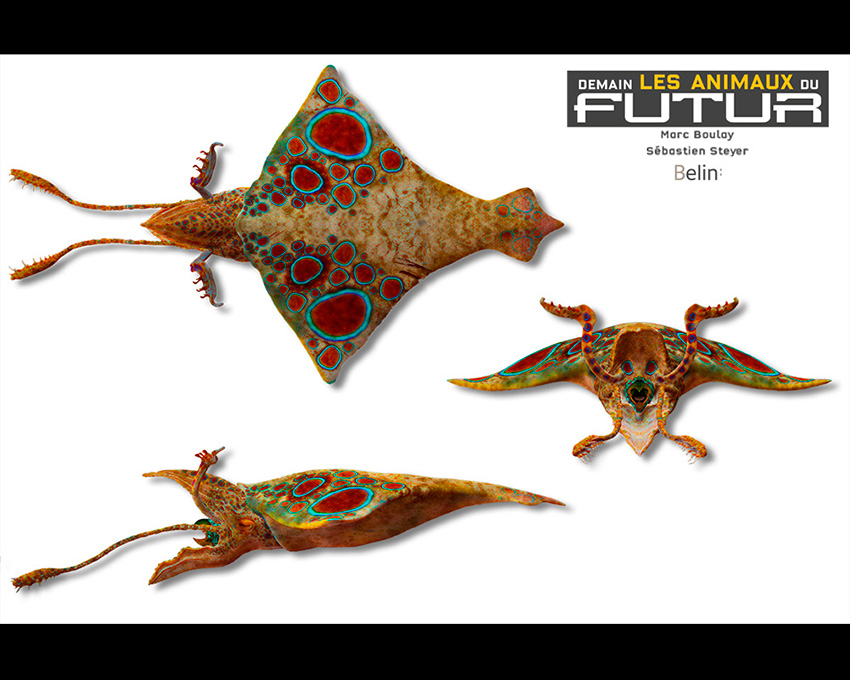
To conclude, what the book does, and does well, is to explore several biotopes. My personal preferences include what the authors did with squids, a clade also radiating to take up niches left by fish and mammals. Above is a giant one, Rhombosepia imperator. It too underwent impressive changes, including the concept that most of its tentacles fused to form false jaws, lined with suction cups. It is, as it was before, a predator, and now uses modified ink to poison its prey.
  I will not show more images from the book: it would spoil the appetite. I realise that readers would want more images, but a review should leave enough unknown for people to want to read the book (this is also the reason why I withhold new Furaha images). I really like the squid radiation, in particular the dolphin analogue 'Delphimimus jamescameroni' (Oh dear Mr Cameron, please have a look at the kind of speculative biology shown here, because it's pretty good!).

The book is not an encyclopaedia of future life; it provides no clues regarding other biotopes. That may be seen as a disadvantage; in a way it is, but I would probably have wanted more even if the book would have had three times the number of pages it has now. Knowing only too well how long it takes to produce such a work, it's perhaps just as well they stopped, to have it published as it is.

Saturday, 30 May 2015

Future evolution from France: 'Demain, les animaux du futur' Review I

Click to enlarge; copyright Éditions Belin 2015  The bird at the top is a Necropteryx, a vulture descendant. The 'helmet' is found on males only, depends on hormones and signifies rank.


Books on speculative biology are rare, so the publication of a new one is an Event. The long-awaited 'Demain. Les animaux du futur' deserves a place of honour in that small library, right next to Dougal Dixon's 'Life after man'. It's very good!


Click to enlarge. Copyright Éditions Belin 2015. I like the clever use of a fake infrared night image. What you are looking at is a confrontation between a predator and a carrion eater, both large birds. 

The book was written and illustrated in a very close collaboration between Marc Boulay, a sculptor who became a ZBrush expert, and Sébastien Steyer, a palaeontologist. As they themselves describe in the book, the artist and the scientist bounced ideas back and forth to shape their creations. The book is published by Belin and is available from Amazon (for 23 Euros, so it's not expensive). Before you all rush off to order it right now, be aware that it is in French.

The book has its own website and there is lots of other information on Marc's site too. It counts over 150 pages and contains more illustrations than text, which is how it should be. Almost all illustrations were done with ZBrush; that is a 3D sculpting programme that has very quickly become a world leader when it comes to sculpting organic forms. Marc is an expert and former beta tester of ZBrush. I knew how good he was with ZBrush, and drew attention to his ability to produce photorealistic illustrations back in 2009. Still, I was a bit hesitant, as I think photorealistic computer generated images run a risk of becoming somewhat lifeless.

Click to enlarge. Copyright Éditions Belin 2015. The image of the head of a male parrot descendent, Tyrannornis rex, shows the level of detail in feathers, skin etc. 

I should not have worried, because Marc pulls it off. In fact, I now think that at this level of artistry photorealism really comes into its own. Paintings have the unique advantages of easily provoking the viewer into imagining a world, often through not showing every detail. Here, every tiny scale, feather, hairs, wrinkle or glint in an eye is visible, and that has an effect in a way opposite to what a painting can do, but just as good. Marc manages to make all those details add life to his creatures: they are actually there.

The book has four chapters: the oceans of the future, the endless mangrove, a new continent and a 'user guide of the future', which in part describes how they designed their creatures, what the design limitations were, etc. Each of the first three chapters has a main text in which unnamed human observers relate what they see in the world around them, so we read about interactions between animals, hunts and other behavioural aspects. The text at times jumps to another perspective providing insights of the reasoning behind a shape or form. I have not read every letter yet, but the authors provide information here and there of the underlying story. This is a world 10 million years in the future. The main players we are used to have disappeared, so there are no large mammals on land, and not even bony fish seemed to have made it through the extinction event. The chapter on the oceans coolly describes that acidification of the oceans might result in the extinction of many animals that make up plankton: this could start to happen in parts of the oceans as soon as 2030. The book does not make a big thing out of this, and the reader is left to fill in the gaps: in a way the book is about  the results of our own actions shaping future life on this planet, for ever altered. The authors chose a period of 10 million years to allow the ecosystems to swing back to stable states again, and also, pragmatically, because other authors had left this particular slot open.

So which animal groups quickly evolved to fill the gaps? There are some lovely and unexpected creations here, but the main players are squid, birds and bats. I expect that this is where people may become critical, either because it is not made clear why these groups survived, or perhaps because of a feeling that 'this has been done before'. As for the latter matter, well, yes, there is truth in that, but it would not be easy to come up with totally novel 'survivor' groups. Dougal Dixon had that luxury with 'After Man', but that was in 1981, because he was the first. Work on the present book started in 2000 as far as I can tell, and in those 15 years many people became interested in speculative biology. I think that that particular term was probably not even in use at the time. Marc and Sébastien do not seem to be worried about this.

Click to enlarge. Copyright Éditions Belin 2015. A big nocturnal terrestrial bat

In fact, when presenting a blood-sucking terrestrial bat (Nosferapoda kinskii), they directly compare it to Dixon's night stalker and the 'future predator' of the television series 'primeval'. By the way, both featured in one of my earlier posts on echolocation. Marc and Sébastien write that creating a terrestrial bat can be considered a classic of speculative biology, and add detail and reasoning to their version: they explain why their 'night vampire' bears most of its weight on its hind legs, so its gait resembles that of knuckle-walking apes. I like this approach of not ignoring earlier works of speculative biology but of accepting that theirs is not the only one. Dixon's work is mentioned more than once in the book, and I am proud to say that my work is acknowledged too: there is a quadrupedal 'giraffe bird' with the species name 'Giraffornis vandijki'. I am honoured!


Click to enlarge. Copyright Éditions Belin 2015. Giraffornis vandijki... I apologise for cutting off the image at the right, but that is where the book pages meet, and I will not ruin the book merely to get a better scan. The male is on top, and a female interacts with a young at the bottom. They are preyed on by Tyrannornis, I am sorry to say.     

I expect that most readers of this blog would want me to post as many as yet unpublished images of the animals in the book as I can cram in this post. I have included very few such images and will show a few more in a second post on this book, one or two weeks from now. But I will restrain myself, as that would spoil the joy of getting your own book. I had seen images on various websites before, but seeing the large number of fresh images formed a large part of the pleasure of reading the book. I hope that others will also restrain themselves, and that Belin finds an English language publisher quickly, so you can all find out for yourselves.

Friday, 28 June 2013

"All yesterdays" by Conway, Kosemen and Naish

This post departs a bit from my self-imposed limit of life on other planets. That was not a strict limitation anyway, as I have also written about future evolution. But both are easily classified as 'speculative biology', and the subject of this post, the reconstruction of extinct animals, is not usually regarded as such. Reconstruction of extinct animals feature in almost any book on the history of life, and there are even some books devoted completely to the imagery of extinct life forms. This specialised form of nature illustration has even acquired its own name: palaeoart. If you would like to see examples of recent -mostly- excellent art, consider this book. It leans heavily towards the current photorealistic style, whereas I personally find a painterly style much more evocative. If you are interested in the early history of palaeoart, I recommend this one ( I think it was the first to coin the term 'deep time'). Sadly, there is no name yet for the 'art of depicting speculative life forms on planets other than Earth', so perhaps one should be invented, even though the number of such books is sadly low. Possible contenders are 'astrobioart' or 'exobioart', not to be confused it with 'biofuturart' (the last one definitely needs to be improved).

The reason to pick out one particular palaeoart book is that this one stresses the speculative aspect of palaeoart, and shows that palaeoart is in fact fairly close to speculative biology. The book is written and illustrated by Darren Naish (from Tetrapod Zoology), Mehmet Kosemen (from Snaiad), and John Conway, a palaeoartist with a refreshingly original style (and a painterly one at that!). The three of them should be able to come up with something very original and they did. The book can be obtained in digital as well as a printed form. The book appeared in 2012, so this is not exactly a quick review. I do not care that much; with food the 'slow food' movement has things to say about eating, and many other things deserve the 'slow' treatment as well; some things are worth being savoured. 

The introductory text of 'All Yesterdays' discusses how palaeoart should be based on a thorough understanding of animal anatomy, but is limited nevertheless because so much of an animal's appearance is determined by its integument. As you know that can range from smooth and shiny through dry and scaly to shape-distorting feathers and pelts for Earth tetrapods. The authors then proceed to play with that idea in two ways, and those are what make the book interesting.

Click to enlarge; copyright John Conway

In the first part of the book, the authors take on Mesozoic animals and add a twist to conventional 'wisdom' of animal reconstructions. They add fatty humps to animals with large vertebral spines, where convention simply stretches a sail between the spines. They seem to have a particular dislike of the 'skinny' way of reconstructing animals, in which the skin is stretched tautly over an animal's skeleton. I agree with them that this style has been overdone. I suppose the underlying reasons to stick to skinny reconstructions for dinosaurs are lingering ideas about them being 'reptiles', and perhaps by a wish to conserve weight. Well, here you will find fat dinosaurs, with stumpy legs emerging from mounds of meat. The image above shows a rather rotund triceratops, which besides being less then athletic also has a range of spikes protruding from its hide.

Click to enlarge; copyright John Conway
The authors also play around with animal behaviour,  a field where reconstruction is nearly entirely  guesswork. Many artists paint Mesozoic landscapes with more animals than there are people in a city park on a sunny Sunday; Here, you find a lone animal on a hillside, with not even one single rampaging predator coming toward it full throttle. There are also plesiosaurs displaying who can lift its neck the highest out of the water; a very nice idea. The image above shows the cover of the book, showing protoceratops in a tree. In a tree? Well, yes. After all, you would not guess that goats could climb trees, but they can. The reasoning here is largely that they have climbed the tree because they could...  

The second part of the book is the truly original part. Here the authors take remnants of present day Earth animals and have some palaeoartists of an undetermined species in the far future have a go at reconstructions.

Click to enlarge: Copyright John Conway
The above is a cat... Very well, a cat whose skull was apparently preserved, but the palaeontologists could only guess at everything else. They came up with this fictional scaly and skinny hide, without cheeks or fur. I like this concept very much, and am tempted to find images of animal skulls and have a go at such fake restorations myself.

Click to enlarge; Copyright CM Kosemen
And this? Well, you are probably familiar with the extinct amphibian whose remains where first taken for those of a human drowned in the biblical great flood. In fairness, that particular mistake was made in 1726, well before palaeontology was underway, and before Linnaeus introduced his biological classification. The animal was later formally classified and named after its inventor, Johann Scheuchzer: it is now Andrias scheuchzeri. In 'All tomorrows', Mehmet Kosemen produced the image of a salamander man shown above, as an example of mistaken identity. The authors label it 'Homo diluvii', the 'man of the deluge'. Spelled with a capital 'H' the name looks like it is an official zoological name. So far I had always seen it referred to as 'homo diluvii testis'. The literal translation of that phrase is 'man, of the flood a witness' (the Romans were not at all particular about word order). That suggests that we are just dealing with a description in the scientific language of the time, not with a formal scientific binomen. I tried to find the scanned book on the internet to check the source but failed. It matters little; this is a great 'Salamander Man'!

All in all, this is an amusing book that makes you think. Mind you, I am not one of those people who think that 'amusing' has a belittling connotation. The combination of amusing and thought-provoking should appeal to everyone interested in speculative biology. The book provides an eye-opener in showing how much of palaeoart, an as yet more 'respected' genre than astrobioart, is full of speculation. In many cases we have become so accustomed to ways of portraying dinosaurs that it has become difficult to look at the reconstructions anew. It is very likely that speculative biology is equally full of such 'familiar faces', and it may be equally difficult to forget them. Still, that may be necessary to take a fresh look. Now, where is that large completely empty sheet of sketching paper?  

Friday, 13 July 2012

Salsa invertebraxa

Some books cannot be classified into a category with any ease; 'Salsa invertebraxa' is definitely such a book. It deals with fictional animals, which criterion by itself reduces the number of books in the putative category enormously. It is not told in a pseudoscientific manner as if the life forms in it actually exist. Dougal Dixon's books are pseudodocumentary in nature, and so is Barlowe's 'Expedition'. If Snaiad, Nereus or Furaha ever make it into book form, they will also fit in the same pseudofactual category. 'Salsa' does none of that; its focus is to tell a story of life through images. It deals with fictional insects functioning as characters with heart and wit, and does this admittedly surprising job brilliantly, I think. I first learned about it through the magazine ImagineFX, and then soon found it on the Behance site. I was intrigued but puzzled by the wonderful but complex images. I found reviews, but the reviewers seemed at a loss to describe what to make of the book. The author, Mozchops, has a page on DeviantArt as well as his own site. If you are interested you should visit all these sites, as they show a fairly large number of the digital paintings Mozchops produced for the book (there is a still larger number of unpublished paintings in the book though. When I found the site of the publisher, Pecksniff Press, I needed but a day or so to decide that I just had to have the book. It was promptly delivered a few days later, but meanwhile I had already contacted Mozchops (Paul Phippen), who was kind enough to explain one or two things about his work. So what is 'Salsa invertebraxa'? You could describe it as a 'graphic novel' telling the story of two insects, comrades from different species travelling through a forest. They are pranksters, stealing eggs from spiders and centipedes. They adorn themselves with the moulted exoskeleton from a cicada-like insect. Decked out in such fashion, they capture colourful caterpillars, suspend them from threads and ride them through the air as if they themselves are knights in armour sitting on war horses. While true, this description might cause the book to come across as silly or even childish. It is neither. It is in fact an extremely complex work that does not give away its secrets lightly. Working out the story needs attention to detail, and there is more to the story than just the above synopsis. The images themselves need careful analysis, because they are full of details and because the artist makes no concessions nor steps down to clarify what it is about. The reader has to rise to the challenge, one I personally enjoyed. There are bits of sparse text, but the words are there to evoke an atmosphere, certainly not as a legend to explain the images. I found myself studying the book several times, and only then did the story start to become clear in my mind. If you like your fantasy biology straight, with little arrows pointing to biological details, you may not like this book. But you would risk missing the incredibly capable artwork. There are certainly enough odd insect shapes in there to satisfy those who like alien animals. Or perhaps their shapes are the result of an alternate evolution on Earth; who knows? I do not think everything in this biology can work. For one thing, I very much doubt that there is space in an insect's head for the neural machinery needed to produce an intelligent prankster, but this is one of those instances where such criticisms are completely beside the point. Ignore it. On rereading the above text, I still doubt that it gives you a full idea what the book is about; you will probably have to read it yourself. I will show a number of images I chose that Mozchops was kind enough to send me in a high-resolution form.
Click to enlarge; copyright Mozchops 2011
Here is an early scene of the two protagonists flying about; the one on the left has clublike extremities while the other is mosquito-like. Just note the shimmer of the wings of the 'mosquito'; it takes skill and belief in your skills to dare paint motion-blurred wings like that, with so little indication of what you see.
Click to enlarge; copyright Mozchops 2011
This image is out on the web already, I think. The two heroes encounter an army of termites, armed to the teeth. I include it so you will get a feeling for how the text adds to the image.
Click to enlarge; copyright Mozchops 2011
Obviously, I could not resist including this one. Regular readers may remember that I did some calculations regarding 'ballonts' some time ago. I had to conclude, to my considerable irritation and disappointment, that my idea of filling Furahan skies with ballooning plankton was not going to work: small ballonts do not work. Luckily, Mozchops had not read that and had designed animals like that. He provided a twist to the idea that I like very much: you are probably all aware of the peculiar mating flight of some dragonflies: the male clasps the female by the neck using claspers on his abdomen. Together the two then fly around to deposit eggs in suitable places. Well, in Mozchops' view the male has a balloon instead of wings, and so the two can float around serenely. Aren't they wonderful? It makes me wish to ignore my own reasoning that small ballonts cannot work...
Click to enlarge; copyright Mozchops 2011
This is one you may have to look at for a while. One of the protagonists, the one with the clubby legs, is riding a caterpillar, as colourful as the saddle cloth of any mediaeval war horse with pennants trailing behind it.
Click to enlarge; copyright Mozchops 2011
At the end of the book the two are met by a host of insects working together as a troupe, the purpose of which is our guess. I wish to show it to you so you can see the inventiveness of the insect shapes. Note the one flying on the right, with its near-mechanical shape and its protruding tongs. The multi-species insect armada contains some of the most wonderful insect shapes in the book.
Click to enlarge; copyright Mozchops 2011
Here, a host of insects, from small to majestic, takes to the skies in an exodus the reasons of which we are not told. Mozchops was kind enough to send me an early sketch of this painting, which is an exclusive for this blog. I would like to draw your attention to one insect at the left, the one with twin booms sticking out backwards. I love its shape, with its twin booms evoking the shape of aircraft such as the P38-Lightning. Note that the entire painting is filled with many such inventions. Other people would probably be content to paint just one such design on one painting; here, we are spoilt for choice. All in all, this may be one of the oddest books I have, but it certainly is also among the ones I like best. It certainly deserves more attention, and I hope that this post helps bring that about.

Saturday, 7 May 2011

Wildlife in the Star Wars universe

The Star Wars films are great adventure movies, but you wouldn't think that there was much biology going on, would you? The Star Wars universe is obviously swarming with intelligent creatures from many different worlds, and these worlds must equally obviously be filled with animals, but you do not get to see many of those. it's not what the films are about. In the second film there was the 'tauntaun' on the ice planet Hoth, and as a hairy mammal-like animal with the body plan of a bipedal carnivorous dinosaur that was an intriguing invention. Otherwise, not many in the early stages came across as great exobiological inventions. In fact, quite a few some could not be taken seriously at all: just think of the gigantic snake-like animal living in an asteroid (in a vacuum!), large enough to have the Millennium Falcon fly between its teeth. Or take the 'Sarlacc', a carnivorous monster buried in the sand on Tatooine: all you see of it is a gigantic mouth in a pit in the sand, reminiscent of an antlion but scaled up to a gigantic level. Its very existence implies that there are lots of rather stupid animals ready to stumble into it maws. No-one would take such a creature seriously from a biological point of view, and no-one should; it's not what the films are about. Still, there is a book about the animals in the Star wars universe, showing someone cared. It is called 'The Wildlife of Star Wars. A Field Guide', by Terryl Whitlatch and Bob Carrau. Terryl Whitlatch has been working as a 'creature designer' for several of the Star Wars films. Typing her name into Google results in so many hits that I do not need to provide many links. Still, here is one with a video interview, and here are two on character design (one and two). The 'Wildlife' book first came out in 2001. I had somehow missed it completely until recently, when a reprint was issued. I found another book of hers showcasing other work, not related to Star Wars: 'Animals Real and Imagined'. The Star Wars book seems to have many creatures in it that did not appear in the films as far as I know. I have to be careful here, as the three newest films (I, II and III) did not make much of an impact on me, aimed as they seemed to be at children. I suspect that most of the animals in the book were not in the films at all, which would imply that Ms Whitlatch had more or less free reign in designing them. The sillier animals such as Giant Space Slugs of over 900 meters long, and the above-mentioned sarlacc occur in the book, should you wish to know more about them. The animals that I assume to be Ms Whitlatch's inventions were much more to my liking. In a way they conform to the general exobiological theme of Star Wars. In it, intelligent beings are almost always humanoid, with two legs, two arms and a sort of alien-looking head that is rather larger than the standard Earth issue human head. The films started when digital creature design did not exist, and alien design followed time-honoured principles, involving actors in rubber suits. Hence the big heads. Ms Whitlatch's aliens more or less follow such principles. The book deals with life on several planets, but you will not be able to determine their planet of origin by looking at their body plan: an animal could come from one planet as well as from the next. Whereas nearly all intelligent beings are humanoid, animals also share many design principles with Earth animals. Quite a few are 'mammaloid', meaning they look a lot like mammals with odd heads. There are also plenty of aviforms and reptiloids, as well as combinations of designs. It is interesting to compare this design strategy with that of Mr Broadmore's Victorian Venusian life forms discussed recently: these were specifically designed to evoke a sense of displacement, i.e. of 'alienness'. Instead, Ms Whitlatch's life forms might be just around the corner. That makes them more believable, but inevitably less alien. Regardless of the degree of their 'alienosity', the animals are all superbly well drawn, with an intimate knowledge of animal anatomy and behaviour. The 'Animals Real and imagined' book contains drawings of existing animals in addition to fantasy ones, proving once more that Ms Whitlatch is a very skilled artist. I will go through a few of her drawings, scanned from the two books. As I did not wish to damage the books, I had to crop some drawings a bit, for which I apologise (you could all get the books yourselves...).
Click to enlarge; copyright Lucasfilm Ltd.
These are Motts from the planet Naboo, revealing how mammalian their body plan is. The way the legs fold, the number of joints, the general shape of the head, all these things say 'earth mammal'; 'ungulate' in fact. But look at the ease with which their poses are captured, and the green thingy walking away from the motts is much more 'alien'!
Click to enlarge; copyright Lucasfilm Ltd.
Also from Naboo, these gullipuds are, as the text says, amphibians. They resemble puffer fish or indeed, some Earth amphibian in being able to inflate their bodies. I like the sense of humour in this and other drawings.
Click to enlarge; copyright Lucasfilm Ltd.
The tree-dwelling Shaupaut. This is another mammaloid. Its elongated fingers are apparently used to 'fish' for avians flying by.
Click to enlarge; copyright Lucasfilm Ltd.
These animals are apparently extinct. They are labelled as stalking birds from Alderaan, and are obviously modelled on large African ground living birds, called 'ground hornbills'. These walk in rows over open fields, hoping to disturb smaller animals so they can be caught and eaten. These birds are doing the exact same thing.
Click to enlarge; copyright Lucasfilm Ltd.
These flying animals are urusais, and while they are members of the same species, there is an enormous difference in anatomy: the male is the one sitting upright balanced on its tail. It has four wings, while the female admiring him only has two. Now that is a rather fundamental difference. I doubt that any animals on Earth take 'sexual dimorphism' to such extremes. You would think that such large differences in shape would result in the two sexes being subjected to very different evolutionary pressures, with resulting different sets of genes for male and female bodies. Earth's insects may be thought to have two sets of bodies as well, but there the two act in different stages of life. It is an interesting concept to have something like that defining the two sexes. I have my doubts however that the differences can go so far as a having different numbers of wings. The text says that their span is about two meters, which means that they must be very heavy. Their bodies and thick tails look good, but do not appear to be designed to save weight. Light bones? A heavy atmosphere?
Click to enlarge; copyright Design Studio Press
This one is not from the Star Wars book, but from the other one. It represents one of the few designs that I do not really like. The reason is that it reminds me too much of the six-legged forms in Avatar that I discussed earlier. Like the Avatar animals, this one does have six limbs, but not as three pairs with their own characteristics, but as one pair of hind legs and two pairs of identical front legs. In fact, their muscle anatomy shows the same problem as Avatar's thanator: the front limbs are, like those of Earth mammals, connected to the axial skeleton almost entirely by muscles. Note that the two sets of muscles seem to run through one another...
Click to enlarge; copyright Lucasfilm Ltd.
I would rather end with something I like better: the Nuna from Naboo, which is a very interesting and humorous drawing. The one on the left is a male, inflating his wattles and hissing to underline his dominance. You can see how well Ms Whitlatch combines animal anatomy with the expression of emotions. The emotions are very readable to us, which is probably not at all would you would expect from alien life forms. Then again, emotions help tell a story, and that is done very well here.