Showing posts with label Jean-Sébastien Steyer. Show all posts

Saturday, 3 January 2026

New speculative biology book about future insects

One main playing field of speculative biology concerns life somewhere else than Earth, such as my Furaha project. Another describes how life on Earth might have evolved if some event in the past had taken a different turn, such as Dougal Dixon’s book The New Dinosaurs, and the third, the subject of this post, deals with life on Earth in the future.

Well-known examples are Dixon’s After Man and the French book Demain, les animaux du futur (see posts A, B, C, D and E). While these projects discuss various animal clades, one group of animals receives less attention than it deserves, based on ecological clout, numbers of species and of individuals: insects!
  
That changed with a new speculative biology book about future insects. Before you run to the nearest bookshop, you should realise that it is in French. At the time of writing the authors do not yet know whether there will be versions in other languages. The book is called Les insectes du futur, a title that should be understandable without knowing French. The subtitle is Petite entomologie post-effondrement, which means ‘small entomology after the collapse’. The book was published last September by Belin in France. The first author is Lucas Etienne, a researcher who designed the arthropods and made the illustrations. You may already know the second author, Jean-Sébastien Steyer, as he was one of the two authors of Demain, les animaux du futur ; he is a palaeontologist (see his book Earth before the dinosaurs) and has published various books popularising science. 

The book counts 163 pages and describes a large variety of insects and other arthropods, as told by two human researchers who make their way from Paris to Monaco in the year 2499. The protagonists make this journey after leaving the underground collection rooms of the Muséum d’Histoire naturelle where they sat out a nuclear war. They encounter many species of arthropods that are as new to them as they are to the reader. The book is divided into chapters that describe ecosystems and various biological principles, such as camouflage, symbiosis, parasitism, flight and adaptations to aquatic life. Let’s have a look at a few organisms.

Click to enlarge; © Belin Éditeur/Humensis, 2025

Nepa dendrobates
This animal may look like a tropical frog, but it is in fact an insect of the clade Hemiptera. The bright dazzling colours of the frog it mimics are a warning to would-be predators that these frogs are poisonous. The insect mimics the frog in colour and shape, so predators should mistake the tasty insect for a poisonous frog and stay clear. This is a nice example of Batesian mimicry, something than can be described as a sheep in wolf’s clothing. I wondered what happens if some predator that never eats frogs comes across such an insect. That predator would not be warned off by the colours because it never eats frogs, poisonous or otherwise. It would still not eat the insect as it wouldn’t recognise the insect as an insect, but as something inedible. Does that turn the effect into simple camouflage rather then Batesian mimicry? That sounds like a nice subject for a biology examination.

Click to enlarge; © Belin Éditeur/Humensis, 2025

Aquatic ants
Quite a few insects adapted to a life underwater, but never ants, or so I thought. I was wrong: there is an ant that dives into the fluid of pitcher plants to steal animals that fell in, and there is a mangrove species that allows its nest to be inundated by the tide. Etienne and Steyer developed their own aquatic ants. They developed gills, have grown considerably larger than any terrestrial ant and have become good swimmers. These ants are still colonial and still build their own housing, which in this case resulting in underwater ant cities. These marine ants developed symbiosis with corals, which is a very interesting idea, so altogether they paint a very intriguing picture.

Click to enlarge; © Belin Éditeur/Humensis, 2025

Abyssal wasp
This wasp descendant can grow to an astonishing length of 60 centimetres. It is bioluminescent thanks to symbiosis with luminescent bacteria. Unfortunately, the book provides little detail how it lives, although it is clear that it has lost its sting.


The story takes place in the year 2499, almost 500 years from now. That may be long enough for mankind to further change the climate and to damage or destroy many ecosystems, bringing about an overall collapse. But how much biological evolution can take place in that time? In other words, what is the maximum speed of evolution? That is probably complex. Factors that must play a role are how large the pressure to change is, such as due to a quickly changing environment and mixing species that were previously separated. The amount of genetic variability and the mutation rate would also be important modifiers of change. The morphological changes in the insect book are so large in such a short time that evolution here has jumped, something known as ‘saltation’.

One theory of saltational evolution by Goldschmidt described ‘hopeful monsters’ that came about through very large mutations, large enough to explain the advent of new species. This concept of saltational evolution was never wholly discarded and new papers keep on appearing on the subject. I do not know enough about it and cannot therefore afford a strong opinion on the matter. Readers of this blog will know about ‘punctuated equilibrium’, a theory stating that species do not change for a long time but may then suddenly undergo a major change. At present, there is evidence for both long periods of stasis as well as for evolutionary jumps. In short, the speed of evolution can vary. 

But the future insect book still forces a closer look at that speed. The fossil record does not exactly have a nice temporal resolution, with a complete fossil every hundred generations or so.


Click to enlarge; source: wikipedia

This Wikipedia graph neatly explains that gradual change over 10,000 years will show up as a qualitative jump if you only sample the record once every 10,000 years. But the graph is quite hypothetical. Very well, let’s hypothesise a bit ourselves. Making an insect look like a frog must involve changes to a great many genes. It seems extremely unlikely for all genes involved to mutate in the correct direction at the same time (but if this does happen, you might get an evolutionary jump). It seems more likely that weeding out any variant that reduces ‘frogginess’ requires untold encounters between predators, the insect and the frog. How many generations would that take? Likewise, adapting insects to water is likely to go through successive stages, perhaps starting with short dips to get food. From there, you can expect changes allowing the animal to last longer under water. I would not be surprised that breeding under water would be one of the last changes to take place. Again, it seems unlikely that all features would change in the correct direction at the same time.          
  
I understand the style figure of using human guides to show these new animals. The alternative would have been to move forward a few million years and to depict the animals as they are, without human interest. Would that have been better? That depends on what you want from such a book. The authors must have had great fun using their new arthropods to illustrate various biological principles such as Batesian mimicry. They did not in fact use the term Batesian mimicry; instead, they chose to teach by example, making their book highly accessible. That is an advantage and does not harm the fun. Come to think of it, showing how biology works is, for me, the essence of why speculative biology is fun.


Saturday, 13 June 2015

Second part of a review of 'Demain, les animaux du futur' (Future evoluton from France II)

In my first review of the book 'Demain, les animaux du futur' I gave an overview of its contents; this second part will provide a broader view.

I have just spent a pleasant day in Paris with the authors of the book, Marc Boulay and Sébastien Steyer, mostly to talk shop. Their book is doing well, and is the best-selling book at present in the nature category in France. Accordingly, the authors are being approached to give interviews quite often. In fact, while we were at Sébastien's place of work, the Muséum National d'Histoire Naturelle (National Natural History Museum), a journalist showed up from Science et Vie. This magazine is in scope probably the closest equivalent in France to Scientific American. Some of the earlier comments on the book also touched on topics that came up in the interview, such as whether the 10 million years that passed from the present to the time depicted in the book are long enough to account for some of the profound changes in body size, shape and lifestyle to have occurred. To answer that, let's have a look at some of the changes the authors envisaged.

Click to enlarge; Copyright Éditions Belin
Ten million years from now, according to the book, giant bats have emerged from the night, so to speak. They are active in broad daylight and have lost three of their five fingers, which makes them look somewhat like pterosaurs. The wingspan of the largest species, Gigapterus tropospherus, shown above, reaches 15 meters for males. This species has dark spots on its wing that help the animal soak up sunlight during the day to use at night or at high altitude. Mind you, the text states that energy is stored through melanocytes, so this is not photosynthesis, just light and hence to a large extent also heat.

Click to enlarge; copyright Éditions Belin
Another instance of rapid evolution is Benthogyrinus giganteus, an amphibian filling the niche of present-day baleen whales. Compared to its present days amphibian cousins it is absolutely gigantic, even longer than a blue whale. It thrives in the seas, something no present amphibian does. The authors are quick to point out that past amphibians like Ichthyostega tolerated brackish water, and they quote Darwin himself, who described a Patagonian frog living in water too salty for humans to drink. But perhaps its most intriguing feature is that the animal is basically a giant tadpole, meaning it is a larva. It procreates as as larva, in contrast to normal tadpoles that have to metamorphose into adult frogs or toads to do so. This process of retaining juvenile characters in adult life, 'neoteny', certainly occurs in amphibians; the axolotl is probably the best-known example. In fact, some of the peculiar traits of Homo sapiens, that's us, also suggest neoteny: compared to adult apes, we have a large cranium, small and weak jaws and teeth, little hair, etc. To my surprise the Wikipedia article on neoteny almost exclusively deals with neoteny in man. It even suggests that Neanderthal man was less neotenic than we are, so Neanderthals represent the 'adult' version of Homo sapiens more than we do. Hmm; is Homo sapiens then in fact just an adolescent version of Man, let loose upon the world without adult supervision? That might explain a thing or two, but I digress...

So how fast can evolution proceed? Some circumstances seem conducive to quick evolution. The foremost is probably a large difference between the demands posed by an environment on an animal's (or plant's) characteristics and its actual traits. If the gap is small, the eventual changes necessary for adaptation will be small too, but we want impressive changes. The required large gap can be bridged by a series of mutations each bridging a small part of the gap, provided each step conveys an advantage by itself. As an example, consider an aquatic life form faced with an enticing new and fresh world beyond the water's surface. If there is anything to be gained from foraying on dry land, such as cheap food or finding a pool that is not drying out, then a mutation that help the animal to accomplish this task will help it to compete with its fellows. A hypothetical adventurous fish making its first clumsy steps on dry ground certainly merits an epitaph such as 'One small step for a fish, but a giant leap for fishkind'. Of course, such a fumbling fish has no advantage whatsoever if dry land is already occupied by agile predators only waiting for the intrepid fish to venture its naive adventure into their territory. The best circumstances for fast evolution may therefore be a combination of, on the one hand, a large gap between demands and capabilities, and on the other hand an empty stage to stop anything impeding runaway adaptive radiation. Those are exactly the circumstances envisaged in 'Demain'.
   The empty stage in the book is the result of the 'sixth extinction', meaning the sixth time Earth witnessed an extinction of a sizeable part of the world's life forms. All were major assaults on life, and the sixth one is is the one that some authors believe we are witnessing right now. But in contrast to previous ones, caused by natural phenomena, the sixth one is caused by Homo sapiens, going about its business with reckless, perhaps adolescent, energy.
   How large the sixth extinction will be is unknown; we are probably just at its beginnings. The authors' scenario considers it to be at least equal to the mother of all extinctions, the one at the end of the Permian. But with the decline of teleost fish and almost of not all mammals, I would guess it is larger still. A nearly complete collapse of the food chains on land and at sea might indeed provide an empty stage for remnant populations to undergo quick adaptive radiation. The remnants in the book, by the way, are not random, but were mostly taken from species with near-ubiquitous representations: birds, bats and cephalopods.
     

Click to enlarge

Above is a photograph (of poor quality, sorry) showing, from top to bottom, Sébastien Steyer, Marc Boulay, and the journalist of Science et Vie, Elsa Abdoun. The locale is the Muséum I mentioned above, and specifically a hall showing a display of present-day whales skeletons, pertinent to the discussion. But why are whales pertinent to this particular book?

Click to enlarge; copyright where appropriate Wikipedia

Whales present a nice factual example of quick evolution. The genus Pakicetus of about 50 million years ago represents a mammal group thought to be the earliest known 'whales', but here that is a cladistic term only: you would not call this mostly terrestrial animal a 'whale' and would probably not call it 'aquatic' any more than you would call a present-day tapir aquatic. But give these 'whales' some time to evolve, and you will encounter the first fully aquatic whales, basilosauridae and dorudontinae, in the seas of 41 to 35 million years ago. What this means is that whales went from terrestrial tapir analogues to fully aquatic animals in only 9 to 15 million years, similar to the 'Demain' book's 10 million years. Of course, the oceans were not empty during this time, so whale evolution might have been even faster on a truly empty stage; even with other players around, whales exploded onto the scene.

Click to enlarge; copyright Éditions Belin

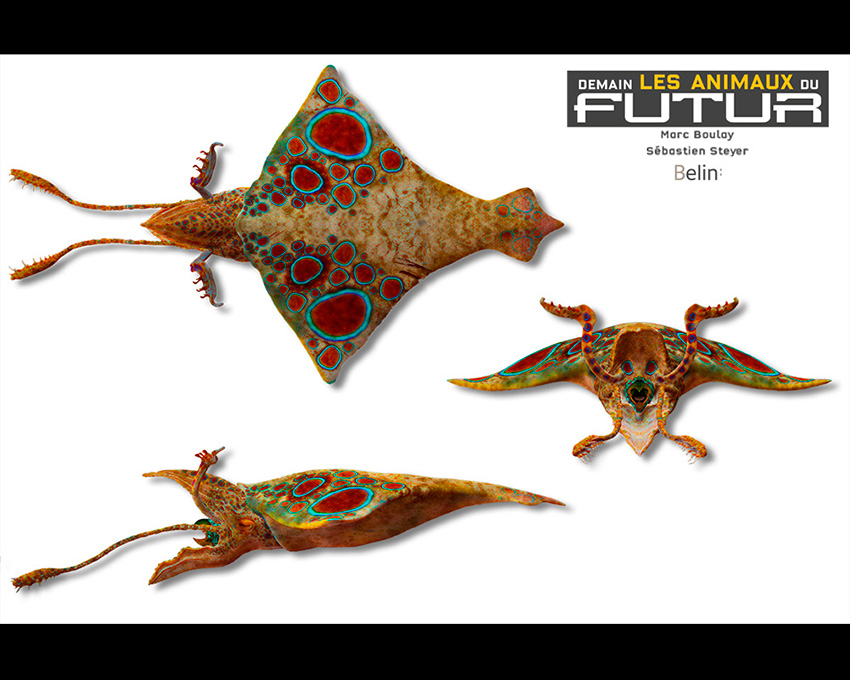
To conclude, what the book does, and does well, is to explore several biotopes. My personal preferences include what the authors did with squids, a clade also radiating to take up niches left by fish and mammals. Above is a giant one, Rhombosepia imperator. It too underwent impressive changes, including the concept that most of its tentacles fused to form false jaws, lined with suction cups. It is, as it was before, a predator, and now uses modified ink to poison its prey.
  I will not show more images from the book: it would spoil the appetite. I realise that readers would want more images, but a review should leave enough unknown for people to want to read the book (this is also the reason why I withhold new Furaha images). I really like the squid radiation, in particular the dolphin analogue 'Delphimimus jamescameroni' (Oh dear Mr Cameron, please have a look at the kind of speculative biology shown here, because it's pretty good!).

The book is not an encyclopaedia of future life; it provides no clues regarding other biotopes. That may be seen as a disadvantage; in a way it is, but I would probably have wanted more even if the book would have had three times the number of pages it has now. Knowing only too well how long it takes to produce such a work, it's perhaps just as well they stopped, to have it published as it is.

Thursday, 8 January 2015

Starting up again: the future is back in France, and a Furaha talk in The Netherlands

The renovation of my house is nearly finished, meaning that life is slowly returning to normal again. One of my new year's resolution was to resume blogging, and I will. Actually, that was the only 'new' New Year's resolution; all the ones from last year had hardly been used and so were still as good as new.

The year's first post will be short and simple. Let's start with a long-awaited arrival, a book about which I have written before in 2011: 'Demain, les animaux du futur'. The literal translation is 'Tomorrow, the animals of the future'. Here are two older posts on the subject: here and here. As I wrote then, the book will be written by Jean-Sébastien Steyer and Marc Boulay. If you search my blog for their names you will find out more about them, and then you could also have a peek at their work, for instance at Marc's site. Actually, Marc's website shows some giant posters on bus stands and buildings, but that is not all. There are also some very nice images from the book on his site, so if you will simply browse through it, you will find the following images, and more besides:


Click to enlarge; copyright Marc Boulay 2000/20015
I must say I love these landscapes, particularly the bottom one, with its trees with aerial roots, suggesting heavy flooding at times. But we'll find out soon enough, in April.

Once or twice I read that people doubted the book was really on its way. Well, if anyone still thiks it is a hoax, perhaps the following link will convince you otherwise: have a look at the French Amazon site. That shows you that the book will cost 23 Euro and will be published on April 10, 2015. You can find it on the UK Amazon site too. I pre-ordered mine already! But I'll want to have it autographed too, so I will have to go to France to see the authors and toast their success...

 ----------------------------------------
 
After my Loncon adventures someone asked me why I did not give similar talks in the Netherlands. Basically I hadn't thought of that, I am sorry to say. But after that I did look around for Dutch SF conventions and contacted the organisers of one. The happy result of that is that I will present a talk on Furaha during the Imagicon meeting, on March 21, 2015, in the town of Ede in The Netherlands. The talk will be based on the London one, but it will be a bit longer; I will show paintings, including a few never published, videos, etc. The talk will obviously be in Dutch though! Dutch readers can access a bit of blurb regarding my lecture on the page reached by clicking 'programma/lezingen' (lectures).  

Friday, 17 May 2013

Back to future evolution in Brussels

In 2009 I wrote about a paper in a Belgian magazine showing models of future animals in the Brussels Museum of Natural Sciences. The animals later also appeared in Darren Naish' Tetrapod Zoology blog. For me, discovering the Brussels animals had as an unforeseen effect that I got to know the makers of the models, for whom designing future animals proved to be more than a single occurrence. Marc Boulay and Jean-Sébastien Steyer have been working on a book on future evolution at least since 1999. The book will be published by Belin in 2014 (in French). There are glimpses of animals as yet unseen by others on Marc's site, by the way.

Back to the future, or back to Brussels, whatever the case may be. I have now finally visited the museum; it is quite good as Natural History museums go, and specialises in dinosaurs. There is an impressive display of nine mounted specimens of Iguanodon bernissartensis, and that alone should be worth the visit. Belgium is famous for its rich supply of Iguanodons, found around 1878 in a coal mine.

Click to enlarge

As you can see, the Iguanodons are standing upright in the tripod position favoured at the time when the skeletons were mounted in 1883, not with their vertebral columns and tails horizontally as would be the case today. This is not because the museum is not up to date; it is  as far as I can tell, so I suppose they are just wary of the cost of remounting various very large dinosaur skeletons. Or perhaps there is a risk of harming the priceless skeletons, or perhaps there is an historical continuity in keeping the Iguanodons mounted according to yesterday's ideas.

The museum has a gallery of evolution, illustrating some major events and their consequences in evolution, such as the developments of eyes, of jaws, of armour and fins. There is a nice video illustrating evolutionary branching, ending for once not with man on top but with many species at the same point in time; if any species is singled out, that is -jokingly- a penguin! At the very end of that gallery there is a small group of models, and those are the animals of the future. That part of the exhibition is rather small and has not got much in the way of explanation. There is a video showing continental drift for the next 50 years, but that is about it. There are no plaques stating what is special about these animals. In fact, I saw a group of children walk by, probably ignorant of the fact that there were fundamental differences between these displays and the multitude of stuffed animals in the museum. There was a sign saying that some items had been removed from the display because of changes being made to the room's climate system; as far as I can tell a snake and a gliding mammal (Trichopteryx dixoni -surely I do not need to explain who that animal is named after-) were missing. Perhaps this also explains the lack of explanations. In this post I will add some explanations, obtained in part from the interview with Jean-Sébastien Steyer in 2009, and to a larger extent directly from his and Marc's comments on a first draft of this post.

Click to enlarge

Corticochaeris gouldi
This is a descendant of the capybara, today's largest rodent. It has become larger, with a disproportionate growth in its teeth, head and front quarters. The magazine text states it is a forest dweller, and its colours seem quite appropriate for that, mimicking spots of light falling through a leaf cover.

I had not seen the species' part of the various names before, as these are only mentioned on small plaques in the museum. The species' names reveal something about the designer's taste in biology and illustration, so they deserve mention. The name 'gouldi' is an homage to the late Stephen Jay Gould. He is considered one of the best writers popularising science of the last century, so I am glad I the designers must have felt similarly.

Click to enlarge

Propellonectes russelli
This is a one meter long descendant of the Northern Giant Petrel, Macronectes halli. As you can see it has evolved into a large flightless swimming bird, propelling itself with its feet by way of flaps on the toes that no doubt fold back with the feet are pulled forwards and that spread out when the feet move back. 

'Russelli' denotes Dale Russell, the Canadian palaeontologist who proposed that dinosaurs might have evolved into an intelligent dinosauroid.


Click to enlarge

Neopygoscelis dentatus
This is a toothed descendant of the penguin species Pygoscelis papua, so its formal name means 'toothed new brush-tailed penguin'. The teeth are apparently not just serrations of the edge of the beak, but proper teeth: the magazine interview states that birds still have the genes for teeth, and that it is not impossible for these genes to regain their expression. Neopygoscelis is an impressive four meters long. Its feet have evolved into large paddles and its wings/flippers have decreased in size, it would seem. That is odd: current penguins have very efficient flippers, so I wonder whether their continued evolution would promote feet at the cost of flippers. The animal appears not to need to climb ashore any more, which would certainly free the feet from their current restrictions as walking appendages. That would make them susceptible to evolution in another direction, but a drive towards them serving as propulsion aids has to start with a propulsion advantage right now, not a future advantage its descendants may gain from enlarged feet. Because of that, I would expect the flippers to stay in place as near-perfect propulsion limbs, and the feet would, well, what would the feet do? Turn into rudders? Disappear altogether? Turn into sexual aids? (In zoology that can always happen...)

Click to enlarge

In the magazine, Neopygoscelis was shown in a penguin-like black-and-white coat (top), but in the museum it is an overall grey colour (bottom). With the magazine in the one hand and my photographs of the museum version in the other, it became clear that the two do not represent the same model at all! Jean-Sebastièn and Marc explained that the process of having the digital designs converted into an actual model had to be done in a hurry to get the models ready for the opening of the exhibition. The result of this was that there was unfortunately not enough opportunity for interaction with the model maker, so the museum models ended up rather different from the original designs. I suppose that that explains the 'feet vs. flipper' exchange in size, which probably reflects a choice of the local model maker. 

Click to enlarge

Helicopodus buriani
For this species and the next, there is nothing in the paper and no explanation in the museum. The model confused me a lot: I could see that it has a segmented body and jointed exoskeletal legs, so it can only be an arthropod. Still, its head looked very unfamiliar, and its eyes certainly look like camera eyes, although it is hard to be certain. Again, it appears that the design suffered from a lack of time for cooperation between the designers and the sculptor. Luckily, I had help from the creators of this odd animal: what we have here is a centipede with a flattened body allowing it to glide through the air. Now that is a neat invention; of course, animals from very diverse groups developed gliding forms, including mammals, lizards, squid and insects, so why not centipedes?

It really is a pity that the museum provides so little information, not even stating that the animal is a glider! (This is a pet peeve of mine: why do museums usually only provide meagre information at infant level? With modern media it should be possible to provide information on many levels, so visitors should be able to choose the level and extent of information they want!)      

'Buriani' refers to Zdenek Burian, whom I consider to be one of the world's best painters ever of prehistoric life forms (and I am not alone in this).

Click to enlarge

Rhombosepia gregaris
The shape and name help here: the 'communal rhomboid-shaped squid'. These are apparently  descendants of cuttlefish swimming head first instead of backwards. Drawing attention to 'swimming head first' may seem strange as it seems the normal direction; true, but squid generally swim with their tentacles trailing them, meaning that anatomically they swim backwards. In fact, many can swim either way. Swimming with the tentacles pointing the way means the tentacles have to be pressed together to form a smooth surface so as not to impede movement. As far as I remember, the thing about Rhombosepia was that its tentacles had fused. I did not check that with its inventors, but relearned that from people commenting on my own blog, who had followed links towards more information on this variant of future evolution. When I checked now, many of those links did not work any more. Those posts were only a few years old, and yet the information has been lost already. With such a quick loss of information in mind, perhaps the guardians of the Brussels museum did well in keeping their Iguanodons in their old-fashioned tripod stance. Concepts of Iguanodon stance are no older than about 125 years, but the skeletons have been underground for more than 500,000 times that length of time.

Having said that, I still find it very difficult to wait for about ONE more year for the book showing us these future animals...

Sunday, 16 September 2012

The Devonian feet of the Furahan marblebill

I really should stop having fun with incomprehensible blog titles. Anyway, too much work again left me no time to write a solid scientific essay. So I will just relate the story of where the 'branching toe theme' originated. The previous post was about redesigning the marblebill, and Spugpow had observed a novel branching pattern of the marblebill's toes.

Click to enlarge.
From: Gould SJ, Ed. The book of Life. Ebury Hutchinson London 1993.


To see where that came from, we have to go back, either to the Devonian or, more appropriately, to books on palaeontology up to about 10 years ago. The image above is from such a book, still available from Amazon in the UK and in the USA. No doubt you have seen similar images before, illustrating how Earth's tetrapod legs evolved from the fins of fish. In the middle right, you will see such a prototypical tetrapod leg: one bone in the upper limb, two parallel bones in the lower limb (the radius and the ulna), a bunch of small bones as a sort of shock absorbers, and five (well, seven) parallel digits with several bones in series. That is basically our arm or our leg. The middle image on the left shows the bones in the ancestral fish limb. Do you see the resemblance? If you do, good for you. I never did, as to me the branching patterns seemed completely different. In effect, the two boned destined to become the radius and ulna may start parallel where they touch the upper limb bone, but their lengths are quite different, and while there are no other bones connected to the radius, some do connect to the ulna. In fact, if you start at the upper arm, there is just one other bone at the front of the limb before you reach the 'lepidotrichia' (the stiffening rods in the fin), but there are three at the hind end of the fin.


Click to enlarge.
Sébastien Steyer. La Terre avant les dinosaures. Copyright Belin 2009


This branching pattern was never explained in such books. In a newer book by Sébastien Steyer, (who by the way is not just a palaeontologist but one of the driving forces behind the future book on future animals I discussed here earlier) you will find the images above. Mind you, besides the French and Dutch versions it is also available in English. The left part shows the fin/limb skeleton of Ichthyostega, and to the right Sébastien has shown a series of limbs showing intermediate forms. Very well, I believe the transition happened, but have never stopped wondering about the branching patterns.

Click to enlarge. Copyright Gert van Dijk

So here are some old sketches. The one on the left in the middle row is more or less our current branching pattern: all fingers have equal numbers of segments (phalanges) and in the middle one of that row I experimented with different patterns: you could first split a limb into two parts and have these two each split into two more, etc. That would be equally 'consistent' in the sense that the number of steps from wrist to tip of a toe is the same. But in the right one on the middle row I played with another way of branching, in which some bones both give rise to a new bone and also continue downwards themselves. In the bottom row I developed the latter pattern some more, finally arriving at the right one, which looks like Ichthyostega's skeleton.

Click to enlarge. Copyright Gert van Dijk

And finally some sketches that show the design taken to extreme consequences. The left one is designed for a marshland creature that needs to spread its weight over a large surface. Mind you, I would never equip Furahan animals with legs that split that far up. I do not think that that makes much sense, as it will double the weight without appreciable advantages. Toes are good for many things: one good thing about them is that they extend stride length, and another is that they help spread weight, act as shock absorbers and help direct forces. Are more toes and longer toes therefore better than few short ones? Well, for these purposes, yes. But there is always a need to conserve mass and energy, so fewer and thinner bones have advantages too. As always, there is an optimum.
The foot on the right is suitable for a very heavy animal of a not too athletic build, rather like an elephant. Its toes are mostly there as shock absorbers and a means to transfer ground forces. They are good for standing and walking sedately. This particular design is not at all suited for athletic animals though, as the toes do not help extend stride length at all: they are much too short for that and hardly bend at all. If you want toes for an athletic animal, think of the feet of a chicken or a tyrannosaur. Well, now you known why I not like the feet of many of Barlowe's animals in 'Expedition' that much: he equipped active athletic animals with unsuitable elephantine feet.

But I digress. In the current Furahan redesign, I decided to build the anatomy of hexapod feet on a pattern that I thought I saw in the fin/feet of Devonian amphibians, that never seemed to be explained. So that is where the marblebill got its feet.

Monday, 13 April 2009

South of Brussels; again...

With spring and all that, there is the garden to consider, so real biology took precedence over speculative biology this Easter weekend. Then again, New Hades Publishers just announced two new books on the Furaha website (one on Epona and one on Snaiad), so don't complain!

--------------------------------------------------

Anyway, what I can do is to direct you once more to our French friends: stirred perhaps in part by the attention given to their work Marc Boulay has been working on a gallery of their future animals. Just go to his site, click on the image of the penguin-like head saying 'Creatief met Darwin' (now where did I see that picture before?) and you will have found it.

Do not worry about the French on the next page. There are four oval links at the top right. Clicking on two of the ones starting with 'ecosystème' should make you happy (the third should make you patient).

Click to enlarge

Here is an appetizer: an Arthrodon, a shark with some interesting characteristics: the row of fins looks like an atavism, but the 'moustache' is a new development: they are electric and are used to stun prey by electrocution.

I really will have to ask them one day how they obtain these nice effects on their sites. Very neat.

Saturday, 28 February 2009

Future evolution south of Brussels

So they have a Propellonectes on display in Brussels, but on the websites of the artists who designed it is a Calcitriornis.

If the previous sentence makes no sense to you whatsoever, please read the entry dealing with this subject first. In effect we are talking about an exposition in Brussels that includes some future animals. I had been using Google to find out more, but need not have bothered, as the material I was looking for is available on the websites of Marc Boulay and Sylvia Lorrain. The three sites contain largely the same material but are not identical, so it pays to visit all three.

Click to enlarge
© Marc Boulay / Sylvia Lorrain - ADAGP Paris 2000-2009
© Jean-Sébastien Steyer - CNRS 2000-2009

I will just show you some images of 'Benthogyrinus' to make you curious. What you see here is a poster-like image with some explanatory text. This states that we are looking at the very last amphibians, descended from the frog genus Xenopus. The species now is an ocean dweller, filling the niche whale sharks once lived in. The animals have developed a salt-excreting gland allowing them to cope with their salty environment. They do not actually look much like frogs, but there is a good reason for that. They are neotenous, meaning that they become sexually mature while formally still being in a larval stage. In effect, they are giant tadpoles. Very giant tadpoles, as they measure up to 20 meters. The males are two or there times smaller than the females and are shaped differently. The next two images illustrate all this nicely.

Click to enlarge
© Marc Boulay / Sylvia Lorrain - ADAGP Paris 2000-2009
© Jean-Sébastien Steyer - CNRS 2000-2009

Click to enlarge
© Marc Boulay / Sylvia Lorrain - ADAGP Paris 2000-2009
© Jean-Sébastien Steyer - CNRS 2000-2009

By the way, if you see a heading 'demos' on their websites, do click on it, as it will lead you to some 'exe' files that provide a slide show with music showcasing their work. Those are definitely worth taking a look.

Nice as all this is, it does not explain why Calcitriornis is the same as Propellonectes. Calcitriornis predates Propellonectes, as is evident from the copyright dates on the images. The answer is given in one of the interviews, and if you want to read it, there is a link on Boulay's site. Here is part one, en here is part two if you need a shortcut. The interview dates from 2006 and mentions a plan for a park on evolution, and that was to contain a section called 'Demain; les animaux du futur' ('tomorrow; the animals of the future'). The same protagonists were involved that we encountered in the Brussels expo: Steyer, Boulay and Lorrain. I do not know whether Dixon was formally involved, but the text makes it clear that they were in contact. That probably explains the traces of his 'Zoology of the future'. Unfortunately for those of us who like such things, nothing came of the plans.

That is sad, but at least it explains the history behind the Brussels' beasties: they were part of an earlier attempt to create a new future. I wonder whether we will hear and see more of the plans from this trio. I hope so.

Oh yes: Jean-Sébastien Steyer has written a book on life before dinosaurs; compared to the dinosaur era that is a time that deserves more attention, and the book looks very good. It is in French, and here is a link.

Saturday, 14 February 2009

Future evolution in Brussels

The February 2009 issue of the Flemish magazine Eos, focusing on the popularisation of science, has as its cover theme 'De dieren van de toekomst' ('the animals of the future'). Now that is an interesting theme! Anyone with an interest in the subject will immediately think of Dougal Dixon's book 'After man, a zoology of the future' (see my installment on 'Why there's no walking on tentacles' for a glimpse at one of his other works). Eos' story is about a new exhibition in Brussels' natural history museum, in which a new evolution gallery opened on February 12 2009, the 200 anniversary of Darwin's birth. Apparently the museum people decided not to let evolution simply stop right in our age, but to leave the clock ticking for another 50 million years into the future. This period is called the Dixonian, so it's clear the people behind it have done their homework. Congratulations Dougal!

The page of the museum website is in Dutch, French and English (but not in German, which is odd, as it is spoken in Belgium and the main museum page does have a German version). It is frustratingly devoid of images of future lifeforms. A bit of internet searching led to a site promising a video of the animals, but at the time of writing the video did not work; I will include the video link here in the hope that it will work later on. So all I had to give you some more information was the magazine. Pick it up, if you can (and can read Dutch).

© Marc Boulay / Sylvia Lorrain - ADAGP Paris 2000-2009
© Jean-Sébastien Steyer - CNRS 2000-2009

Click to enlarge

Above is an image taken from the cover; it shows five of the to-be-evolved animals with their names.

© Marc Boulay / Sylvia Lorrain - ADAGP Paris 2000-2009
© Jean-Sébastien Steyer - CNRS 2000-2009

Click to enlarge

This is a close up of Neopyghoscelis, a penguin descendant reaching up to 4 meters in length. I wonder whether the image shows a young animal, as the size of the eye seems much too large for a 4-m bird. Eyes don't usually increase in size at the same rate as overall body size.

Anyway, one of its more interesting features is that it redeveloped teeth. Looking at the image I thought that these were pseudoteeth, i.e., bumps developing from the rim of the penguin's beak, but the text suggests that the teeth are the result of the genes for teeth, dormant in present birds, having become active again. I wonder if that event is more likely than reshaping the rim of the beak, but either 'solution' would do the trick, I guess. The text says 'Creative with Darwin' in Dutch.

© Marc Boulay / Sylvia Lorrain - ADAGP Paris 2000-2009
© Jean-Sébastien Steyer - CNRS 2000-2009

Click to enlarge

And this is a Propellonectes (remember that name!). The legend says that is a descendant of a present-day petrel, that has lost its wings and swims with much enlarged feet. It is about 1 metre in length.

Very nice work. I will keep an eye on the museum site to see if more material appears. The magazine story is largely about how evolution works, but also provided some names on the people who thought all this up. It looks like a very interesting set of people. Jean-Sébastien Steyer is a palaeontologist working in Paris, and I guess he's the one responsible for coming up with biologically sound lifeforms. As an aside, I think that that particular activity could with reason be described as 'creationism', to be defined as thinking up animals based on sound biological principles. It's a pity that the word seems to be in use already, in a rather less entertaining setting...

Then two people come in to breathe life into the designs (I think I had better be careful with my metaphors here, but in Darwin week some leeway is allowed). The first is Marc Boulay, who does 3D computer sculpting in Z-brush, and just looking at his page makes me wish I had chosen to go into creative work in my life rather than pursue an academic career; oh well, I admit it, perhaps I am just a tiny bit envious...

© Marc Boulay / Sylvia Lorrain - ADAGP Paris 2000-2009
© Jean-Sébastien Steyer - CNRS 2000-2009

Click to enlarge

The image above should whet your appetite for more. Dixon lovers will recognise this as one of his creations, a Tetraceras. But if that isn't enough, the task force also included Sylvia Lorrain, and her website tipped me from just containable envy after seeing Boulay's work into a feeling of deep inadequacy; they are that good. She combines 3D models with photographs to produce realistic depictions of animals, which is very tricky as it soon becomes tacky. She pulls it off.

© Marc Boulay / Sylvia Lorrain - ADAGP Paris 2000-2009
© Jean-Sébastien Steyer - CNRS 2000-2009

Click to enlarge

This particular bird is something I found on her site. Be certain to visit their sites, as there is more to see there. Obviously, this is a diving bird, and it's called a Calcitriornis. Hang on, that is the same bird shown in Eos as a Propellonectes! What is going on here? Calcitriornis evolving into Propellonectes? I think I will try to find the story behind this matter another day.

Now it's back to Brussels, so to speak. The team so far had everything it took to depicting 3D animals, but in 2D! The museum apparently wanted 3D items to display; ironic, in a way. The sculptor Yves Gaumetou did the final job of putting flesh on the digital bones. It's probably modeling clay or something similar, but the results can be touched and you can walk around them, and that was the point. His site contains excellent sculptures of present day animals in life-like poses.

I definitely think I will have to go to Brussels one of these days.

-------------------------------------------
Remarks added in December 2010: Seeing that Darren Naish of Tet Zoo directed some traffic to this old post, I looked at it myself, and found that some links no longer worked and that the post is behind the news. Here is an update.

Marc Boulay is now here: http://www.marcboulay.net/
Sylvia Lorrain is still here: http://www.sylvialorrain.net/
Sébastien Steyer's page has moved as well: http://www2.mnhn.fr/hdt203/info/steyer.php

Other newsworthy items may be that Sébastien has written a very nice book on early vertebrate evolution, available in French and Dutch (as far as I know). Marc and Sébastien are working on a book on future evolution on Earth; you can read more about it on Marc's site.

Finally, I later wrote some more on the Brussels expo and on Marc and Sylvia's work. If you want to read it, here is a post that links to the other posts.

Sigmund Nastrazurro

PS. I still haven't seen the Brussels expo myself...