Showing posts with label sebastien steyer. Show all posts

Tuesday, 10 April 2018

Ten years on

The first post of this blog was published on April 22, 2008, or ten years ago. I wrote several earlier progress reports. It is time for a new one, especially because of the festive nature of ten years of blogging. Well, more or less, because the rate of new posts has been low in the past few years. More on that later. 

Let's start with a comparison with 5 years ago, when I also wrote a progress report. Then, there had been 307,000 page views according to the blogger 'stats' page, and now the counter stands at 639,478 views. I am not altogether certain that all these visits represent actual people; perhaps there were bots  as well. What is certain is that I had written 197 posts five years ago, whereas the counter now stands at 233 posts, so it is obvious I wrote more posts in the first five than the second five years.  There were 1638 comments in all, and I must say that I enjoy the interactions. The comments have quite often made me think a bit harder about what the project, and gave rise to new animals on more than one occasion. Thanks to all who read my posts with such enthusiasm!

The 'stats' section also tells me what the most-visited posts were over these ten years. Here they are, with their previous ranking from five years ago between parentheses:

1. (1) Swimming in Sand 1: the Sandworms of Dune; 5 Feb 2011; 8854 views       
2. (5) A future book on future evolution from France; 19 Nov 2011; 6239 views       
3. (4) Avatar's 'Walking with hexapods'; 11 Feb 2010; 4862 views
4. (2) Warren Fahy's "Fragment"; 8 Aug 2010; 4010 views                   
5. (-) Future evolution from France: 'Demain, les animaux...; 30 May 2015; 3327 views
6. (3) A century of thoats; 5 May 2012; 2996 views
7. (-) Create your own planet (using Celestia); 13 Aug 2011; 2717 views   
8. (-) The anatomy of giants in 'Game of Thrones'; 11 Jun 2016; 2661 views           
9. (9) Ballooning animals and Newtonian fitness; 15 Jul 2011; 2338 views   
10. (-) Second part of a review of 'Demain, les animaux...; 13 Jun 2015; 1958 views   

There are four newcomers in the top-10, but it seems that the sandworms of Dune are unbeatable. My French friends Marc Boulay and Sébastien Steyer will be pleased to learn that their work occurs no less than three times in the top-10: first as an announcement in 2011, and then as a two-part review in 2015. I hope that this signals an immense interest in books on speculative biology, because that would be good more my own project: The Book.
Click to enlarge; copyright Gert van Dijk
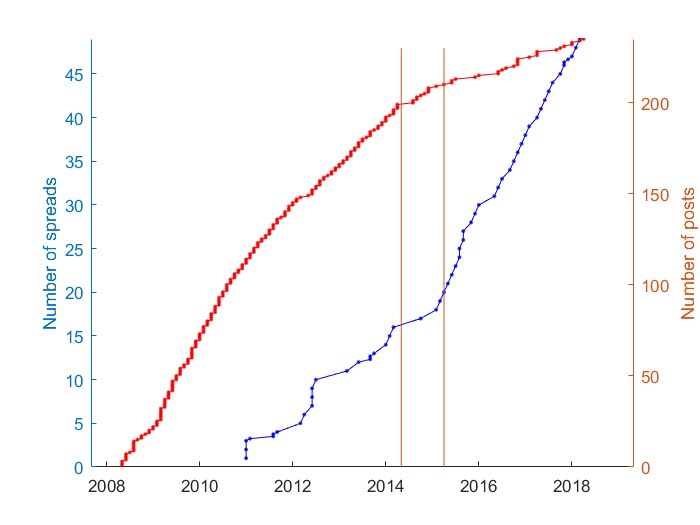
Some of you may recall that I had announced that I would spend less time blogging to have more time to work on The Book. The graph above shows the cumulative number of blog posts in red, from 0 in 2008 to 233 now (the present one excluded), as well as the cumulative number of spreads in blue, starting in 2011. A spread is a two-page account of a species, a chapter introduction, or of any topic worthy of devoting two pages to. The number of spreads started in 2011 because I had made the switch to digital painting and started collecting the slowly increasing number of spreads in an InDesign manuscript. I am at present working on the fiftieth spread, so within a short while the manuscript will have exactly 100 pages. Not bad, hey?

But did the reduction of blogging benefit The Book? The two vertical red lines indicate the post in 2014 in which I announced a temporary stop, and the one in 2015 in which I said that I would stop blogging except for the occasional post. Have a look at the rate of increase of the two lines: the total number of posts rose much slower from then on, while the number of spreads rose appreciably faster. The rate of new spreads since then is about nine spreads a year, which is less than the 12 I hoped to be able to manage. But please remember that this is not a job and that each spread takes presumably 20-30 hours to produce. I you ever write a book, do just that: write it; don't paint it! Mind you, The Book does not consist of images only: there are over 32,000 words at present, which is the length of a novella.

I always aimed at something like 125 pages, simply because comparable works have such a number of pages. At present I think the number will be more like 130, but we'll see. The good news is that I expect that the number of spreads per year will increase, so producing the remaining 15 spreads shouldn't take very long. Mind you, 'not very long' should be considered from the perspective that such a project may take a few decades...              
    
Because this is the tenth year of blogging, I also aim to write a few extra posts this year. I think I will finally write the long-awaited post 'What are toes for?' There will also be posts on equations: the Drake equation, the Seager equation and possibly the Nastrazzurro equation...

Saturday, 30 May 2015

Future evolution from France: 'Demain, les animaux du futur' Review I

Click to enlarge; copyright Éditions Belin 2015  The bird at the top is a Necropteryx, a vulture descendant. The 'helmet' is found on males only, depends on hormones and signifies rank.


Books on speculative biology are rare, so the publication of a new one is an Event. The long-awaited 'Demain. Les animaux du futur' deserves a place of honour in that small library, right next to Dougal Dixon's 'Life after man'. It's very good!


Click to enlarge. Copyright Éditions Belin 2015. I like the clever use of a fake infrared night image. What you are looking at is a confrontation between a predator and a carrion eater, both large birds. 

The book was written and illustrated in a very close collaboration between Marc Boulay, a sculptor who became a ZBrush expert, and Sébastien Steyer, a palaeontologist. As they themselves describe in the book, the artist and the scientist bounced ideas back and forth to shape their creations. The book is published by Belin and is available from Amazon (for 23 Euros, so it's not expensive). Before you all rush off to order it right now, be aware that it is in French.

The book has its own website and there is lots of other information on Marc's site too. It counts over 150 pages and contains more illustrations than text, which is how it should be. Almost all illustrations were done with ZBrush; that is a 3D sculpting programme that has very quickly become a world leader when it comes to sculpting organic forms. Marc is an expert and former beta tester of ZBrush. I knew how good he was with ZBrush, and drew attention to his ability to produce photorealistic illustrations back in 2009. Still, I was a bit hesitant, as I think photorealistic computer generated images run a risk of becoming somewhat lifeless.

Click to enlarge. Copyright Éditions Belin 2015. The image of the head of a male parrot descendent, Tyrannornis rex, shows the level of detail in feathers, skin etc. 

I should not have worried, because Marc pulls it off. In fact, I now think that at this level of artistry photorealism really comes into its own. Paintings have the unique advantages of easily provoking the viewer into imagining a world, often through not showing every detail. Here, every tiny scale, feather, hairs, wrinkle or glint in an eye is visible, and that has an effect in a way opposite to what a painting can do, but just as good. Marc manages to make all those details add life to his creatures: they are actually there.

The book has four chapters: the oceans of the future, the endless mangrove, a new continent and a 'user guide of the future', which in part describes how they designed their creatures, what the design limitations were, etc. Each of the first three chapters has a main text in which unnamed human observers relate what they see in the world around them, so we read about interactions between animals, hunts and other behavioural aspects. The text at times jumps to another perspective providing insights of the reasoning behind a shape or form. I have not read every letter yet, but the authors provide information here and there of the underlying story. This is a world 10 million years in the future. The main players we are used to have disappeared, so there are no large mammals on land, and not even bony fish seemed to have made it through the extinction event. The chapter on the oceans coolly describes that acidification of the oceans might result in the extinction of many animals that make up plankton: this could start to happen in parts of the oceans as soon as 2030. The book does not make a big thing out of this, and the reader is left to fill in the gaps: in a way the book is about  the results of our own actions shaping future life on this planet, for ever altered. The authors chose a period of 10 million years to allow the ecosystems to swing back to stable states again, and also, pragmatically, because other authors had left this particular slot open.

So which animal groups quickly evolved to fill the gaps? There are some lovely and unexpected creations here, but the main players are squid, birds and bats. I expect that this is where people may become critical, either because it is not made clear why these groups survived, or perhaps because of a feeling that 'this has been done before'. As for the latter matter, well, yes, there is truth in that, but it would not be easy to come up with totally novel 'survivor' groups. Dougal Dixon had that luxury with 'After Man', but that was in 1981, because he was the first. Work on the present book started in 2000 as far as I can tell, and in those 15 years many people became interested in speculative biology. I think that that particular term was probably not even in use at the time. Marc and Sébastien do not seem to be worried about this.

Click to enlarge. Copyright Éditions Belin 2015. A big nocturnal terrestrial bat

In fact, when presenting a blood-sucking terrestrial bat (Nosferapoda kinskii), they directly compare it to Dixon's night stalker and the 'future predator' of the television series 'primeval'. By the way, both featured in one of my earlier posts on echolocation. Marc and Sébastien write that creating a terrestrial bat can be considered a classic of speculative biology, and add detail and reasoning to their version: they explain why their 'night vampire' bears most of its weight on its hind legs, so its gait resembles that of knuckle-walking apes. I like this approach of not ignoring earlier works of speculative biology but of accepting that theirs is not the only one. Dixon's work is mentioned more than once in the book, and I am proud to say that my work is acknowledged too: there is a quadrupedal 'giraffe bird' with the species name 'Giraffornis vandijki'. I am honoured!


Click to enlarge. Copyright Éditions Belin 2015. Giraffornis vandijki... I apologise for cutting off the image at the right, but that is where the book pages meet, and I will not ruin the book merely to get a better scan. The male is on top, and a female interacts with a young at the bottom. They are preyed on by Tyrannornis, I am sorry to say.     

I expect that most readers of this blog would want me to post as many as yet unpublished images of the animals in the book as I can cram in this post. I have included very few such images and will show a few more in a second post on this book, one or two weeks from now. But I will restrain myself, as that would spoil the joy of getting your own book. I had seen images on various websites before, but seeing the large number of fresh images formed a large part of the pleasure of reading the book. I hope that others will also restrain themselves, and that Belin finds an English language publisher quickly, so you can all find out for yourselves.

Saturday, 25 May 2013

Predatory penguin's evolution in Brussels' future evolution back on course.

Regular readers may have noted a predilection for incomprehensible titles, or let's say titles that need a lot of knowledge to be comprehensible. This one fits that bill, I think. The previous post dealt with models of future animals in the Brussels museum of natural history. One thing that struck me was that the model of a Neopygoscelis, a penguin descendant, differed quite a bit from the earlier published design. The feet had expanded at the cost of the flippers, an evolution that I would not have expected. The designers, Marc Boulay and Jean-Sébastien Steyer, explained that the actual models had been produced without much control by themselves, explaining the changes. Marc and Sébastien are working on a book about future evolution that will appear in 2014, as told here previously (you can read starting here or here).

My discussion of the odd 'evolution' of the Neopygoscelis model persuaded them to send me two photographs of Neopygoscelis as it will appear in the book, meaning 'Furahan Biology and Allied Matters' gets another exclusive preview of that work.

Click to enlarge
The photograph above shows clearly that the model maker had evolved the enormous hind legs of the museum model quite separately from the designers' ideas. The ratio of flipper to feet size clearly shows that the flippers are still the primary propulsion method of this animal. The feet with their long nails do look formidable though, but not as a propulsion organ. The eyes are large, so the animal does not seem that large to me; the size of 4 m as stated for tye museum model seems too large for this particular animal. Note that the nails differ in size between the two animals, so I guess that we are looking at sexual dimorphism here, with one a male and one a female. I do not know which one is which, though: Marc and Sébastien sent me the photographs, but no accompanying text. That is probably wise: always leave the reader wishing for more...

Click to enlarge
The image above shows a pair of Neopygoscelis in their habitat in photorealistic mode. A very nice addition. So there are now three versions of Neopygoscelis: the digital illustration  originally shown in the magazine, the grey model in the museum that we should probably regard as a largely 'unauthorised' version, and the one in this post, that will make it into the book. That is, unless the designers feel a last-minute need to change something before the book goes to press.

I have in the past reworked oil paintings, sometimes more than once, but doing so was a big job: it involved scraping off layers of paint before adding new ones, so the process was quite destructive. Working digitally means you can do the same thing without losing anything. Most older Furaha animals were designed for visual attraction than a coherent body plan, but I am remedying that slowly, whole keeping visual appeal intact -in fact I try to improve it-. There is always a temptation to go back and push and pull at a design some more. Obviously, the same temptation works for the designers of 'Demain: les animaux du futur', but there is one big difference: there is a publisher, so there is a deadline, and so at some point the image is finished and you cannot go back any more; what a luxury.

I can't wait for the book. When it appears I will write about it here, and perhaps earlier than that as well...  

Tuesday, 29 November 2011

Animals of the Future? Allons-y!

This is a short follow-up to the last post, on the project of my French friends & colleagues: 'Demain, les animaux du futur'.

Messieurs Boulay and Steyer wrote that they were quite happy to see that the post had generated numerous pertinent responses, so there.

More to the point, they decided to provide a bit more information on their website in the form of two new videos, on on the 'Demain...' project and one on the terraforming of Mars. It seems that the firm of Cossima Productions is off to a good start. Here is a direct link to the page where you can see both videos. From there, you can also click on the 'YouTube' logos under each video.


Here is the one where Boulay & Steyer explain what the project is all about. Mind you, the quality of the video on this blog is less good than the version you can see on the Cossima site or on YouTube, so if you want a higher quality, use that route or just go here directly.

Yes, it is in French; do not act surprised, it's what people in France speak. Perhaps I can be persuaded to provide a translation, but right away I haven't got the time to do so.

---------------------------------------------------------------------------
Additional text (December 2, 2011): With a bit of help by Marc in figuring out what they said I translated the text of the video. Any errors are my fault.

Sébastien Steyer:
"Marc and I both love science fiction. Every time we saw what films and other works in science fiction offered in the way of an exobiological bestiary, we had a thing or two to say about it. So, instead of criticising the work of others, we wished to create our own universe and to imagine speculative biology in Earth's future.
-----
For example, we designed a future flightless parrot, in which we envisaged a reduction of its wings up to the point where they disappeared altogether, with an accompanying lengthening and strong development of its legs. Bit by bit we came up with an animal we thought likely, ten million years from now.
---
This is no longer science fiction, it's more like 'fiction science'. It is a projection, but one taking known evolutionary, tectonic and climatological models into consideration."
---
Marc Boulay:
"Making a sculpture, regardless of whether of a past, a present or a future animal, involves an anormous amount of work in getting source material and discussions with scientists. That takes up about 90% of my time. The rest is applying that knowledge. Doing the sculpture takes up about 10% of my time. "

Saturday, 19 November 2011

A future book on future evolution from France

Click to enlarge; copyright M Boulay / JS Steyer

Yes, there will be a new book on speculative evolution, a real proper book, that you can actually hold in your hands. It will describe life on Earth 10 million years in the future, or well after man. Future evolution on Earth is a branch of speculative biology I have hardly discussed in this blog, but I thought I would make an exception for this project. Do not run to the bookstore just yet, as the book will probably be published in the second half of 2012. This means you have about a year to brush up on your French, because that is the language it will appear in.

It will be entitled 'Demain: les animaux du futur' ('Tomorrow: animals of the future'), and will be published by 'Éditions Belin'. The authors, Marc Boulay and Sébastien Steyer, told me that they are currently working on the second of what will be five chapters. Marc is a digital sculptor and Z-Brush expert, who has an extensive knowledge of animal sculpture and whose work has featured on this blog before. Does anyone remember me posting on an exposition in Brussels where future animals were shown, posted in February 2009? Well, Marc proved to have had a hand in their design, as I later found out and discussed here, here and here. Sébastien is a palaeontologist from Paris, who does not limit himself to going on fossil-hunting expeditions in Africa and writing scientific papers, but took the time to write a -very readable!- book on 'Earth before the dinosaurs'. If you like that subject, you might wish to take a look the French or Dutch versions; an English version is in the works. Together with Pierre Godlewski they have formed a firm, Cossima productions, to produce not just the book but other projects as well, probably including a television documentary as well as a book. The idea for the project began in 1999 and is completely independent of 'The Future is Wild'.

So what will be in the 'Demain' book? Obviously, we do not know yet, but you can get some glimpses at the site of Marc Boulay and of Cossima Productions. Perhaps the animals that were once shown on their sites will appear in the book. As these sites have been shut down, only some hints remain here and there, including on my own blog.


Click to enlarge; copyright M Boulay / JS Steyer

I really liked Benthogyrinus. The accompanying text says that it about the only surviving amphibian, a descendant of the frog species Xenopus. It has developed glands to expel salt and now lives in the seas. It reproduces in its larval stage and exhibits profound sexual dimorphism, i.e., males are much smaller and are shaped differently than females. For more images on this animal please read the original post.


Above is a demo reel of Diatrymimum boiseï, obtained from the links above. It is a large predatory bird, that has not just lost the power of flight but has lost its wings altogether, bones and all. It evolved from a parrot (Psittacus). As you can see the authors did their homework: whereas most people would limit their skeletal studies to some sketches, in this instance the skeleton has been worked out in full 3D detail. From then on the video shows how the body is shaped, and after that there are some colour studies. The background, with iits light to dark gray gradient, is typical for ZBrush. As a whole the demo shows what can be done with ZBrush (if you are a very accomplished 3D artist, that is!). What struck me is that the femur (the thighbone) is not horizontal as in ostriches but is oriented much more vertically, making the limb much more reminescent of that of a predatory dinosaur such as Tyrannosaurus. Such dinosaurs can afford to have their limb in this position because their tails balance the weight of the front part of the body, meaning that their centre of gravity is near the hip joints, and as long as the feet are directly underneath the centre of gravity, the animal won't keel over. Ostriches do not have heavy tails, meaning their centre of gravity is well in front of the hip joints. In order not to fall the feet still have to be underneath the centre of gravity, and the ostrich does that by having its thighs in a more horizontal position than Diatrymimus. I think Diatrymimus gets away with this by having a short and rather small body.


And this demo reel shows more of Marc's ZBrush work. There are ants, Burgess shale animals as well as dinosaurs and other Mesozoic animals, but about 40 seconds after the start there are glimpses of animals that may well be future animals, but whether they are part of the project described above, I do not know. Perhaps the authors will let us know. At any rate I will keep you informed when the book comes out, hopefully a year from now.

----------------------------------------

Additional remarks (November 12 2011)

Marc sent me an email that he was happy with the post and added a file of a much better quality video. I agree that the videos I had shown you were not very good. The problem was not the source material, which was excellent, but in getting that quality here on the blog. The Google blogger program alters videos and shrinks them to fit one and the same size. Unfortunately, I cannot therefore replace the videos above with better ones. But what I can do, and should have done, is to point out where you can find better quality ones.

Both videos can be found on Youtube: here is the Diatrymimus one, and here is the 2010 demo reel.

Marc also added some other images for you to look at:

Click to enlarge; copyright M Boulay / JS Steyer

This is D. boiseï again, this time with lots of details of the head. I suppose that readers will have noted the development of teeth-like structures, lost by its bird ancestors a long time ago? The two commenters so far drew attention to the lack of feathers. I can understand how feathers might be lost on the head for predators: many vultures have unfeathered heads. But there is as yet no explanation for the total loss of feathers elsewhere on the body. We will either have to wait for the book, or perhaps Marc or Sébastien will take the bait and write a comment...


Click to enlarge; copyright M Boulay / JS Steyer

And a new species as well! It is called 'Spatamagnalis ruber'. If memory serves me right, a 'spata' is a short or broad sword, and ruber is definitely 'red'. Apparently, there are more flightless birds in this future. And featherless too... is it the climate?