Last year I discussed possible gait patterns for animals that walk on an odd number of legs, including various tripod walkers. Around the same time I was contacted by a reader who asked me to help him visualise a gait design. I will not go into details, but the idea was to have an animal, the tiborou, that was to have two paired legs in front and a third unpaired leg in the midline towards the back of the animal.
At that point I thought that this would be similar to the tripod walks discussed in my post, and that all their gaits could be summed up by defining the phase differences between legs. The legs of a walking human have a phase difference of half a cycle or 180 degrees. The hind legs of a hopping kangaroo move together, so the difference is 0 degrees. Back to a tripod walk: a straightforward pattern would be to have legs at 120 degree intervals (there is an animation of that on my old post). Other 'logical' patterns would be to have two legs move together (0 degrees) while the remaining one has an 180 degree difference.
But that was not at all what the reader, Metalraptor, had in mind. He asked for something I at first found very hard to visualise. All the gaits just mentioned have one thing in common, and that is that the walking cycle lasts equally long for all legs. When you think about it, that is how all Earth animals walk, regardless of how many legs they have. The gait of the tiborou had to depart radically from this idea, by having the hind leg go through two cycles in the time it took a front leg to move through one. Now just try to see visualise that...
In the end I thought I should write a small computer programme to illustrate the gait. The following reasoning helped to define its characteristics. Instead of imagining an animal moving over the ground, imagine it staying in place and having its feet slide beneath it (as if it is walking on a treadmill). Now make a film and look at individual frames: when a leg is on the ground its foot will move a certain distance between successive frames. If two legs are on the ground at the same time, that distance between frames must be the same for all legs. If not, one foot will be slipping over the surface. This must be true for any walking gait, and so holds for the tiborou as well. So: the hind leg moves the same distance over the ground between frames as a front leg, and yet moves through two cycles while the front legs move through one. There is only one way out: short steps.
Unfortunately I did not have a handy routine for a lateral view of a leg walking cycle, so I more or less let the matter lie. But later I found out that gaits with different cycle lengths actually occur on Earth! Well, to be precise, I know of just one. I discussed it in my post on brachiation. which showed monkeys that use their tail to grip branches at twice the frequency of the arms.
That knowledge put me back on track and I wrote a rough program to show what such a gait could look like. It is shown above. Please note that the animation makes no attempt at showing feet and it is otherwise also quite unrefined. The white dots are the points where the end of legs end up during a walking cycle.
Here is the animal once more; this time it moves across the surface. That makes it easier to see that the feet of the front and hind limbs do not move relative to one another when on the ground. You can also see that the steps of the hind leg are short, both in time and distance.
Seeing that gaits in which different legs have different cycle frequencies are not just a fictional invention but also something that occurs on Earth, they probably deserves a name. Perhaps it is time for another Furahan neologism, following centaurism and cernuation: how about a 'harmonic gait'? 'Harmonic', when dealing with frequencies, is often used to describe frequencies that differ from one another by multiplying or dividing them by a whole number. That is the case here, as the hind legs moves at twice the frequency of the other ones.
Oh dear... That thought immediately suggests that there could be 'inharmonic' gaits in which different legs have different cycle frequencies, but not related through whole numbers. They probably make little biological sense, but having thought of it I cannot get rid of the concept. I am trying to visualise an animal walking with such a gait right now, and it feels like the insulation of my brain is overheating...
Sunday, 27 June 2010


Saturday, 19 June 2010
Scaling, or 'size matters, but so does gravity'
How do you show a mouse and a dinosaur in the same picture to illustrate the difference in size? That odd question came up while I was preparing for this post. The theme is how making animals bigger, 'scaling', affects not just their size but their shape as well. Scaling is of interest for speculative biology because gravity plays a role, so how do gravity and size interact to determine the overall shape of an animal?
It is not rare to read statements to the effect that animals on a high gravity world must have thick columnar legs and those on a low gravity world will have spindly legs. In fact, I have written several such statements in this blog. The problem is that these statements are not very precise. After all, thick-legged elephants and spindly-legged spiders share the same gravity, so such statements are at best incomplete. There are several excellent books on scaling in animals (here's one that is easily available), but none deal with the added effect of different gravity. This post will not do that either; gravity will be dealt with later. Before discussing it another matter deserves attention: how will legs look if their only function is to act as pillars to support weight. In reality, they move, and that requires other design characteristics as well. Some knowledge of mathematics is needed.
 Click to enlarge; copyright Gert van Dijk
Let's start with a simple thought experiment: a small block sitting on a column, marked A in the picture above. The column has just the right width to support the weight of the block sitting on it without collapsing. The cylinder stands in for a bone in a leg. Its capability to support weight depends on the surface area of its cross section. Suppose its diameter is D: the formula for the cross section contains D^2. The actual diameter in centimeters is not relevant; what is important is that an increase in diameter is accompanied by a larger increase in cross section: doubling the diameter increases the cross section four times, and a triple diameter causes the diameter to increase nine times. You all knew that, I guess.
The block sitting on the leg can be described by the length of any of its edges; let's call that L. The volume of the block is given by L to the third power, here written as L^3. We are more interested in weight than in volume, and weight depends on several things: the mass of the object and the force of gravity (which we will forget about for the moment). The mass of an object depends on the relative density of the material (whether it is light or heavy; we will also forget about that) and of course on the volume of the object. The weight of the block is proportional to its volume, and so to L^3.
Now let's make everything bigger by multiplying every length measure by 2: both L and D become twice as large. That is situation B in the image above. The weight of the block is 8 times larger than it was: it was proportional to volume, L^3, and the new volume is (2L)^3=8L^3. You can check that visually: the old block fits 8 times in the new one. The diameter of the column has doubled too. The original diameter was proportional to D^2, so the new one becomes (2D)^2, or 4D^2. In other words, it has become four times as big. It can therefore carry four times as much weight as the original column. That is nice, but it is not good enough, as the block sitting on it has become 8 times heavier!
The only way to get around this is to redesign the width of the column. By how much does the original diameter D have to be changed to support a block weighing 8 times the original one? The answer is that the column's cross-sectional area must become 8 times larger than it was. That equation is not that hard to solve. If a scaling factor x for the diameter is introduced, so the new diameter becomes xD, the new cross section will become (xD)^2 which is x^2D^2. The x^2 bit says how much larger the cross section has to become. which was 8 times; hence x^2=8. X is the square root of 8, or about 2.83. So the new diameter should not be doubled, but should increase by 2.83, and that is what was done in situation C, shown above.
Remember where the '8' came from that we too the square root of: it was the third power of 2, and 2 was the factor x we increased size by. What we in fact did was take the factor x, raise it to the third power to put the new weight in, and then take the square root to get the new diameter factor. Doing it in one go means raising the factor to the power of 3/2.
 Click to enlarge; Copyright Gert van Dijk
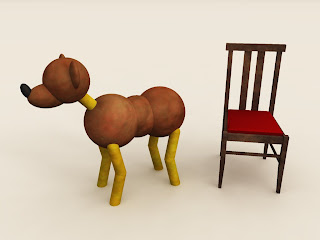
So this is why large animals need relatively thicker legs than small ones: cross sections depend on squaring a length measure and weights on raising it to the third power. For my next trick, I illustrated this for a stick animal. I made a 'Disneius caniformis (varietas hortiformis)', i.e., the garden-variety cartoon doggie, shown above. Its body and head consist of spheres, and these correspond to the block above: as for a block, its volume depends on a length measure raised to the third power. The legs and its neck are coloured yellow, and correspond to the column above: the diameter of these yellow body parts will be adjusted to the weight of all the brown parts. D. caniformis above is one meter in length, so it is the size of a large dog. The chair is there to give some idea of scale.
 Click to enlarge; copyright Gert van Dijk
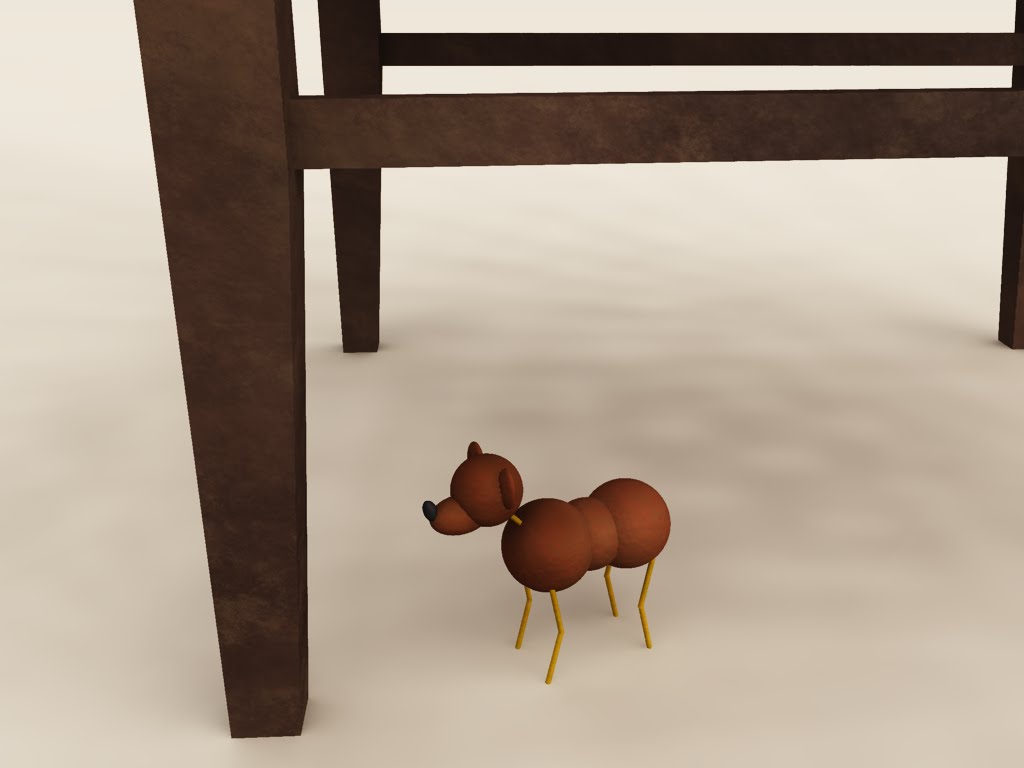
Let's do some fast evolution and evolve a cousin that is 10 times smaller, so the size factor is 0.1: D. musformis. It is only 10 cm long and weighs 1000 times less than D. caniformis. The diameter of its legs was altered by a factor 0.1^1.5, or 0.0316. The result is an animal with different characteristics, much more fitting with a small animal. You may wonder why I did not splay its legs sideways or bend them more, but such matters will be kept for another post.
 Click to enlarge; Copyright Gert van Dijk
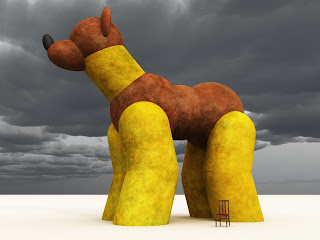
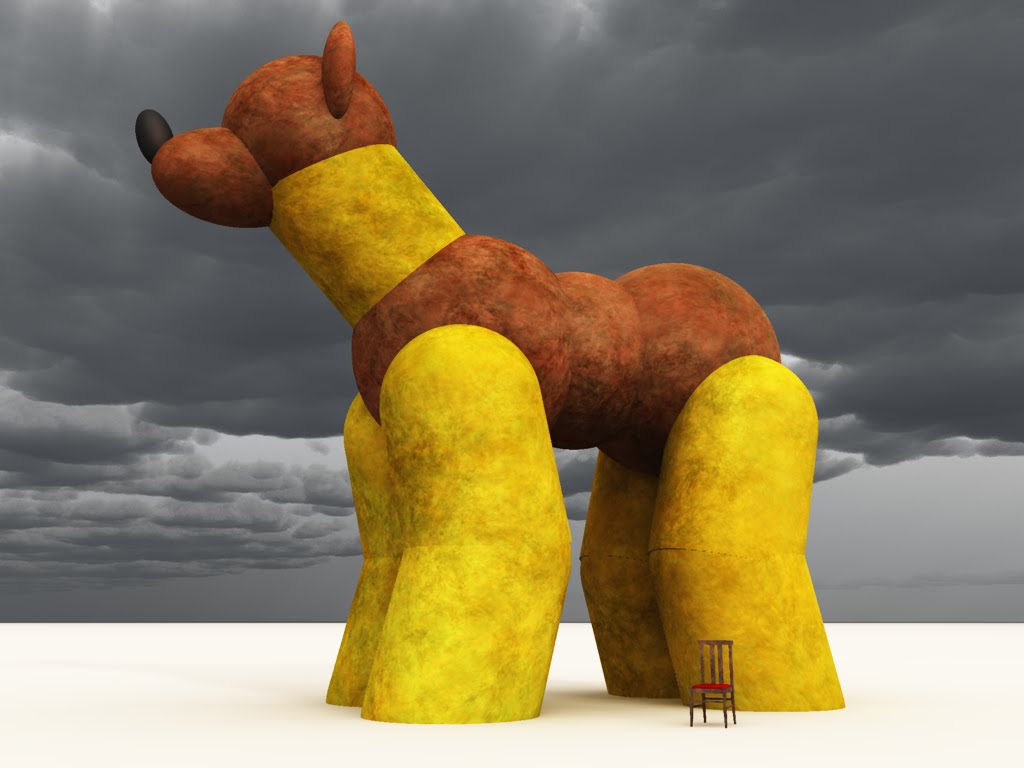
Evolution could have gone the other way, so the size factor becomes 10. The resulting D. giganticus is 10 m long and 1000 times heavier than D. caniformis. This animal only has equals among dinosaurs and a few of the largest mammals ever. Its legs have become truly colossal: their diameter has increased by a factor 31.6! (that is 10^1.5). You may well wonder whether such an animal is still practical: after all: the enlarged legs now make up a much larger portion of its body mass than for D. caniformis, while doing the same thing: allowing the animal to stand.
 Click to enlarge; copyright Gert van Dijk
Finally, here are the three species together, and this was the problem I started with: how do you depict a mouse and a dinosaur in one picture? Zooming out enough to make D. giganticus visible meant rendering D. musformis invisible, so instead I zoomed in enough to make D. musformis visible while keeping D. giganticus most impressive feature visible: its legs.
A warning for those who are still reading this: there is quite a bit of evidence that the mechanics explained above do work. For instance, within bovids (cows and their kin) bone diameter is related to bone length along the principle explained above. Here is an internet page which explains some of the same things and shows some factual data (my data are from other sources). Most bovids look rather alike, and that may help explain why the relation fits so well. If you take mammals of all shapes and form, the fit is less good and skeleton mass does not increase as much as it 'should'. There appear to be various reasons for this. The most important one is that legs move, which, as said, poses other demands on their design. So please do not start designing animals with exactly these configurations, as that may be incorrect.
Similar thoughts hold for other organs and tissues. For instance, the force a typical mammalian muscle exerts is proportional to the cross section of its fibres. Do you see the problem? When you double an animal's size the mass of its muscles increases eightfold, but their strength only increases fourfold. Relatively speaking you have made the animal weaker! Very complex, animal scaling; it's a god thing the effects of gravity are less complex...
It is not rare to read statements to the effect that animals on a high gravity world must have thick columnar legs and those on a low gravity world will have spindly legs. In fact, I have written several such statements in this blog. The problem is that these statements are not very precise. After all, thick-legged elephants and spindly-legged spiders share the same gravity, so such statements are at best incomplete. There are several excellent books on scaling in animals (here's one that is easily available), but none deal with the added effect of different gravity. This post will not do that either; gravity will be dealt with later. Before discussing it another matter deserves attention: how will legs look if their only function is to act as pillars to support weight. In reality, they move, and that requires other design characteristics as well. Some knowledge of mathematics is needed.
 Click to enlarge; copyright Gert van Dijk
Let's start with a simple thought experiment: a small block sitting on a column, marked A in the picture above. The column has just the right width to support the weight of the block sitting on it without collapsing. The cylinder stands in for a bone in a leg. Its capability to support weight depends on the surface area of its cross section. Suppose its diameter is D: the formula for the cross section contains D^2. The actual diameter in centimeters is not relevant; what is important is that an increase in diameter is accompanied by a larger increase in cross section: doubling the diameter increases the cross section four times, and a triple diameter causes the diameter to increase nine times. You all knew that, I guess.
The block sitting on the leg can be described by the length of any of its edges; let's call that L. The volume of the block is given by L to the third power, here written as L^3. We are more interested in weight than in volume, and weight depends on several things: the mass of the object and the force of gravity (which we will forget about for the moment). The mass of an object depends on the relative density of the material (whether it is light or heavy; we will also forget about that) and of course on the volume of the object. The weight of the block is proportional to its volume, and so to L^3.
Now let's make everything bigger by multiplying every length measure by 2: both L and D become twice as large. That is situation B in the image above. The weight of the block is 8 times larger than it was: it was proportional to volume, L^3, and the new volume is (2L)^3=8L^3. You can check that visually: the old block fits 8 times in the new one. The diameter of the column has doubled too. The original diameter was proportional to D^2, so the new one becomes (2D)^2, or 4D^2. In other words, it has become four times as big. It can therefore carry four times as much weight as the original column. That is nice, but it is not good enough, as the block sitting on it has become 8 times heavier!
The only way to get around this is to redesign the width of the column. By how much does the original diameter D have to be changed to support a block weighing 8 times the original one? The answer is that the column's cross-sectional area must become 8 times larger than it was. That equation is not that hard to solve. If a scaling factor x for the diameter is introduced, so the new diameter becomes xD, the new cross section will become (xD)^2 which is x^2D^2. The x^2 bit says how much larger the cross section has to become. which was 8 times; hence x^2=8. X is the square root of 8, or about 2.83. So the new diameter should not be doubled, but should increase by 2.83, and that is what was done in situation C, shown above.
Remember where the '8' came from that we too the square root of: it was the third power of 2, and 2 was the factor x we increased size by. What we in fact did was take the factor x, raise it to the third power to put the new weight in, and then take the square root to get the new diameter factor. Doing it in one go means raising the factor to the power of 3/2.
 Click to enlarge; Copyright Gert van Dijk
So this is why large animals need relatively thicker legs than small ones: cross sections depend on squaring a length measure and weights on raising it to the third power. For my next trick, I illustrated this for a stick animal. I made a 'Disneius caniformis (varietas hortiformis)', i.e., the garden-variety cartoon doggie, shown above. Its body and head consist of spheres, and these correspond to the block above: as for a block, its volume depends on a length measure raised to the third power. The legs and its neck are coloured yellow, and correspond to the column above: the diameter of these yellow body parts will be adjusted to the weight of all the brown parts. D. caniformis above is one meter in length, so it is the size of a large dog. The chair is there to give some idea of scale.
 Click to enlarge; copyright Gert van Dijk
Let's do some fast evolution and evolve a cousin that is 10 times smaller, so the size factor is 0.1: D. musformis. It is only 10 cm long and weighs 1000 times less than D. caniformis. The diameter of its legs was altered by a factor 0.1^1.5, or 0.0316. The result is an animal with different characteristics, much more fitting with a small animal. You may wonder why I did not splay its legs sideways or bend them more, but such matters will be kept for another post.
 Click to enlarge; Copyright Gert van Dijk
Evolution could have gone the other way, so the size factor becomes 10. The resulting D. giganticus is 10 m long and 1000 times heavier than D. caniformis. This animal only has equals among dinosaurs and a few of the largest mammals ever. Its legs have become truly colossal: their diameter has increased by a factor 31.6! (that is 10^1.5). You may well wonder whether such an animal is still practical: after all: the enlarged legs now make up a much larger portion of its body mass than for D. caniformis, while doing the same thing: allowing the animal to stand.
 Click to enlarge; copyright Gert van Dijk
A warning for those who are still reading this: there is quite a bit of evidence that the mechanics explained above do work. For instance, within bovids (cows and their kin) bone diameter is related to bone length along the principle explained above. Here is an internet page which explains some of the same things and shows some factual data (my data are from other sources). Most bovids look rather alike, and that may help explain why the relation fits so well. If you take mammals of all shapes and form, the fit is less good and skeleton mass does not increase as much as it 'should'. There appear to be various reasons for this. The most important one is that legs move, which, as said, poses other demands on their design. So please do not start designing animals with exactly these configurations, as that may be incorrect.
Similar thoughts hold for other organs and tissues. For instance, the force a typical mammalian muscle exerts is proportional to the cross section of its fibres. Do you see the problem? When you double an animal's size the mass of its muscles increases eightfold, but their strength only increases fourfold. Relatively speaking you have made the animal weaker! Very complex, animal scaling; it's a god thing the effects of gravity are less complex...
Sunday, 6 June 2010
The Diary of Inhuman Species III
Over a year ago I last paid attention to The Diary Of Inhuman Species. I thought that the sheer good natured fun of the creatures there might offset the somewhat depressing tone of the previous post. That tone was due to the inept designs shown by the Discovery Cahannel in their series "Into the universe".
Stan, the author of The Diary, has been very active in the meantime. He has followed his book by publishing stickers of a few of his creatures, and then asked people to send him photographs of any scene whatsoever, but one of his stickers had to be present in the scene. Together with some friends he has produced a very nice film showing giant spider creatures. Their movements are particularly fluid and quite convincing, except of course for the fact that no creatures of such size can walk with such relatively feeble legs. But in Stan's case I do not mind such obvious errors, whereas I do when the Discovery Channel makes mistakes. The reason is that the Discovery Channel pretends to be serious and therefore deserves a critical response. The Diary has no such pretensions at all. Having said that, what response does the Diary deserve? Have a look at a few of his recent creatures and form your own opinion. Here they are:
 Click to enlarge; copyright Stan / Grograou
 Click to enlarge; copyright Stan / Grograou
 Click to enlarge; copyright Stan / Grograou
For me, they show that the artist had great fun in making them, and I find their exuberance contagious. I also like the changes in style.

 Click to enlarge; copyright Stan / Grograou
Recently he posted a 'paper toy', which is a model of one of his creatures that can be downloaded, printed, cut out and glued together. The original is to be found here. I immediately started thinking whether I should do one too...
Thursday, 27 May 2010
"Into the universe" and right off a cliff
In my last post I promised to report back on any interesting alien animals in the recent Discovery Channel series 'Into the Universe with Stephen Hawking'. Well, the Discovery Channel has the relevant footage on its site, right here. Some of the images of the program on aliens are rather nice, particularly where the computer generated imagery concerns space hardware. The underwater creatures and the ballonts weren't bad either. One life form really caught my attention however, but I cannot say I am positively impressed. Have a look at the following video.
I was interested right up to the point where camera rotates to reveal that the animal is in fact clinging to a vertical rock surface. Until then I thought that the mouth design was kind of interesting, scraping algae or their equivalents off a flat surface. You could debate on how well it would work, and that would be fun. But the rather large problem is how the animal manages to cling to a vertical rock surface.
It pays to think about the forces needed to keep an object fixed to a vertical surface. The centre of gravity of the object will be some distance away from the wall, producing a lever effect on the contact area. Think of a painting hanging from a nail: the top pulls away from the wall while the bottom presses against it. If you had to fix a heavy object to a wall with only one screw, you would put it in where you have to counteract a pulling force: at the top. The bottom of the contact area will stay against the wall anyway. In short, the top end of the contact area pulls away from the surface and the bottom end presses against it.
This also holds for rock-climbing humans. Feet press against the wall, but fingers pull on it. This is much easier if there are gaps the fingers can be hooked into, as otherwise friction is the only force to stop the body tumbling down. Keeping the body close to the rock minimises how hard the fingers have to pull, so the less secure the grip is, the closer you will want to stay near the surface. The same principles are at work on a woodpecker on a tree trunk: woodpeckers rest their stiff tails against the the bottom contact point, and their claws, the top contact area, dig into the bark and pull on it.
 Click to enlarge; copyright Discovery channel
Back to Discovery's 'rocksucking cliffhanger' (as it appears to be nameless I made that name up). The image above was taken from the video, but was rotated to show the animal in its vertical position. It has two legs at the bottom, and at the top the mouth is the obvious device to pull on the rock surface. I must say that this is in itself a rather nice idea. You may argue that such a large mouth would need improbably large flat areas, or that dust, snow or rain water could really make life difficult, but such matters might be worked out.
 Click to enlarge; copyright Gert van Dijk
In the sketch above you see my take on the situation (marked A). The body is held fairly far away from the cliff wall, meaning that there are serious lever effects. A line connects the centre of gravity with the lowest point of contact, where rotating forces will push the feet against the rock. The mouth has to suck rather hard to prevent a fall (blue arrow). But what happens if the animal lets go with its mouth, as in sketch B? Ah, right... No cliffhanger here: it will fall, and I can think of only two ways to stop it doing so. The first is that the new top contact area, the toes, must exert an unbelievably strong sucking ability; that possibility is shown here, but I see no evidence of that, and it is very impractical. The other way would be for the cliffhanger to shift its mouth to a new position extremely quickly, before the body has moved downwards so far that there is no stopping it anymore. The video shows that repositioning the mouth takes about one second. On earth an object will in principle fall 4.9 meters in the first second of a fall! This distance would be less on a low-gravity world, and I do not know how many body-lengths that is, as there is no size indication. Still, it sounds as if the fall would then be unstoppable. You would want the loss of sucking power to last as short as possible: it it would only last for 0.1 second, the animal's centre of gravity would only move downwards by 4.9 cm. The process had better be failsafe though; no second chances here. A much better solution would be to having two or more sucking devices, as their use could then be alternated.
As shown, I do not see the animal working as designed. It's a pity, really. As with Avatar, it would not have been that difficult to get someone to have a critical look and iron out the problems. It's not rocket science, after all. Why do companies as big as Discovery let such matters slip? The only answers seem to be that they take science a lot less seriously than they pretend to do, or that they do not take their audience seriously. I am very much in favour of science popularisation, but fumbling it gives the wrong idea.
Tuesday, 18 May 2010
Furaha in Cosmos Magazine
 Click to enlarge; copyright Cosmos magazine
The planet Furaha occurs in a recent article in the Australian Magazine 'Cosmos'. Seeing how mammals in Australia seem a bit otherwordly, that seems fitting in a way. The issue in question, #32, is devoted to SETI. The Search for ExtraTerrestrial Intelligence has been going on for 50 years now. The word 'intelligence' in SETI always makes me wonder how intelligence should be defined in this context, and I will digress a bit about that subject at the end of this post.
But first, back to the article in question: 'Alien Safari'. It deals with the ways in which matters such as photosynthesis and biomechanics shape animal and plant evolution. It was written by Lewis Dartnell, a British astrobiologist. Long-term readers may remember that Lewis used some Furahan images to help illustrate a talk he gave at the Cheltenham Science Fair in the UK last year.
 Click to enlarge; current copyright: Cosmos magazine
What you see here is the double spread page starting the article. Yes, that is a Furahan forest, with a greenish hue (that's artistic license). In fact, it is almost the same forest that you saw a few weeks ago in the screensaver post. I am not willing to give away much about the article, as the issue of Cosmos is still for sale, and you should of course all buy it! But I can tell you that there are more Furahan pictures in there, and also that Lewis was kind enough to draw attention to the Furaha website and to yours truly. The 'gracile' neocarnivore that occurs on the 'land' page of the site, and whose head I use for my icon, is there as well. Lewis uses it in the context of hexapod animals to explain the principle of 'centaurism', i.e., the freeing of front limbs for tasks other than a locomotor one. I wonder if this will help spread the use of this word. After coining it, I found out that it seems to be in use in some languages to denote horsemanship, as far as I can tell.
 Click to enlarge; copyright Gert van Dijk
Simply because I could not resist here is another version of that forest, with a somewhat other vegetation. The original is one of the largest renderings I ever did, at 4600 pixels wide. By the way, please do not think that I was the only one contributing illustrations to the article. One illustrator is well known among those who like speculative alien animals, and that is Alex Ries, who contributed his superb 'Shadow of the Sun' painting to the article (and who featured on this blog). Here it is on his own web site.
So, if you all order issue #32 of Cosmos Magazine right now, the editor might ask for more such articles as well as more of my paintings.
Meanwhile, have I got anything against intelligence? Absolutely not; it is just that I wonder how smart a species has to be before it can be counted as intelligent. The most important doubt I have is whether 'smartness' should only focus on the ability to recognise, formulate and understand problems, which seems to be the dictionary approach. I do not care much whether the problems in question concern climate change or more complex questions such as life, the universe and everything. A rather different take would be to reserve 'intelligence' for the additional ability to act on and solve such problems. That might be asking for a lot though, and biological evolution is not a good mechanism to emphasize long-term goals over short-term ones. We have no idea whether or not other sapient species are wiser than we are; apparently Stephen Hawking recently warned that contact with intelligent aliens might harm us, based upon the notion that they might be like us!
Well, there certainly is no intelligent life on Furaha; there was a species once that showed evidence of sapience. However, this species, a predator, went extinct as suitable prey died out on its island habitat; no big mystery as to how that happened...
The main reason for not keeping that species was not cynicism, but simply that I am more interested in biological principles than in sophonts. There is enough to astound and thrill in biology, or in other sciences for that matter. Magazines like Cosmos help popularise science, something I find extremely important. But waxing philosophical means it is time to return to Earth (well, sort of). I just found out that Hawking made his remarks in a Discovery Channel programme that promises some alien animals. I will try to find them, as I am curious how well they follow the sort of evolutionary principles that Lewis discussed in his article, and that I try to explain in this blog. If I find any interesting ones, I will drag them back here and probe them; after all, that is what sophonts seem to like to do to animals from worlds not their own.
Sunday, 9 May 2010
Two years on
 Click to enlarge; copyright Gert van Dijk
I hardly ever post two days in a row, but this post hasn't got anything new to say about speculative biology, so it does not really count in that respect. It is about the blog itself, which has reached its second birthday. I wished to commemorate it by drawing attention to the fact that several Furaha images accompany an article by Lewis Dartnell (Hi Lewis!) on alien life in the Australian Magazine Cosmos, but my copy hasn't arrived yet. If you are down there, get #32!
Writing a blog is addictive, and I if I did not keep a check on it I would hardly have time to spend on the Furaha project. So where does that stand?
As far as programming maps and texturing planets is concerned, that part is finished, except for designing rivers and lakes that realistically follow terrain contours. But those will be hardly visible anyway, and so have little priority. I have lay-out templates in InDesign so I can show publishers what the book might look like. The one thing that needs attention is paintings. I do not think I need more full ones with background scenery, but rather the kind you would see in a field guide or an encyclopedia. There should be images of hexapod evolutionary descent, of spidrid morphological variability, and of the vast range of Fishes IV, V and VI. As I am a slow painter, I decided to take up digital painting. Most people say that they take to graphics tablets in a day or so, but I am not one of them: I still have trouble linking the scren with my motor programs. While I am slowly winning the struggle with Photoshop, I have now also bought Painter on the advice of a pro (merci Sylvia), a program that feels more natural to me. The gracile neocarnivore's head at the top of this post concerns a design I had already done in oils; I did it again digitally to test the waters. It's not good enough yet, but there's progress.
Thanks to the regular readers and commenters; quite often the comments make me think of another subject for a post.
Finally, I was thinking about changing the name of the blog. When I started I thought it would mostly be about Furaha with some other items thrown in, but that is not what happened; in fact, it is the other way around. Perhaps it should be 'Speculative Biology and Furahan Affairs'; any suggestions?
Saturday, 8 May 2010
Why there is no 'Walking with tentacles'... V
The series of posts on 'Why there is no walking with tentacles' was supposed to have ended in December 2008 (see posts one, two, three and four). To summarise, I argued that a land-based existence of a tentacled animal would induce rapid evolution. The tentacles should evolve the ability to bear weight, which boils down to resisting compressive forces. Pure tentacles, without any solid bit in them, cannot do that, or very inefficiently at best. So I envisaged the development of incompressible elements. The Walking Tentacle Mark II was a bit like a string of beads held in place by surrounding muscles. The next stage would be a reduction in the number of elements, resulting in proper legs, no longer worthy of the name 'tentacle'.
But recently I read something very interesting about Earth's cephalopods (squids, octopuses, etc) that shines another light on the ability of cephalopod tentacles to function as legs. By the way, the usual term for octopus tentacles is 'arms', and only the two prey-catching appendages of squids are called 'tentacles'; their other appendages are called arms as well. Because I am looking at their function I will stick to 'tentacles' here. My interest was piqued by the following sentence: "... flexible arms, with no joints as fixed reference points, cannot discriminate between shapes, however elaborate the brain." I found this in a section entitled 'What has limited the evolution of cephalopods?' in a book by Janet Moore on Invertebrates (the book is quite interesting for would-be animal designers). Click to enlarge; copyright Gert van Dijk
Can all these problems be reconciled with turning tentacles into walking limbs? Well, yes. After all, the Mark II had evolved a series of incompressible elements with joints in between them purely for mechanical reasons. Those elements of the Mark II are shown on the right in the image above. On the left is its successor, a proper leg with a reduced number of segments. The Mark II set-up is just what is needed to allow propriocepsis like ours to evolve; I am assuming here that it is advantageous to have such a sense. If there is a small sensing error in each limb, having a large number of short segments adds up to more uncertainty about where the limb is than having a smaller number of longer segments. Reducing the number of elements was better mechanically anyway, and may also allow a more sophisticated, or at least more reliable sense of position as well. There are probably advantages in the motor control of movements as well, but I think I will skip that (or reserve it for another post, who knows?).
But recently I read something very interesting about Earth's cephalopods (squids, octopuses, etc) that shines another light on the ability of cephalopod tentacles to function as legs. By the way, the usual term for octopus tentacles is 'arms', and only the two prey-catching appendages of squids are called 'tentacles'; their other appendages are called arms as well. Because I am looking at their function I will stick to 'tentacles' here. My interest was piqued by the following sentence: "... flexible arms, with no joints as fixed reference points, cannot discriminate between shapes, however elaborate the brain." I found this in a section entitled 'What has limited the evolution of cephalopods?' in a book by Janet Moore on Invertebrates (the book is quite interesting for would-be animal designers).
If cephalopods indeed cannot feel well enough to tell shapes apart, that is bad news for having their tentacles turn into functional legs. In man, the ability to sense where our limbs are enables us to walk in the dark and to recognise objects by manipulating them. I will come back to the importance of this sense, called proprioception, later. First I searched for more data on tactile function in cephalopods. Luckily, there is an excellent summary in Scholarpedia, so everyone can read it.

Click to enlarge; sources through link in text
It turns out that octopuses are quite good at feeling the texture of an object, and you can teach them (using rewards etc.) to tell two objects apart that have the same shape but a different texture. In the graph above octopuses were given two different objects, and they had to learn how to tell the two apart. When the two lines with black and open markings diverge, the octopuses managed to learn the difference, but when the lines do not separate, the octopuses hadn't a clue what the humans wanted them to learn. At the top, the octopuses quickly learned that a cylinder with grooves is not the same as one without them. But if you give them cylinders with the same surface texture, but with a different mass because one has a weight hidden in it, they have no idea. They cannot tell a heavy from a light object. The remaining two graphs were control experiments proving the same thing. Other experiments also showed that octopuses are indeed very bad at recognizing shapes. The most likely explanation is that they cannot judge well where the various parts of their limbs are in relation to other parts.
The Scholarpedia review does not go so far as to state, in contrast to the book, that it is the lack of solid parts that is to blame for this, but that does make sense. Consider our limbs, or those of insects for that matter. Telling where the end of the limb is requires two things: the first are sensors to tell the degree to which all joints are bent, and the second item of knowledge is a table containing the lengths of all segments in-between the joints. In fact, working that out does not require more than fairly simple trigonometry. Can an octopus do the same? The lack of joints makes it more difficult. What it would need is some kind of sensor that can tell where it is in relation to another one in theedimensional space: direction as well as distance. Off the top of my head I cannot think of any biological sensors like that. The point is not whether any exist, but that the octopus doesn't seem to have any! One more reminder that alienness can be found on our doorstep.
Do you actually need propriocepsis? Humans do! There are a few people in whom this sense has been wiped out completely by disease, and these people cannot tell the position of their body and their limbs without looking. Most cannot walk, even though their muscles are fine. There are many more examples showing that the ability to feel where your body is in space in extremely important for human, and I would guess vertebrate, control over posture and movement.
What I find hard to understand is how the octopus moves about without such an option. The clip above shows an octopus disguised as some plants walking over the sea floor (on YouTube here). That is impressive, and there are many more video's showing rather impressive feats of movement. Their control over their tentacles must be organised differently from the way we control movement. Again, they're rather alien.
 Click to enlarge; copyright Gert van Dijk
Can all these problems be reconciled with turning tentacles into walking limbs? Well, yes. After all, the Mark II had evolved a series of incompressible elements with joints in between them purely for mechanical reasons. Those elements of the Mark II are shown on the right in the image above. On the left is its successor, a proper leg with a reduced number of segments. The Mark II set-up is just what is needed to allow propriocepsis like ours to evolve; I am assuming here that it is advantageous to have such a sense. If there is a small sensing error in each limb, having a large number of short segments adds up to more uncertainty about where the limb is than having a smaller number of longer segments. Reducing the number of elements was better mechanically anyway, and may also allow a more sophisticated, or at least more reliable sense of position as well. There are probably advantages in the motor control of movements as well, but I think I will skip that (or reserve it for another post, who knows?).
Subscribe to:
Posts (Atom)