Showing posts with label Disneius. Show all posts

Friday, 8 May 2020

It's a plant! It's an animal! It's a bitroph!


Click to enlarge; Source: wikipedia

Several years ago, a species of sea slug had its day of fame on internet sites specialising in scientific news. Those sites all showed a bright green flattened blob. like the image above. This sea slug was green because it performed photosynthesis, which animals are generally not supposed to do.

I guess everyone interested in speculative biology sat up straight, because a lifeform that is part animal and part plant exudes ‘alienness’ through every pore. But was the flow of alienness coming out of those pores accompanied by oxygen, as in plants, or by carbon dioxide, something more befitting an animal? 

The slugs of the genus Elysia get their photosynthetic ability by feeding on algae. Algae, as the well-informed readers of this blog will know, perform photosynthesis in intracellular organelles called chloroplasts. The slugs eat the algae, but rather than simply digesting the chloroplasts too, they envelop then through phagocytosis, and keep them alive, in their own bodies. From then on the chloroplasts are called ‘kleptoplasts’, or ‘stolen plasts’.

It turns out that the photosynthetic slugs can live quite well in the dark, so they do not critically rely on photosynthesis. They do use photosynthesis as an auxiliary power source, mostly when they are starved anyway. When the slugs are kept in the dark AND starved, the number of kleptoplasts decreases, so the slugs then apparently disassemble the then useless chloroplasts and get a final energy boost from the hapless organelles (Cartaxana et al  2017).

Plant-animal combinations are not novel in speculative biology. Actually, there is a group of creatures  on Furaha called, for the time being, ‘mixomorphs’. They probably share characteristics with plants as well as with animals. The ‘probably’ is in there because I always had the uneasy feeling that a plant-animal combination might not work. After all, Earth is not filled with such creatures, doing whatever it is ‘plantanimals’ do when they are not just sitting in the sun. Does their absence mean that they do not make sense?

The concept of animals performing their own photosynthesis certainly sounds like a good idea. Earth plants take in carbon dioxide (CO2), water (H2O) and sunlight and turn them into carbohydrates. Because they turn nonbiological material into carbohydrates, they are called ‘autotroph’. Animals cannot do that and require some ready-made carbohydrates as a source of carbon, making them ‘heterotroph’. By breaking up those carbohydrates animals get materials for their own bodies, producing H2O, CO2 and energy. An animal is a plant in metabolic reverse, in a way.

Why not do what the slug does and cut out the middle man? This plant-animal chimaera could use photosynthesis as an auxiliary and cheap way to store free energy in carbohydrates, giving it an edge over animals that have to hunt, chew and digest to get any carbohydrates. They would even have an edge over plants in that a major problem with photosynthesis for plants is that there is so little CO2 in the air. The animal part of a chimaera would produce more then enough CO2 to boost photosynthesis of the plant part.

Click to enlarge; source: wikipedia

Autotroph + heterotroph = bitroph
There is a nice scheme on Wikipedia explaining the full nomenclature of how lifeforms get energy and carbohydrates. There are three big two-by-two divisions, shown above. These result in six fragments of phrases: hetero- vs. auto-, chemo- vs. photo-, and organo- vs. litho-. There are eight possible combinations. Our garden-variety plants (sorry for that pun...) are ‘photo-litho-auto-troph’, while ordinary animals are ‘chemo-organo-hetero-troph’.

This nice scheme seems to cover all the possibilities, creating a challenge for speculative biology lovers: where should we classify animals that can photosynthesise? Note that there already are lifeforms that cannot build their own carbohydrates and yet use photosynthesis: photo-litho- and photo-organo-heterotrophs. However, they are all bacteria, and to increase the ‘alienness’ level we want creatures we can see without a microscope, and that we can stroke, or supply with compost. Or both. Also, as these creatures would run both energy pathways, they do not fit in the scheme. They might be labelled ‘autoheterotroph’; I can't say I much like the term ‘plantanimal’. Let’s introduce ‘bitroph’ to emphasize the dual energy principle (without also adding 'photo-organo-litho-chemo-').            

Bitrophy in practice

'Bitrophism' needs consideration of energy requirements. The first question is how much energy you get from a leaf, or a standardised area performing photosynthesis.  Luckily, that information was already available on my bookshelf, in ‘Energy for animal life’ by the late R. McNeill Alexander (if you want to give your speculative biology a scientific edge, get his books). 
   
In bright sunlight the flux of light on the surface of the Earths is about 1000 Watt per square meter, and with that light intensity the rate of photosynthesis reaches a maximum of 21 Watt per square meter. This ratio of 21 to 1000 shows, again, how inefficient photosynthesis is. Mind you, this light flux is the maximum value in Alexander's biome, which was England. Just outside the atmosphere you get 1370 Watt per square meter. Obviously, seasons, clouds, latitude, and the time of day all influence the amount of sunlight the surface actually gets. For now, let’s go with that value of 21 Watt per square meter.

The next question is how much energy an animal actually needs. That also depends on many things, such as its activity, but it's minimum level is largely fixed: the ‘minimal metabolic rate’ describes the energy requirement of an animal doing nothing, except being alive. This rate depends on two factors.

The first is the type of animal: warm-blooded animals such as birds and mammals burn energy at much higher rates than other groups, such as lizards, fishes, etc. For two animals that have the same mass, a mammal uses almost 5 times the energy of a lizard (even one warmed up to 37 °C), and 12 times the energy of a crustacean at 20 °C.

The second factor is mass: a 100 kg animal will use more energy than a 10 kg one. However, it needs less than 10 times as much. As Alexander remarked: ”Weight for weight, it is a great deal cheaper to feed elephants than mice.”  The relationship between minimal metabolic rate (MMR) is an exponential one, and has the form

MMR = a (body mass) ^ b

(formatting is difficult here; the '^b' part means 'to the power of b'

The exponent ‘b’ differs somewhat between animal groups, but lies close to 0.75. The fact that it is less than 1 explains why large animals have a lower metabolic rate per kg than small ones. The factor ‘a’ is the one that differs between animal groups (it is 3.3. for mammals, 0.68 for warm lizards, and 027 for crustaceans.

Click to enlarge; copyright Gert van Dijk
          
The image above provides the Minimal Metabolic Rate the rate for mammals, (warm) lizards and crustaceans, all ranging from 0.1 to 1 kg. The crustaceans burn the least energy, and bigger animals need more energy than small ones.

But we wanted to get to photosynthesis; remember that one square meter of photosynthetic area provides 21 Watts, so I provided an additional y-axis on the right, which is simply the left y-axis divided by 21. The right one tells you how many square meters of photosynthetic area we need for each point on the graph. A 1 kg mammal will need about 0.16 square meters of ‘leaf’. That corresponds to a square with sides of 40 cm. Examples of 1 kg mammals are seven-banded armadillos, muskrat, pine martens, platypuses, meerkats and European hedgehogs. Just picture one of those them with a 40 cm by 40 cm parasol to catch sunlight. A large fruit-eating bat may also have a mass of 1 kg; it needs a large wing area anyway; hmmm...

Anyway, as I found it difficult to imagine how large that actually is, I assembled a mock animal with a mass of 1 kg (the volume can be calculated because the animal consists of spheres and cylinders; its density is 1.05). I used mammal characteristics to calculate the disc it needs to provide the energy for its MMR.

Click to enlarge; copyright Gert van Dijk

The image above shows such a 'Disneius solamor'. The small squares on the ground are 1x1 cm, and the larger ones 5x5 cm. The animal is 21 cm long, and the radius of its dark green 'sun disc' ('antenna'? 'leaf'?) is 22 cm. It needs that to power its MMR. A general human provides additional scale. Hm; the animal does not look very elegant, and that large 'leaf' looks rather vulnerable.

But we are not done yet. The calculations so far used maximum light settings, which is not realistic. And how about the effect of mass? How about animals that are thriftier with energy than mammals? How about more efficient photosynthesis? I suspect that this post may already have passed the 'maximum allowed complexity per unit of enjoyment ratio' (MACPUOER), so I will stop here. But I will very likely return to this theme.
       

----------------------------
PS. Although I welcome the large number of questions the blog has recently received, many had nothing to do with the post under which they were asked, and many could easily have been answered by using the blog's search options. So from now on I will be less likely to answer such questions.  Surely you would prefer me to spend my time working on The Book or on writing posts?

Sunday, 13 January 2013

Monopods: getting off on the wrong foot?


How many legs can animals have? That is a subject that has been discussed more than once in this blog and its comments. A first gross division of 'leggedness' could be whether the number of legs is even or odd (for odd numbers see here and here), and a second one whether the overall pattern is one of radial or bilateral symmetry. Last week Petr commented on the Xenohox Gazelle, an animal on the doubly odd side of this classification, in that in combines a radial design with an odd number of legs. For those of you who are well-versed in such things, the difference between the radial design of animals such as my tetropters and the Xenohox gazelle is that the axis of symmetry is vertical in the former and horizontal in the latter.


 Fragment from The Future is Wild

Getting back to the topic at hand, Petr asked what I thought of animals with just one leg. I realised that I had omitted walking with one leg or with no legs at all (whether the latter is possible may be a matter of semantics, but there are aspects of moving without legs that resemble those of true walking). Are there many such beasts in speculative fiction? The first one to come to mind is the 'desert hopper', an animal evolved from snails in 'The future is wild'. The DVD is easily available. There is also the Eponan springcroc; there are undoubtedly more.

What should be the proper term for this mode of locomotion? There is a choice between  Greek and Latin equivalents. Examples are the Greek 'tetrapod' and the Latin 'quadruped'. For one-leggers, the words could be 'uniped' (Latin) or 'monopod' (Greek). I prefer the rhythm of the Greek one, so let's stick to that one.      

Monopods have biomechanical problems. The first can be demonstrated easily by hopping on one leg. You will it fatiguing. One reason, but not a major one, is that one set of muscles does the work normally done by two. Fair enough, but the bigger problem has gravity as its cause. Any walk cycle has a stance phase in which the leg pushes against the ground and a swing phase in which thee leg swings forwards, free from the ground. During that swing phase the body will of course fall down, unless another leg supports it. Monopod animals, not having another leg, must deal with the tendency of the body to fall. Do not underestimate this: a normal human biped walk cycle lasts about 1 second, and each leg is off the ground for about 40% of the cycle, meaning about 0.4 seconds. In that time the other leg s supports the body, but what if there wasn't one? Under Earth gravity a time of 0.4 seconds is long enough time to fall 78 cm, much too far to catch up easily with the next step. That unsupported phase should therefore be as short as possible: for 03 second the fall will be 44 cm, for 0.2 seconds it will be 20 cm, and for 0.1 second it will be a mere 5 cm.

During running there are periods in which no leg touches the ground, resembling the monopod problem. Still, our bodies do not move down a long way during the unsupported phase: the unsupported phase does not last long because we do have two legs and because the rate of cycling is much higher than during walking; also we actually jump up enough to combat the falling tendency.
 
Let's turn the biped human into a monopod human. If you keep the leg moving at the same rate as if you were walking with two legs, the unsupported phase will be about 0.4 seconds as shown above. The only way not to fall 80 cm during that time would be to jump up in each step. This is a sizable jump, costing lots of energy. Of course, speeding up the rate of movement helps, but that calls for high acceleration and deceleration, also costing lots of energy. There is probably an optimal balance in there, minimizing the energy for forward movement. The balance would, as holds for any gait with any number of legs, depend on speed. Monopod animals might not be good at low speeds, because gravity does not allow for a slow jump.

A monopod animal is like a human on a pogo stick. 'Pogoing' (we need a verb) would cost less on a low-gravity world, so perhaps they should be sought there. There is probably an optimal mass for pogoing animals. Jumping is not a good idea for animals with a large mass, because they then need disproportionately heavy skeletons. There would be lower limits too: you might think that falling is irrelevant for animals as small as insects, as they would not hurt themselves much by doing so. Then again, the short distance means that there is no time to break the fall, and whatever your size, during a fall control of the body is lost, never a good idea.

Click to enlarge; copyright Gert van Dijk
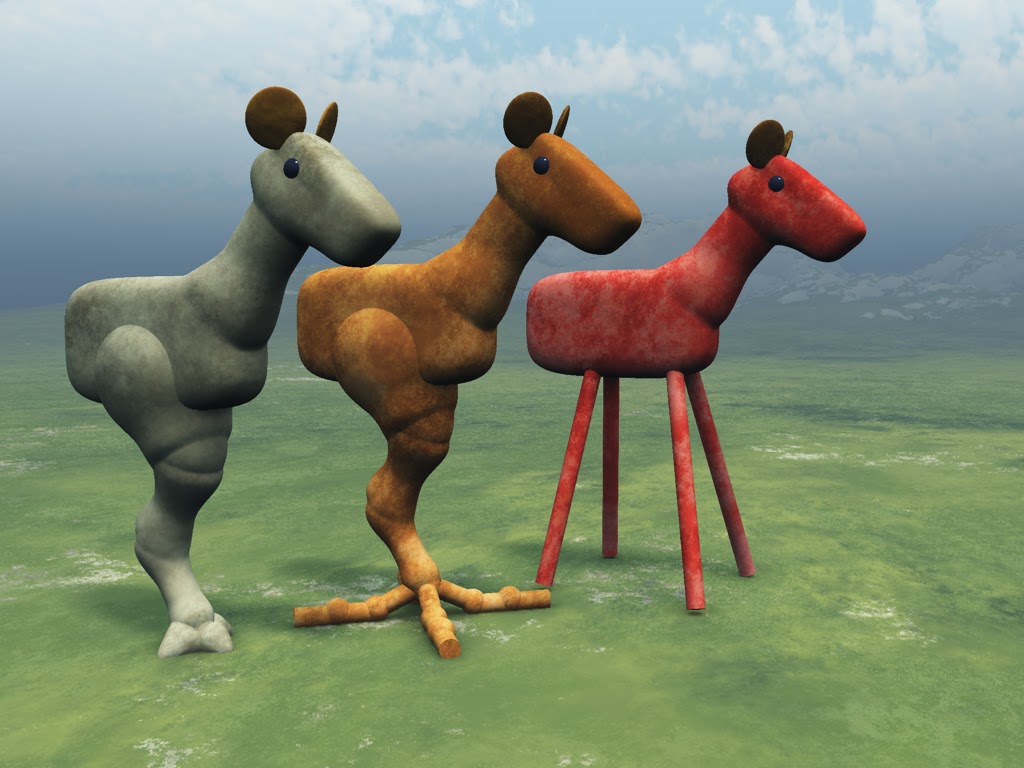
Another big problem for a monopod would be stability, as shown above. Standing on three legs or more is easy, because there is little skill involved in holding the centre of gravity over the support area on the ground, defined by the points where the feet touch the ground. Bipeds can only stand upright with a sophisticated neural control system. For a monopod such as 'Unipes disneyi', on the left,  the support area is small, requiring an even more sophisticated control system. Sideways forces would pose a very large problem for monopods. Wind is more likely to blow very small animals over than larger ones, and for insects and the like it pays to splay their legs: it produces a large support area. So, alien monopods perhaps should probably not live on planets with very dense atmospheres. The obvious way to solve that problem would be to have long toes sticking out in all directions: the middle monopod in the illustration. They would have to be very strong to counter a tendency of the body to move. In this respect the toes would probably be inferior to legs that stick out towards the same points on the ground but starting from the body, shown on the right. But if the starting point is one leg, the toes would probably be the answer. I do wonder about the body scheme of an animal with just one leg; would that preclude the presence of other paired limbs or organs?        

Finally, having one leg results in no redundancy whatsoever: a monopod with a leg injury is probably doomed, whereas a biped might limp away, and a millipede would simply continue on its way.

Click to enlarge; copyright Gert van Dijk
Are there workarounds? I am tempted to think so. Take the large-toed animal at the left above and make it stand on the tips of its toes. Evolve it a bit to get the animal at the right: the toes get bigger and the upper part of the leg shrinks. Now that animal could just swing one toe forwards while keeping the other ones on the ground. By repeating this movement for the other toes it would no longer need to jump up. But what that does, obviously, is upgrading the status of the toes to that of legs, and then the animal is no longer a monopod but a secondary tetrapod. And a very silly one at that.   

Friday, 8 October 2010

These legs are made for walking (Legs II)

In my last post I played with some concepts about leg design, mostly concerning whether it is better to have sprawling legs or ones that function as pillars. It turned out that there is no answer that is always correct: for large animals pillars help minimise energy expenditure in the form of muscle power, and for small animals sprawling legs provide protection against wind forces, something that gets more consequential the smaller you get. Perhaps wind is also one of the reasons why small arthropods are so good at gripping surfaces tightly: I had thought that that was mainly a neat feature to cling to vertical surfaces or even to land on a ceiling, but perhaps simply keeping put where you are if there is a strong wind weighs in too. What do insects do when there is a real gale out there? Does anyone know?

There are still enough problems to play with. I took the Disneius species that had just evolved last time and decided to take its legs one step further, i.e., I tried to simplify their design some more. The reasoning was that legs largely have to move in the body direction, rendering movements in other directions less important. The result is Disneius mechanicus:

Click to enlarge; copyright Gert van Dijk

And here it is. This has taken the idea to an ultimate form: the joints in its legs rotate purely in forwards and backwards directions. Note that this would not work in real life, as the animal would not be able to turn. In real life you would want to make the feet and at least one joint higher up more adaptable.

The legs are built in a zigzag way, like those of its predecessors. Last time I discussed that avoiding bending ‘moments’ becomes easier the nearer the joints are near the centre of gravity. Mind you, zigzagging legs in which the joints zigzag inside and outside are not necessarily worse than ones that do their zigzagging forwards and backwards. The usual explanation for the anatomy of mammal legs is that ‘vertical’ is better, but just suppose you take one of D. mechanicus’ legs and turn it by 90 degrees. If its foot was directly underneath the hip joint to start with, the rotation will not change that. The joint angles do not change either. All this leads me to conclude that ‘verticality’ in limbs depends more on having straight legs than on the direction the joints zigzag in. Legs that predominantly move forward and backwards have the advantage of allowing simpler joints, and simpler joints may allow less muscle strength to control their position: a good thing. I would expect large animals with highly evolved legs to adopt forwards and backwards bending as well. A bit boring, but that is what you get with universal laws of nature.

Luckily there are enough items left that might make alien animals more alien-looking. As you can see, the fore and aft legs of D. mechanicus are exactly alike. This is not what mammal legs look like. From a mechanical point of view fore and aft leg tend to have different effects, with aft legs providing more propulsive force than front ones. Is that also the reason why mammal knees point forwards and their elbows backwards? It seems as if, starting with a newt, its upper arms were rotated backwards and its thighs forwards to turn it into a mammal with fore-aft moving legs.

Click to enlarge

Here is a picture from this site that explains just that phenomenon. It explains why the bones in the forearm are crossed while those in the leg are not. But that is just one way to look at things. In the same newt-to-mammal trip, a third large movable segment was added to the newt's two. In the front leg the shoulder blade turned into a movable segment, and in the hind leg foot bones were recruited. If you look at the result from a functional point of view, the first large movable segment is the shoulder blade in the front limb and the thigh bone in the hind limb. Both point forwards, and from that the other segments zig backwards and then forwards. That is what D. mechanicus looks like! Based on this functional view, I feel that identical front and hind legs are theoretically quite possible. Prolonged specialisation for braking and weight carrying (front legs) and propulsion (hind legs) might change some aspects, but I see no need to ‘prescribe’ the typical mammal pattern as the only feasible one.

Click to enlarge; copyright Gert van Dijk

So here is a variant (the left one) in which the upper segments starts the zigzag by pointing backwards, not forwards, as in the righthand side one. Can this work? At present I see no reason why not. Perhaps I should do some animation studies to see if any big problems come up. But if there are none, an animal could have front legs that start with a zig and hind legs that start with a zag, or vice versa. They are in the background of the image above, but a closer look follows.

Click to enlarge; copyright Gert van Dijk

And here they are: we could make up interesting leg formulae, like ‘zigzig’for an animal in which both front and hind legs start with a forwards zig (and in which the other segments follow the lead of the first segment). ‘Zagzig’ denotes an animal with a front leg starting with a backwards zag while the hind leg starts forwards. You can think of what a ‘zigzagzig’ means for yourselves.

Click to enlarge; copyright Gert van Dijk

Just for fun here is a herd of the beasties. How many zigzags should there be? I do not know. If there is a proper foot, in which many segments touch the floor, I would expect all of them to bend backwards to promote ‘rolling’ over the ground. If just one segment touches the ground, as in hoofed mammals, I have no idea. But the majority of long segments will likely zigzag.

Click to enlarge; copyright Gert van Dijk

Here is an animal with more zigzags, along with an ancestor. The giraffomorph looks weak to me. There must be an optimum number of segments to achieve good manoeuvrability and/or good speed, but I do not dare speculate on that, or at least not now. I also do not know why the scapula in mammals is not connected by joints to the vertebral column, in contrast to the hind legs. Does it have to do with shock absorption versus propulsion? Perhaps those are good subjects for later posts.

Wednesday, 22 September 2010

Legs to stand on

When I sketch a large alien animal, its legs tend to take on the shape of Earth legs with a life of their own. Depending on their general way of life, the animals' legs look like those of mammals, reptiles or amphibians. When the animals are insect-sized, the legs that take shape on the paper are thin and stick out sideways. Apparently the parts of my brain that are responsible for these patterns are so indoctrinated by life on Earth that it takes an effort not to produce them. I am not alone in this, as a glance at websites such as Speculative Evolution will reveal.

Click to enlarge; from 'Primeval'

The wish to 'alienate' the animals can easily result in trickery, such as inflating the arthropod design to the size of a large mammal, or to give the animal tentacles to walk on. The two images above are from the series 'Primeval', a British television series (I like it, by the way!). The heroes encounter some Silurian animals. As you probably know, there were some impressive arthropods around at the time, but they weren't impressive enough for the makers of this series. A pity, as there are enough ways to tell a good story without being silly. There are various reasons such animals could not be that big, and they could no more cling to the ceiling than you can. Effects of scaling are largely to blame, discussed earlier here and here.

But even if you do take physical constraints into consideration, there are thousands of intriguing questions to ask. For instance, if sprawling legs are a bad idea for large animals, why do small animals have them? Why do mammal legs folded in a zigzag manner, with successive bones pointing in opposite directions? Why shoulder blades? What is the optimal number of leg segments? This post presents some -rambling- thoughts on such questions.

Click to enlarge; copyright Gert van Dijk

Let's start with an animal with insect-like sprawling legs. It's not insect-sized though, but mammal-sized. There are four legs, but that is not the point. There are three segments to each leg, but that is not the point either. The joints are all ball and socket joints providing movement around three axes each; that is a bit much, but I will get back to that.

It does not look comfortable, does it? Neither would you if you had to walk around in a similar position: like doing push-ups all day. The poor beast (Disneius salamandris) will have to spend a lot of energy to keep its body from sagging to the ground. In other words, it takes energy to keep the joints in their current positions. To understand how you can minimise that force requires a bit of knowledge about levers, vectors and torques.

Click to enlarge; copyright Gert van Dijk

Here is a drawing of the body with just one leg. Let's pretend the body and parts of the leg are stuck together, so there is just one joint to consider (where blue and brown meet). Gravity pulls at the mass of the animal at its centre of gravity, with a force marked 'W' (for weight). How much 'turning power' does that result in at the joint? Easy: connect the joint and the centre of gravity with a line of distance d. Now, using vectors, draw the component of W that is at a right angle to line d; that force is what turns the joint (marked with a black arrow 'R'). The longer the arrow for R , the higher the force. How much turning power this exerts at the joint is obtained by multiplying d with F: the turning 'moment' or 'torque'.

Click to enlarge; copyright Gert van Dijk

To make that a bit more intuitive I overlaid a wrench on the graph. The wrench grips the joint, and the part where you would put your hand is at the centre of gravity. To use the wrench you would pull or push on it at a right angle to it, right? That would be the force 'R'. The harder you pull, the larger the torque will be. If you were to use a longer wrench with the same force, you would also get more torque. More force and longer handles; that is about all there is to it. Back to D. salamandris; it will have to exert an equally large torque of its own using muscle forces -not drawn- to stop the joint from moving.

Click to enlarge; copyright Gert van Dijk

Here is the same reasoning worked out for another joint. In all cases the torque, the product of multiplying d with R, calls for lots of muscle power. Avoiding all this energy expenditure calls for minimising the torque. You can make d smaller by getting the joints as close to the centre of gravity as you can. Minimising R also works, and to do that you should make the line d as vertically as possible: get the joints underneath the body. I think that this principle also explains why legs tend to bend in zigzag fashion: it keeps the joints more or less close together and minimises gravity-induced torque. So, poor D. salamandris does it all wrong.

Click to enlarge; copyright Gert van Dijk

But before we let D. Salamandris go extinct, let's have a look at what its sprawling stance means for the anatomy of the joints in its legs. Above you see one leg in a few positions, obtained by rotating it around the axis in the joint connecting it to the body. To get a movement suitable for walking, its foot should move in a straight line from front to aft (in reality the foot would stay put but the body would move forwards; seen from the body it is the foot that moves backwards). Getting the foot on the stripe only requires straitening some of the joints a bit. But ensuring that the foot always points forwards also requires that there is a way to rotate some of the bones around a longitudinal axis. If you start to think about this some more, you will find that having legs stick sideways requires rather complex joints; it may seem easy, but is not.

Click to enlarge; copyright Gert van Dijk

Here is an intermediary stage in standing on one's own legs: this animal has brought its feet in underneath its body, and its legs show a zigzag pattern, but mostly sideways (a final stage will appear in a future post). This does not solve all problems, as you may well ask why insect do walk with their legs sprawling to the sides. After all, if bringing the legs in is so advantageous, why do not all animals do so? There may be two answers to that. Sprawling and having bent legs is not advantageous if gravity is a big problem, as such positions require lots of muscle power. As discussed previously in my posts on scaling, such problems increase very quickly as animals get bigger. Make them smaller, and the added energy expenditure hardly counts any more in the overall budget. There is also an advantage for small animals to have sprawling legs: it helps them from being blown over by the wind.

Click to enlarge; copyright Gert van Dijk

Above is a similar drawing as previously, but now with a horizontal force acting on the animals: wind. Wind forces can cause the animal to topple over, and once again the component of wind force that does that is at a right angle to the line connecting the centre of gravity to the point of rotation: where the feet touch the ground. The animal with the lower centre of gravity and the more sprawling legs is better protected against wind forces: the force R is small and directed upwards, meaning the weight of the animal counteracts it. For the upright animal the story is different: R is directed sideways, is not counteracted by gravity, and the animal only needs to tilt a bit before the centre of gravity is no longer above the feet.

Once again, scaling plays a part: when you are very small, wind forces play a relatively larger role than at our human size. The same works when you supplant air with water: walking under water will be very difficult if the water is streaming at some velocity. So, vertical legs become more advantageous when animal mass increases, and the more so on planets with a strong gravity. Horizontal, sprawling legs are better when being blown over is an issue, and that is more likely to happen when animal mass is very low, when the atmosphere is very syrupy or the wind becomes stronger. Which legs are best when you are an animal on a very high gravity world with gale forces howling through its soupy atmosphere? Difficult to say; perhaps it should have vertical weight-bearing legs as well as lateral struts...

Sunday, 18 July 2010

Size matters, but so does gravity II

In a previous post on scaling I tried to explain why you cannot simply double all size measures of an animal if you want to make it bigger. Leg bones in particular should become more than twice as thick. The reason was that doubling an animal's length, height and width will make it weigh not two but eight times as much. To withstand the eightfold increase in weight the cross section of the leg bones has to become eight times larger, instead of four times, which is what you get if you merely double the diameter. The wanted diameter change is obtained by taking the square root of how much the cross section has to change. The square root of 8 is 2.82, so there we are.

All that held for altering an animal's size on one and the same planet; but what happens if the animal's size is kept the same, but it is transferred to a world with a different gravity? This is easy: the leg bones once again have to withstand the weight of the animal, so the question is how much that changes under the influence of another gravity. Weight is a force: it is the product of the gravitational acceleration g and the object's mass. From that it follows that weight is directly proportional to the value of g, and that value depends on the planet; Earth's gravity is taken as the standard, so it is at 1g. Transporting a animal of any given weight to a 2g world will double that weight, and being on a 3g world will triple it, etc. To adapt its bones to these new environments, their cross section will have to become twice as large on a 2g world, three times as large on a 3g world, etc. What that means for the diameter of the bones is not difficult to work out: for the 2g world the original diameter has to multiplied by the square root of 2, which is 1.41, and for the 3g world the value would be the square root of 3, or 1.73.

Click to enlarge; copyright Gert van Dijk

The picture above shows a mass on a cylinder. The diameter of the cylinder is just right to support the weight of the cube. The cubes are thought to stand on three different worlds, with 0.5g, 1g and 2g. The cylinders have been changed to make them right for each world, so their diameters are 0.70, 1, and 1.41.

Click to enlarge; copyright Gert van Dijk

For the mathematically inclined here is the relationship between body size, leg bone diameter and gravity, all together. The change in overall size you want to achieve is given on the x-axis (so '3' means the animal's height, length and width are all to become three times the original size), and the y-axis shows by how much you have to multiply the original leg bone diameter to obtain the new one. The three blue lines give the relationship for three different values of g. Suppose that your animal will run into trouble if the bone diameter increases beyond four times, for instance because too much of the animal will be bone! The graph shows that you reach that diameter value when the size increases a bit more than two times on a 2g world, but on a 0.5g world the animal can become more than three times the original size. So you can have animals with thin bones on a heavy planet, but they just have to be rather smaller than animals with similar bones on a low-gravity planet.

Click to enlarge; copyright Gert van Dijk

Finally here is the cartoon doggie (Disneius caniformis) adapted to three different worlds. Of course, there are other things to take care of when designing life forms for worlds with different gravities. While an animal's weight changes by transporting it to another world, its mass does not, and its inertia does not either. Muscle mass will need to be changed as well, as withstanding a greater weight will require larger muscles. Leg position may have to be changed as well. The more difficult it is to counter a high weight, the more likely it is that the legs will be kept vertically, i.e., without major angles between the bones. The difficulty in question depends both on an animal's mass and on local gravity. Mind you, there is more to be said on leg bending, as well as on leg splaying; the two are not the same thing, but perhaps that is something for another post.


PS. It seems to be getting more difficult to find new interesting speculative biology projects out there that aren't well-known already. I have my eye on one, but suggestions are welcome.

Saturday, 19 June 2010

Scaling, or 'size matters, but so does gravity'

How do you show a mouse and a dinosaur in the same picture to illustrate the difference in size? That odd question came up while I was preparing for this post. The theme is how making animals bigger, 'scaling', affects not just their size but their shape as well. Scaling is of interest for speculative biology because gravity plays a role, so how do gravity and size interact to determine the overall shape of an animal?

It is not rare to read statements to the effect that animals on a high gravity world must have thick columnar legs and those on a low gravity world will have spindly legs. In fact, I have written several such statements in this blog. The problem is that these statements are not very precise. After all, thick-legged elephants and spindly-legged spiders share the same gravity, so such statements are at best incomplete. There are several excellent books on scaling in animals (here's one that is easily available), but none deal with the added effect of different gravity. This post will not do that either; gravity will be dealt with later. Before discussing it another matter deserves attention: how will legs look if their only function is to act as pillars to support weight. In reality, they move, and that requires other design characteristics as well. Some knowledge of mathematics is needed.

Click to enlarge; copyright Gert van Dijk

Let's start with a simple thought experiment: a small block sitting on a column, marked A in the picture above. The column has just the right width to support the weight of the block sitting on it without collapsing. The cylinder stands in for a bone in a leg. Its capability to support weight depends on the surface area of its cross section. Suppose its diameter is D: the formula for the cross section contains D^2. The actual diameter in centimeters is not relevant; what is important is that an increase in diameter is accompanied by a larger increase in cross section: doubling the diameter increases the cross section four times, and a triple diameter causes the diameter to increase nine times. You all knew that, I guess.

The block sitting on the leg can be described by the length of any of its edges; let's call that L. The volume of the block is given by L to the third power, here written as L^3. We are more interested in weight than in volume, and weight depends on several things: the mass of the object and the force of gravity (which we will forget about for the moment). The mass of an object depends on the relative density of the material (whether it is light or heavy; we will also forget about that) and of course on the volume of the object. The weight of the block is proportional to its volume, and so to L^3.

Now let's make everything bigger by multiplying every length measure by 2: both L and D become twice as large. That is situation B in the image above. The weight of the block is 8 times larger than it was: it was proportional to volume, L^3, and the new volume is (2L)^3=8L^3. You can check that visually: the old block fits 8 times in the new one. The diameter of the column has doubled too. The original diameter was proportional to D^2, so the new one becomes (2D)^2, or 4D^2. In other words, it has become four times as big. It can therefore carry four times as much weight as the original column. That is nice, but it is not good enough, as the block sitting on it has become 8 times heavier!

The only way to get around this is to redesign the width of the column. By how much does the original diameter D have to be changed to support a block weighing 8 times the original one? The answer is that the column's cross-sectional area must become 8 times larger than it was. That equation is not that hard to solve. If a scaling factor x for the diameter is introduced, so the new diameter becomes xD, the new cross section will become (xD)^2 which is x^2D^2. The x^2 bit says how much larger the cross section has to become. which was 8 times; hence x^2=8. X is the square root of 8, or about 2.83. So the new diameter should not be doubled, but should increase by 2.83, and that is what was done in situation C, shown above.

Remember where the '8' came from that we too the square root of: it was the third power of 2, and 2 was the factor x we increased size by. What we in fact did was take the factor x, raise it to the third power to put the new weight in, and then take the square root to get the new diameter factor. Doing it in one go means raising the factor to the power of 3/2.


Click to enlarge; Copyright Gert van Dijk

So this is why large animals need relatively thicker legs than small ones: cross sections depend on squaring a length measure and weights on raising it to the third power. For my next trick, I illustrated this for a stick animal. I made a 'Disneius caniformis (varietas hortiformis)', i.e., the garden-variety cartoon doggie, shown above. Its body and head consist of spheres, and these correspond to the block above: as for a block, its volume depends on a length measure raised to the third power. The legs and its neck are coloured yellow, and correspond to the column above: the diameter of these yellow body parts will be adjusted to the weight of all the brown parts. D. caniformis above is one meter in length, so it is the size of a large dog. The chair is there to give some idea of scale.


Click to enlarge; copyright Gert van Dijk

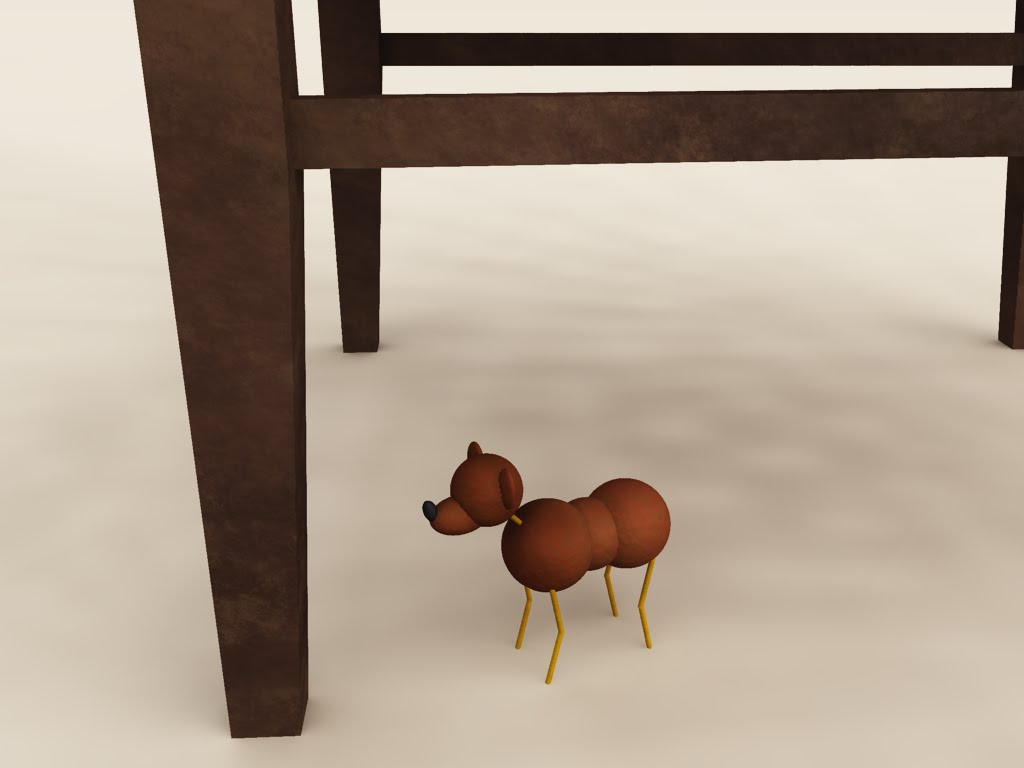
Let's do some fast evolution and evolve a cousin that is 10 times smaller, so the size factor is 0.1: D. musformis. It is only 10 cm long and weighs 1000 times less than D. caniformis. The diameter of its legs was altered by a factor 0.1^1.5, or 0.0316. The result is an animal with different characteristics, much more fitting with a small animal. You may wonder why I did not splay its legs sideways or bend them more, but such matters will be kept for another post.


Click to enlarge; Copyright Gert van Dijk

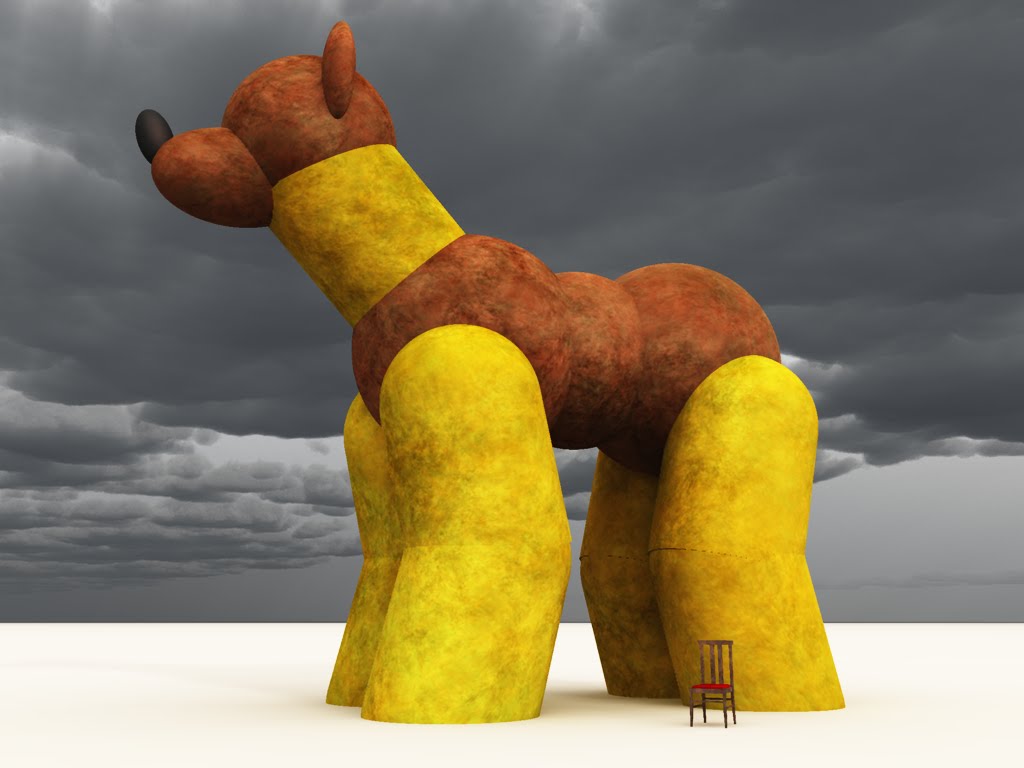
Evolution could have gone the other way, so the size factor becomes 10. The resulting D. giganticus is 10 m long and 1000 times heavier than D. caniformis. This animal only has equals among dinosaurs and a few of the largest mammals ever. Its legs have become truly colossal: their diameter has increased by a factor 31.6! (that is 10^1.5). You may well wonder whether such an animal is still practical: after all: the enlarged legs now make up a much larger portion of its body mass than for D. caniformis, while doing the same thing: allowing the animal to stand.


Click to enlarge; copyright Gert van Dijk

Finally, here are the three species together, and this was the problem I started with: how do you depict a mouse and a dinosaur in one picture? Zooming out enough to make D. giganticus visible meant rendering D. musformis invisible, so instead I zoomed in enough to make D. musformis visible while keeping D. giganticus most impressive feature visible: its legs.

A warning for those who are still reading this: there is quite a bit of evidence that the mechanics explained above do work. For instance, within bovids (cows and their kin) bone diameter is related to bone length along the principle explained above. Here is an internet page which explains some of the same things and shows some factual data (my data are from other sources). Most bovids look rather alike, and that may help explain why the relation fits so well. If you take mammals of all shapes and form, the fit is less good and skeleton mass does not increase as much as it 'should'. There appear to be various reasons for this. The most important one is that legs move, which, as said, poses other demands on their design. So please do not start designing animals with exactly these configurations, as that may be incorrect.

Similar thoughts hold for other organs and tissues. For instance, the force a typical mammalian muscle exerts is proportional to the cross section of its fibres. Do you see the problem? When you double an animal's size the mass of its muscles increases eightfold, but their strength only increases fourfold. Relatively speaking you have made the animal weaker! Very complex, animal scaling; it's a god thing the effects of gravity are less complex...