Saturday, 9 March 2013

Skitters ('Falling Skies'), spidrids and footless crabs

The previous post was devoted to spidrids, Furahan radially symmetrical walking animals. In thinking about their movement my attention was drawn more and more to Earth crabs, because the anatomy of their legs proved to resemble the anatomy I had chosen for spidrid legs. I admit that spidrid leg anatomy mostly came about because of a wish to see them walk. There are programming problems that I cannot solve myself (inverse kinematics) and I do not have any of the high-end graphics programs that can do it for me. So that is why I came up with the simple scheme I discussed before: at the hip joint there is a vertical axis of movement allowing clockwise rotation, but all other leg segments have horizontal axes enabling shortening and extension of the legs. Later, the exact same scheme proved popular with robot builders.

Last time I discussed a feature of crab (or spidrid) legs that I still do not understand well: slanting. I tried to contact arthropod experts but without luck so far. But there is another feature of crabs I do not understand: why do they not have feet? Crab legs more or less just end in rounded points. This is odd, because crabs, often living in tidal water, need to be able to get to good hold on the ground they are walking on, or else they may be swept away by the current. You would expect feet with curved claws for that. I have not found a discussion of why crabs do not have feet, just one mention of the fact that they do not. As I was considering adding feet to spidrids, I wondered whether there could be an anatomical reason for their absence. That will be discussed first, and only then will the 'skitters' of  'Falling Skies' be discussed: they have feet.
Click to enlarge; copyright Gert van Dijk
In the past I discussed the influence of leg posture on the anatomy of leg joints, and in particular how many axes are needed. The image above shows a new version of an old design (Mechanicus disneius). In the left image the leg is simply rotated forward around the vertical axis of the hip/shoulder joint: the foot ends up rotated with respect to the ground. While walking, the foot should move along a path shown as a stripe on the ground; in reality the animal moves forwards and the foot stays on the ground; it's the same relative movement. The foot should point forwards during the entire step, and that requires rotation around an axis parallel to the most distal leg segment, shown by an axis sticking out of it. The image on the right shows where the foot should be: many joint positions need to be adapted, but the one important here is the rotation of the feet around that longitudinal distal leg axis. By the way, rotate your hands palm up and palm down: what you are doing is pronation (palm down) and supination (palm up), which is just such a movement, due to the long bones in the forearm crossing and uncrossing.

The need for pronation and supination must be present for any animal with sprawling legs. That does not only include lizards and turtles, but arthropods -and spidrids and radial robots!-. I have not found any mention of how arthropods solve this problem. The robot builders just ignore it. Insects have a series of short segments at the need of their legs, the tarsus, linked through ball and socket joints. Are they how insects cope? Does the tarsus more or less flip around during a leg cycle? As said, crabs have no feet, so the end segment of their legs must turn in place during a step, rotating against the ground. Do crabs have no feet because there is no mechanism for pronation and supination? I cannot believe that. All this rotation with friction without a proper way to grab the ground seems an odd way to design a leg, and yet it seems to be there. If anyone knows an arthropod limb expert, please ask them...

Click to enlarge
What does all this have to do with the skitters of the television series 'Falling Skies'? Well, they have radial legs with feet, in an interesting example of 'convergent speculation'. A skitter is shown above, along with my simplified version to illustrate its anatomy (Disneius horrificus). Skitters have invaded an conquered Earth, but as the story unfolds it seems they did so under duress, so to speak. Their top end shows bilateral symmetry but their nether end has radial symmetry, which is odd. There are more aspects that suggest we should be well prepared to suspend disbelief (I like the series). For one, the legs are overly thick given that there are six of them. In itself that might indicate evolution in a very high gravity, but the sprawled position of the legs argues strongly against that. They can walk along vertical walls, a feature so unlikely there is little need to discuss it. They communicate through radio, an old favourite of speculative biology that seems difficult to get underway in an evolutionary sense. (All right, here is why I think so: the evolution of biological radio might well start with a primitive capability to receive radio waves, but can you see/hear with that sense? Where is the benefit?).

                            
The video fragments above show skitters in action. I have repeated the very short fragments to make it easier to see what is going on. It is clear that their nether ends are indeed fully radial, and that the feet accordingly stick out in all directions.


Above you see another fragment, one I rather like. I have repeated this one a few times as well. The skitter turns as it negotiates the path between the furniture. It must turn, as its top end has clear front and back sides: if it has to face the humans, it has to turn. With that clear preference you would expect its bottom end to have an equally clear fore to aft distinction, but that part is radially symmetrical. The one distinguishing feature of radial symmetry is that it allows movement in all directions. With such feet, a skitter might be expected to walk in any direction with equal ease, even directions in which it cannot see...  

The feet remain planted on the floor during the turn, so the legs in fact rotate around a longitudinal axis of the distal leg segment. That is nice; a pity that the anatomical mechanism is not visible. I very much like the way the animators solved the problem of how an organism with such a wide leg base negotiates the limited space between the furniture, designed for the much narrower forms of humans. The skitter behaves like an all-terrain vehicle and simply puts its legs on the furniture where needed, evening out the differences in height between its feet as it goes. That is very well done, I think.

But still... Leaving spidrids with leg points that pirouette against the ground at every step is very unsatisfying. The feeling is a bit like when you are unable to solve a puzzle, the answer of which must be staring you in the face. I think I will equip spidrids with feet, if only to end the irritation. That still leaves crabs, presenting the same puzzle...    


Sunday, 24 February 2013

Sprirally slanted spidrids

Arthropod leg design seem straightforward, but there are several aspects about them that i do not understand, so I have been trying to find out more about them. Answers prove hard to find though, and so for this post I will limit myself to just one thing: why do Earth arthropods such as crabs and scorpions often walk with their legs slanted with respect to the vertical?

Click to enlarge; copyright Gert van Dijk

This image shows my prototypical spidrid. Most joints are fairly simple with just one axis of rotation. The legs turn clockwise or anticlockwise at the joint with the vertical axis near the body; let's call that the coxa, to keep the arthropod analogue going (the word means 'hip'). The other joints simply bend and straighten the leg. The result of this simple design is that each leg operates in a vertical plane. I felt that this makes sense from a construction point of view; no slanting here.

Click to enlarge; from Wikipedia
But this wonderful image of a crab shows a different pattern: the plane in which each legs lies is heavily slanted with respect to the vertical. From a point of countering gravity this design does not seem wise, but crabs are not very large, so gravity is less a constraint than it is for animals with a larger mass. Slanting must be good for something. It makes the crab flatter while the reach of the leg is not compromised. Perhaps flattening is good for animals living in crevasses. Another possible explanation might have to do with propulsion. In your typical spidrid the propulsive force of the legs at the side comes from muscles that rotate the leg clockwise or anticlockwise with regard to the body. This joint lies far from the point where the leg exerts force on the ground, which may weaken the design. The muscles that extend and flex the leg do not help much in propulsion. But slanting the legs would mean that those same muscles can now add their force to pushing against the ground. Perhaps that is it; if so, I will have to look harder for evidence.


But instead of doing so I wondered whether slanting could work for spidrids, so I played a bit with Matlab and produced some animations. My first idea was to put an angle to the vertical axis connecting the leg to the body. Doing so would slant the leg when it rotates with respect to the body, and more so the more the leg is rotated. When the leg is just sticking out from the body it would not be slanted. What you see above is the result. As you can see, the leading and trailing legs are not rotated in a clockwise or anticlockwise direction, but 'just stick out'. They do not exhibit slanting at all. The other legs are slanted when at maximal angles, and the extension muscles in them could help push the animal forward. It looks intriguing, doesn't it?


Of course, I could not resist having the legs slant the other way, but that was probably a mistake: I do not see them providing additional propulsion this way. The spidrid is not flattened, because the leading and trailing legs still lie in a vertical plane.


If flattening is needed, all legs will have to be slanted, and that idea resulted in the spidrid above. Aas far as propulsion is concerned there may be a problem. Crabs are bilaterally symmetrical, so the left and right legs can both push against the ground in the slanted position. But spidrids have radial symmetry, and that means that legs on one side can provide an additional push while the ones on the other side do not. But I am not certain that that is what slanting is for, so perhaps it is no problem. Meanwhile, I rather like the somewhat sinister aspect of this 'spirally slanted spidrid'             

Saturday, 9 February 2013

Another grouillard: Eructator admonitionis

After an involuntary six month hiatus I have finally been able to pick up painting again, and have since finished one small painting, one big one, have started a new large one, and have generally been working toward producing a pdf file that I can send to publishers as a sample of the book that should persuade them to publish it. I need to do just one additional illustration for the marblebill page, one that will probably show a dawn scene with screeching marblebills outlined against the sky.

I decided to show you one such additional illustration, showing a species of grouillard related to the one on the Furaha site.

Click to enlarge; copyright Gert van Dijk
 And here it is. As you can see, it has a banded colour pattern that just screams 'Here I am!' to any animal with a decent vision. Remember that the grouillard you are familiar with (Oructator olidus) was black and brightly red, so it wasn't exactly given to camouflage either. These warning colours, because that is what they are, tell other animals not to fool around with a grouillard: except for its extremely nauseating and somewhat toxic spit, the animals taste extraordinarily awful. Young predators may bite into a grouillard once, and that grouillard will not live to tell about the experience. But the predator will, and will not bother another grouillard for a long time, if ever.

So there you are. It was fun painting the mossy fungoid thingy on the branch. I still have no good notion of what all the various brushes in Corel Painter 12 can do, my favourite painting software. When I find a better fungoid-producing bbrush, I may erase this one and do it again. So far I set out to copy my usual method of working in oils as closely as possible. That seems to work nicely, so it is time to see what else I can do with this box of tricks.

Monday, 21 January 2013

Furaha on the silver screen: "How to describe a cloud"

In previous posts I had mentioned that Furaha would appear in a film, hadn't I? Yes, I had; the proof is here, in a post of almost one year ago.

Well, the wait is almost over. Next Saturday the film will see its world première at the International Film Festival in Rotterdam. The director is David Verbeek, and the film is produced by Conijn Films. The film is in Chinese, but it is a Dutch film nevertheless. I will write more about it later. Meanwhile, here is the information from the website of the festival (right here):

"A young woman in Taipei is confronted with the blindness of her mother who is convinced she has a sixth sense. Shot with little facilities, but it is Verbeek’s most mature film - about uprooting, spirituality and modernity. Nominated for The Big Screen Award.

David Verbeek made this film on a tiny budget in the lull before his larger Dead & Beautiful had been fully financed. With its reflections on the role of spirituality in modern society, this film may be a precursor to his next, a socially critical vampire film.
 

But How to Describe a Cloud can stand on its own two feet. The story of Liling seems to unfold intuitively. When her mother goes blind, the young musician is suddenly forced to leave her big-city cocoon and return to the small island where she grew up. There, her scientific approach to blindness, in which she presents the world to her mother through words on the advice of the doctor, clashes with her old mother's spiritual approach. She argues that she can’t see the world around her any more, but can still sense it. Could the science fiction drawings of the former scientist with whom she flirts in the city provide mediation? Also see Immortelle in Tiger Awards Competition for Short Films."


Just guess who made the 'science fiction drawings of the former scientist'... To prove that, here is the film's trailer (there is a much better quality version on YouTube here).


 Exciting, isn't it?

Sunday, 13 January 2013

Monopods: getting off on the wrong foot?


How many legs can animals have? That is a subject that has been discussed more than once in this blog and its comments. A first gross division of 'leggedness' could be whether the number of legs is even or odd (for odd numbers see here and here), and a second one whether the overall pattern is one of radial or bilateral symmetry. Last week Petr commented on the Xenohox Gazelle, an animal on the doubly odd side of this classification, in that in combines a radial design with an odd number of legs. For those of you who are well-versed in such things, the difference between the radial design of animals such as my tetropters and the Xenohox gazelle is that the axis of symmetry is vertical in the former and horizontal in the latter.


 Fragment from The Future is Wild

Getting back to the topic at hand, Petr asked what I thought of animals with just one leg. I realised that I had omitted walking with one leg or with no legs at all (whether the latter is possible may be a matter of semantics, but there are aspects of moving without legs that resemble those of true walking). Are there many such beasts in speculative fiction? The first one to come to mind is the 'desert hopper', an animal evolved from snails in 'The future is wild'. The DVD is easily available. There is also the Eponan springcroc; there are undoubtedly more.

What should be the proper term for this mode of locomotion? There is a choice between  Greek and Latin equivalents. Examples are the Greek 'tetrapod' and the Latin 'quadruped'. For one-leggers, the words could be 'uniped' (Latin) or 'monopod' (Greek). I prefer the rhythm of the Greek one, so let's stick to that one.      

Monopods have biomechanical problems. The first can be demonstrated easily by hopping on one leg. You will it fatiguing. One reason, but not a major one, is that one set of muscles does the work normally done by two. Fair enough, but the bigger problem has gravity as its cause. Any walk cycle has a stance phase in which the leg pushes against the ground and a swing phase in which thee leg swings forwards, free from the ground. During that swing phase the body will of course fall down, unless another leg supports it. Monopod animals, not having another leg, must deal with the tendency of the body to fall. Do not underestimate this: a normal human biped walk cycle lasts about 1 second, and each leg is off the ground for about 40% of the cycle, meaning about 0.4 seconds. In that time the other leg s supports the body, but what if there wasn't one? Under Earth gravity a time of 0.4 seconds is long enough time to fall 78 cm, much too far to catch up easily with the next step. That unsupported phase should therefore be as short as possible: for 03 second the fall will be 44 cm, for 0.2 seconds it will be 20 cm, and for 0.1 second it will be a mere 5 cm.

During running there are periods in which no leg touches the ground, resembling the monopod problem. Still, our bodies do not move down a long way during the unsupported phase: the unsupported phase does not last long because we do have two legs and because the rate of cycling is much higher than during walking; also we actually jump up enough to combat the falling tendency.
 
Let's turn the biped human into a monopod human. If you keep the leg moving at the same rate as if you were walking with two legs, the unsupported phase will be about 0.4 seconds as shown above. The only way not to fall 80 cm during that time would be to jump up in each step. This is a sizable jump, costing lots of energy. Of course, speeding up the rate of movement helps, but that calls for high acceleration and deceleration, also costing lots of energy. There is probably an optimal balance in there, minimizing the energy for forward movement. The balance would, as holds for any gait with any number of legs, depend on speed. Monopod animals might not be good at low speeds, because gravity does not allow for a slow jump.

A monopod animal is like a human on a pogo stick. 'Pogoing' (we need a verb) would cost less on a low-gravity world, so perhaps they should be sought there. There is probably an optimal mass for pogoing animals. Jumping is not a good idea for animals with a large mass, because they then need disproportionately heavy skeletons. There would be lower limits too: you might think that falling is irrelevant for animals as small as insects, as they would not hurt themselves much by doing so. Then again, the short distance means that there is no time to break the fall, and whatever your size, during a fall control of the body is lost, never a good idea.

Click to enlarge; copyright Gert van Dijk
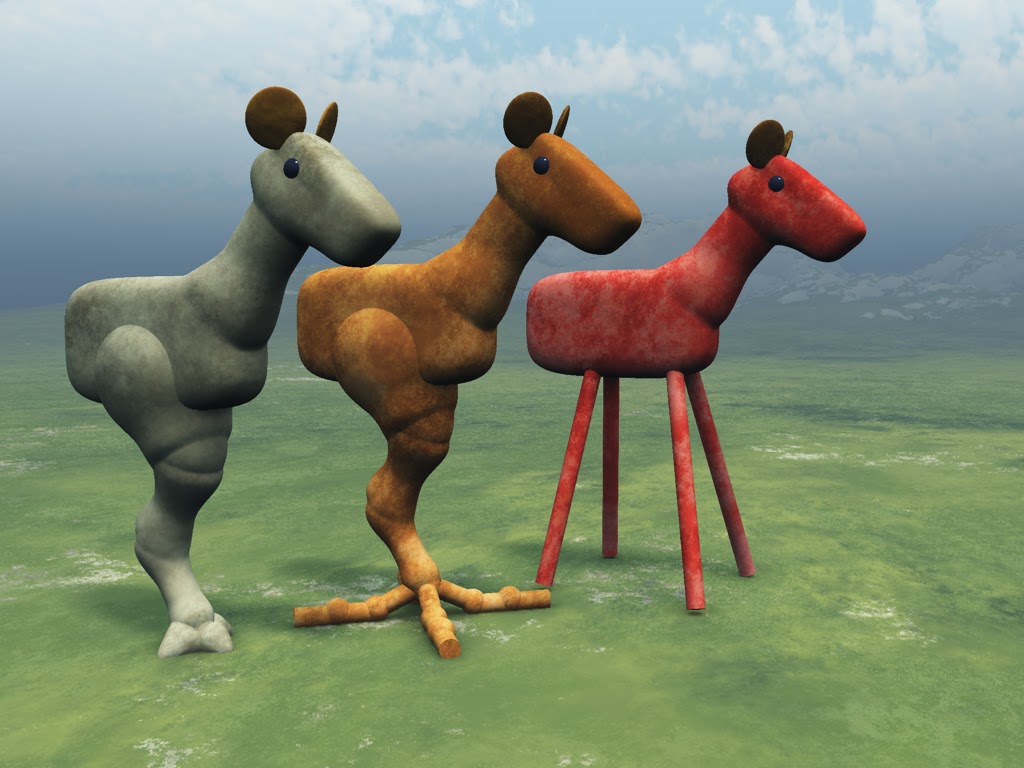
Another big problem for a monopod would be stability, as shown above. Standing on three legs or more is easy, because there is little skill involved in holding the centre of gravity over the support area on the ground, defined by the points where the feet touch the ground. Bipeds can only stand upright with a sophisticated neural control system. For a monopod such as 'Unipes disneyi', on the left,  the support area is small, requiring an even more sophisticated control system. Sideways forces would pose a very large problem for monopods. Wind is more likely to blow very small animals over than larger ones, and for insects and the like it pays to splay their legs: it produces a large support area. So, alien monopods perhaps should probably not live on planets with very dense atmospheres. The obvious way to solve that problem would be to have long toes sticking out in all directions: the middle monopod in the illustration. They would have to be very strong to counter a tendency of the body to move. In this respect the toes would probably be inferior to legs that stick out towards the same points on the ground but starting from the body, shown on the right. But if the starting point is one leg, the toes would probably be the answer. I do wonder about the body scheme of an animal with just one leg; would that preclude the presence of other paired limbs or organs?        

Finally, having one leg results in no redundancy whatsoever: a monopod with a leg injury is probably doomed, whereas a biped might limp away, and a millipede would simply continue on its way.

Click to enlarge; copyright Gert van Dijk
Are there workarounds? I am tempted to think so. Take the large-toed animal at the left above and make it stand on the tips of its toes. Evolve it a bit to get the animal at the right: the toes get bigger and the upper part of the leg shrinks. Now that animal could just swing one toe forwards while keeping the other ones on the ground. By repeating this movement for the other toes it would no longer need to jump up. But what that does, obviously, is upgrading the status of the toes to that of legs, and then the animal is no longer a monopod but a secondary tetrapod. And a very silly one at that.   

Sunday, 30 December 2012

Tetropters V: a livelier animation

Regular readers may know that I return to the subject of tetropters from time to time, in a slow and fragmented effort to produce a documentary video showing the little beasties hovering through the air as if they were real, perhaps with an appropriate narrator (as I wrote earlier, David Attenborough would be perfect).

New readers may however respond by saying "What on Earth is a tetropter!?". Part of the answer lies in rephrasing that as "What on Furaha is a tetropter!?" Well, tetropters are small exoskeletal insectoids with a radial base-four Bauplan using a double clap-and-fling wing movement. That is about as short a description as can be given, I think. Those who wish to read more can find the latest instalment ('Tetropters IV') right here, with links to the previous three chapters.

'Tetropters IV' had reached the stage where I could simulate tetropter wing movement, resulting in animations showing a completely immobile body in a completely immobile environment and a fixed camera position. To get there had required a lot of work, but so much more was needed: the animals' bodies should be detailed -and should probably have internal movement as well-; there should be a larger variety of wing shapes; the animal should tilt a bit in the direction of movement, and larger tetropters with slow wing beats should bob up and down in flight, like a butterfly does when flying. And to mimic the effect of a macro lens the scene the depth of field should be narrow, with blurring of nearby and far objects.

 Copyright Gert van Dijk

I used some time in the holiday season to work on the animation, pushing against the limitations of time and capability. The first result of that push stage is shown above, and had the animal moving about freely in three dimensions. To do so I wrote a program in Matlab to define a 3D path in x, y and z-coordinates. The movement is based on the number of frames per second and the numbers of seconds the film should last for. To keep the wings moving there is the number of frames per cycle to consider. I added a little tremor to the vertical component of the movement, so the animal bobs up and down a bit, in phase with its wing beats. All this resulted is a text file with a lot of numbers stipulating where the animal is and at which phase its wings are. The more difficult part was convincing the rendering program 'Vue Infinite' to accept all these numbers and produce a nice image per frame. I had to work on a program in the language 'Python', which I am hardly familiar with, but which can be used to control almost any function in Vue Infinite. I got over that and made the animation above. Not too bad, is it? In an earlier version Evan Black commented that an improved animation might have the effect that the coarser aspects of the design, such as wing attachment, would be less noticeable if the animation would be developed more. I think that that now proves to be true. By the way, the three axes and the balls are there to tell me whether the animal is with regard to local space. I also did not bother to set the wing cycle to match with the movement; in a real scene the wings should beat much more often over the course of such a movement.

Copyright Gert van Dijk

The next stage, shown above, involved 'lens blurring' and body tilting. After various tries and errors Vue Infinite could do lens blurring, but in a very complicated manner: there was a variable that had to entered as a percentage, so I stopped at 100%. The blurring only worked as intended when I set it to 2000%, something I learned after having received help from the Vue Infinite forum at E-on software.
  As for the body tilting, that involved rotations around all three axes. I wrote the program so i could control the rotations by hand, but added an automated feature that differentiated a position path. There should probably be a time delay in that the body should probably start to tilt in a given direction slightly before it starts to move that way, but the lack of such a delay is not noticeable. There could be various way for tetropters to change direction; they could change the aspect ration of specific wings or during specific phases of wing movement, or they could bend their bodies to change their centre of gravity. Regardless, I think the tilt adds a nice touch, rendering the flight a bit like that of a helicopter.

Copyright Gert van Dijk 

The animation above shows where I am now: camera movement. The camera follows the tetropter. As all this is a simulation that could be done perfectly, so every bob up and down would be followed, and the body would stay centred on the image with mathematical perfection. That would look very artificial: a human camera operator would lag behind the movement and would not follow tiny variations. I mimicked that by having the camera follow a smoothed path rather than the actual one, but I do not think the smoothing is good enough yet; it probably needs a delay function as well.

Oh well, there are enough things left for the next stage, such as adding a suitable body. I will probably sculpt one in Sculptrix or build one in Vue itself. The latter option will result in an artificial technical look but has the advantage of colouring the animal with ease. The Sculptrix option will produce a much more biologically looking body, but requires colouring in some other program, another new task to learn (apparently Photoshop can be used to paint 3D objects). So, do not hold your breath, but 'Tetropters VI' will probably be the final documentary, adding all the items mentioned earlier.

Except for the narrator, I am afraid...

Sunday, 16 December 2012

From the Archives (VI): the woolly-haired shuffler

It is time to delve in the crypts of the Furahan Archives once more. There are body plans there that have never seen the light of day, and remnants of species long forgotten. Scribbled notes in a mixture of languages show that names of continents, animals or even the entire planet evolved as did the animals. The more prosaic version boils down to an unsorted stack of paper of all possible sizes and types.


Click to enlarge; copyright Gert van Dijk
This post will deal with how the woolly-haired shuffler (Gigatheron inexorabilis) came into being. The two small doodles on the left show running animals with big heads that seem to have overlapping layers of skin or armour on their body. Their overall shapes suggest a warthog or a ram, and perhaps that is where the inspiration came from. The one on the right was done with felt-tipped pen, and mostly shows a head with interesting horns or teeth as well as a nice neck shield. There certainly is nothing resembling the overlapping dermal plates that came to characterise the shuffler.


Click to enlarge; copyright Gert van Dijk
This one is rather similar, and the fact that it is a colour sketch means that I had starting thinking about elevating the idea to a full painting. The head has not changed much, but does not work well: the eyes are above the horns in the middle. Those horns have already developed the split tips that I still like, making the horns look as if they developed from entwined separate cores. The colours suggest dawn on a very cold plain, with some direct light coming in horizontally from the left. That colour scheme would probably have worked quite well, as it would have allowed the bits of snow that are scraped aside by the animal as well as the mountain in the background to be highlighted in pure white.

Click to enlarge; copyright Gert van Dijk
Some developmental sketches must be missing, as the head of the next one has already evolved to its final shape: the eyes have moved down and the lower teeth now form a perfect shovel. The shield and the face below the horns together form a triangle, while the shovel and parts of the contour of the horns form an oval framing the face. You often see such ovals, circles and spirals around major parts of the composition in art books. I have never consciously used such design elements while drawing, and am always a bit amazed that they are in fact there. Drawing involves rummaging around with many shapes until they sort of 'click in place', so i guess that the 'clicking in place' involves an unconscious search for lines and shapes.

What this drawing reveals is that I am not a painter at heart: I do not think in blobs of colour or light and dark, but in lines. This drawing was done on transparent paper, something I used to transfer a drawing onto the prepared board, ready for painting. I traced the final design with pencil on transparent paper, and then laid that, reversed, on the board. By tracing the lines once more with a soft pencil the tracing was transferred. Here, I cannot have been happy with the animal's body, which is clearly still being developed: the overlapping skirts are there, but they do not reach down very far, and the body is rather small.

Click to enlarge; copyright Gert van Dijk
Here is another colour sketch. This became the final design. The head is exactly the same, but the body has grown, making the animal much more impressive. There isn't much of a background: just a peak mimicking the shape of the shuffler's shoulders. The bits of colour show that I was thinking of using bits of unexpected colour here and there, something I had seen in the works of Frank Frazetta and that I wished to experiment with.

Click to enlarge; copyright Gert van Dijk

And here is the final painting again. The shuffler's story probably does not end here though. When I will have the time in a month or two to pick up the project again, I will continue the digital make over of old paintings. The eyes may change, and so will the fur, I think. Some of you may remember that I mentioned a film in which Furaha would feature. That project is still alive, although progressing slowly, and the final version should feature a shuffler...