Showing posts with label spidrid. Show all posts

Wednesday, 13 November 2019

Work in progress: the prigoon again


Lately, I have been wondering whether it is really a good idea to keep the paintings hidden until the publication of the eventual book. If I do not show the paintings, then I should probably keep interest going by writing posts more often. But the kind of posts I write, with literature searches and illustrations made to order, take a lot of time.

Perhaps I should write some shorter posts instead, just short ones, without much depth. Let me known what you think of such an approach.

Click to enlarge; copyright Gert van Dijk
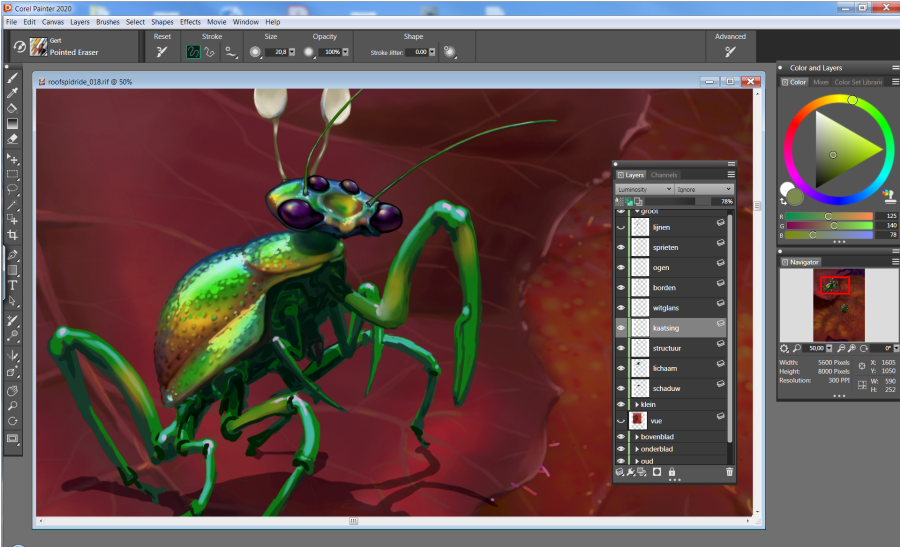
 To try it out, here is a work in progress: I have worked on the prigoon's head and back shield. I like painting textures, and thought I should try my hand at iridescence.  The legs need to be detailed, but that is fairly boring work. After that I wil work on the shdows some more, because the animal is a bit flat right now. At the very end I will probably use blurring to create the idea of macro photography.

Wednesday, 27 December 2017

"The Spirally Slanted Spidrid's Mad Dash For Safety!"

Last September I presented part of a painting showing the Mad Sickle, a species of spirally slanted spidrid ('slanties'). The comments quickly gave rise to two new ideas: the first was that the legs and body of slanties might hook up to form a nearly impregnable wall. I should probably do a painting of one. The second was that slanties might well move by cartwheeling. Imagine that as follows: a spidrid's body along with the legs sticking out in all directions forms a disk; now flip the disc onto its edge and roll it along; that's it.  Slanties might use this trick to escape very quickly down a hill.


As usual, life on earth manages to trump anything the speculative biologist can think of. To prove that, here is a short video showing a Namibian spider using exactly that same trick to escaper down a hill, narrated by Sir David Attenborough. There are also spiders that actually do a series of somersaults, head over tails, but that is another type of movement and also another story: here's a video).

Slanties have an additional trick up their sleeves: once flipped on their side, there is nothing to stop them from using the power of their legs to make this an active way of locomotion. Slanties need not be content with passively rolling downhill; they can get out of the way on horizontal terrain too. Actually, they could even roll uphill. I do not think that that would be more effective than normal walking (normal for slanties, that is!), but they could. 

Mind you, I am not saying I am the first to invent this way of locomotion for a fictive animal. I have written about Warren Fahy's 'disc ant' in the past, and there may be earlier manifestations as well.

   
So here is a quick animation of a slanted spidrid moving in this fashion. The legs flex and extend while the body rotates. I suppose it could also move on the other direction with nearly the same movement. We are looking at the dorsal side of the beast.


Here it is again, rolling in and out of view.

I doubt the animal would use this type of movement as part of its normal repertoire, because I do not think it would be able to see well, with the entire world circling around them like mad. In this respect, the movement is a bit like 'cernuation', a term to describe the movement of the 'squibbon' of The Future is Wild. To read about possible visual problems, find the posts here and here. The poor spidrid only sees the world as a blur when wheeling around in this way, and that is why it uses wheeling only as a last resort to escape from predation.

Saturday, 8 June 2013

Spidrids and rusps: works in progress

The main Furaha site hasn't seen any significant change for quite some time now, which makes me feel a bit irresponsible. I have devoted the time I spend on this project wholly on the blog and on new paintings. As for the site,  I will get around to a complete 'redecoration' one of these days, and the blog is what you are reading right now, so there.

I am keeping the new paintings for the book but can show you bits of works in progress now and then, both of paintings and of blog material. In this post I will show progress on two themes, not that odd as I usually work on several themes at once (a major interest at present is working out which aspects of plants can be tweaked on other worlds, and what the results would look like; that is progressing nicely).

Copyright Gert van Dijk

I have discussed spidrids here several times, the last time here. That post showed them walking on uneven terrain in a variety of gaits. Those animations, done in Matlab showed how an animal with radial symmetry changed direction without turning. Although the animations showed that well, a proper 3D animation would be better. I am not aiming to achieve the quality of Avatar or Walking with Dinosaurs, but getting to a point in that general direction would be nice. The challenge then was to translate sets of coordinates of one system (matlab) into rotation and translation values for objects in a completely different format (Vue), and then controlling Vue to make an animation one frame at a time (Python). I won't bother you with the details. As you can see above, I am now at the stage where I can control the legs and have them end up on the right orientation and position. It really looks much better at a larger size, but blogger does not allow that. The low light was chosen so I could see whether the feet end up on the correct spots of the surface: their shadows just touch them, so that works! But when the innermost segment moves beyond the vertical, that segment flips around, so my rotation subroutine isn't quite right yet. I'll solve it. Meanwhile, it's starting to look real, isn't it? Now just imagine a body in between, texture on the ground, plants and shrubs with leaves swaying in the breeze, the sound of spidrid legs on the floor, and the occasional 'chikking' of the spidrid itself. I can see it already; perhaps imagination is better than animation...

Click to enlarge; copyright Gert van Dijk
Rusps! After my last encounter with them I thought some more about a possible painting. I decided it would look good as a double page spread, occupying the top of both pages. That results in a very wide format, just the thing for an animal that is itself long and horizontal. I decided to 'stagger' successive legs: segment x has the legs placed a bit to the inside, and segment x+1 has the placed to the outside, x+2 to the inside again, etc. In that way the stride might be long without the animal knocking its legs together. As there are so many legs, each one can be skinny. So I took the 3D model of a segment I did earlier, strung them together and starting playing in Vue with positions and curves. But I also needed a head, so I sculpted one roughly in Sculptris. I do not need a detailed sculpt as the sculpt is only a simple aid to produce the painting, not an end in itself. (Then again, if I did that, I could perhaps sell you models of spidrids and rusps). That is what you see above.

Click to enlarge; copyright Gert van Dijk
Here is another view of the rusp head. You cannot see the inner design of the snout, but the story is as follows.This particular rusp species, Megacrambis brucus, is very large and has an accordingly large head. It always pays to conserve energy, so moving that massive head or even the entire body to eat one bite is wasteful. It is better to stick a small head on a long neck (sauropods) or extend the reach in another way (arms, trunks, hooks). Inside the rusps' snout, technically a  'rostrum', there are rings connected to one anther at right angles to allow pointing the rostrum in all directions. Then there is one of those intriguing linkage systems that fish in our world excel at. Putting that in action extends the reach of the rostrum two- to threefold. Finally, at the end there are some grasping mouthparts. I put some more conventional mouth parts underneath; they are probably part of the overall rusp design.

Click to enlarge; copyright Gert van Dijk
Anyway, I put all he 3D parts together in Vue and played some more, seen at the top. Below you see  a quick over painting of the result. I was aiming for an overall diagonal effect in the composition, of which the shadow falling over the rusps's body is a part. I am not certain whether I will keep it though. I will keep the strong light against the dark clouds, as it helps to highlight the front whip. Megacrambis' English name will be 'Mammoth rusp', but I am not certain yet. Furaha was first discovered by Swahili speakers, so some of their names survived. I am also considering 'Mdudu Mzee' , roughly translated as 'respected elderly bug'. Any preferences?


Saturday, 6 April 2013

Crabs as spidrids, spidrids as crabs...

I recently realised that Earth crab locomotion resembles Furahan spidrid walking more than I expected. I may have spent too much time on spidrids or not enough on crab locomotion, as there was a lot to learn about radial walking, odd as that may sound. I found a very nice paper on walking patterns of decapod crustaceans (basically crabs and lobsters) beginning with the sentence 'Most decapod crustaceans can walk in any direction they please'. 

From: Vidal-Gadea et al. Arthropod Structure & Development 2008; 37: 95–108 (adapted)
The image above is from that paper and shows leg movements of a sideways-walking crab, a forwards walking crab, and a forwards-moving lobster. The ability to move in any direction without turning the body is one of the main features of a radial walking design, something I thought did not exist on earth. Apparently crabs, particularly forwards walking ones, are quite 'radial'. In fact, the paper uses the very word 'radial' to describe leg positions for the forwards walking crab. A peculiar convergence with spidrids is that its common name is 'spider crab' (Libinia emarginata).


While most crabs preferentially walk sideways, they can combine directions and walk diagonally if they so wish. The video above shows a crab that starts walking backwards but gradually adds a horizontal element until it ends up walking sideways only. (Click the link to see the source at a better quality).


And here is an example of a forward walking crab. Again, the original has better quality. If you look carefully you will see that the legs do not all point sideways: the front ones are angled to the front, and the hind ones point almost backwards. In short, they are almost placed and held radially around the body. Are spidrids crustaceoid or are crustacea spidridoid?

Click to enlarge; copyright Gert van Dijk

Spidrid legs, although the mere result of a thought exercise, are rather like real crab legs. The image above shows the simplified leg anatomy, say of a sideways-walking crab (or of a spidrid leg). The bottom part shows that the leg can turn forwards and backwards around a vertical hinge close to the body, movements labelled 'promotion' and 'remotion' in technical papers. Let's call that the 'body-leg joint'. The other joints, the 'intraleg joints', in spidrids have horizontal axes allowing the leg to be straightened and flexed (see the top part). There would be muscles for every joint, but I only showed them for one.

If the animal moves in the direction shown here the leg does not need  action of the promotor and remotor muscles: the power for movement comes from the intraleg joints.  If you rotate the direction of movement 90 degrees, muscle force for this leg has to come from the body-leg joint, meaning the promotor and remotor muscles.

Click to enlarge; Copyright Gert van Dijk

So what does all this mean for spidrids? Well, regardless of the direction it walks in, a spidrid has some legs parallel to the direction of movement and some at a right angle to it. The image above shows how that relates to the direction of movement and to the necessary range of motion. The legs parallel to the movement function as the legs in sideways-walking crabs, and  depend on intraleg flexion and extension, pulling and pushing the beastie. The legs at largely right angles to the movement depend on promotion and remotion. The leg in between simply make use of both sets of muscles to varying degrees. (Mind you, the word 'promotion' in crabs always refers towards the front end of the animal; in adapting it for spidrid use it must mean 'in the direction of movement', there being no front end.)

The next evolutionary spidrid twist stemmed from the idea that one of these two types of force production might be superior to the other. How would spidrids make use of that edge, while staying radially symmetrical? Before tackling that I realised I had never shown the spidrid's ability to change direction without turning. Solving that posed some interesting Matlab programming problems, but never mind, it works. I added height for fun and slanted the body a bit when the beastie is on a slope to make it look more natural.

 Copyright Gert van Dijk

Here it is! Finally, a spidrid that negotiates terrain and make a sharp turn. As you can see, the sharp turn calls for some interesting leg movements. With a shallow turn you would not see the changes well. So this is how real radial animals walk. By the way, should a rich Hollywood director wish to buy the concept for a film, I am available! Anyway, it is now time to adapt this standard spidrid walk to more energy-efficient gaits.

Copyright Gert van Dijk

The one above is built on the assumption that flexion/extension is more efficient than promotion/remotion. So, this species uses its promotion/remotion muscles to swing the legs as far parallel to the direction of movement as they will go. There are probably anatomical limits to this, so some legs still stick out at a right angle to the direction of movement regardless. The turn becomes odd, as some legs have to swing a long way to end up in their new position.

Copyright Gert van Dijk

But the existence of forwards-moving crabs shows that under given circumstances using promotion and remotion as the power house is feasible. The animation above has a spidrid moving its legs with a preference for positions at a right angle to the movement. This movement also calls for large leg swings when the animal changes direction. The legs bump into one another, which can be solved with phase changes, but I left it as it is for now. The anatomy of the animal is the same in all three variants, which may be unwise; I can see the last type having shorter legs to improve leverage, at the cost of stride length.

So there we are! Rampaging spidrids! What else is left for spidrid movement? An obvious additional adaptation would be to include slanting, but I will not provide an animation of that; what you see here was quite complex. Then again, I now have a program resulting in 3D coordinates for any part of a spidrid negotiating a 3D terrain. Perhaps I should go for a photorealistic animation? How about the 'Crown of Thorns' (Coruna spinea) making its way over rocks? Or the 'Blue Jester' (Fossor azureus) walking on the forest floor? The 'Lesser Strandsprab' (Nepa aranea) would do well on a beach, but the 'Hairstar' (Coma confusa) would be difficult to depict, with its hair cover. By the way, all of these appear in paintings I am working on...                    

Saturday, 9 March 2013

Skitters ('Falling Skies'), spidrids and footless crabs

The previous post was devoted to spidrids, Furahan radially symmetrical walking animals. In thinking about their movement my attention was drawn more and more to Earth crabs, because the anatomy of their legs proved to resemble the anatomy I had chosen for spidrid legs. I admit that spidrid leg anatomy mostly came about because of a wish to see them walk. There are programming problems that I cannot solve myself (inverse kinematics) and I do not have any of the high-end graphics programs that can do it for me. So that is why I came up with the simple scheme I discussed before: at the hip joint there is a vertical axis of movement allowing clockwise rotation, but all other leg segments have horizontal axes enabling shortening and extension of the legs. Later, the exact same scheme proved popular with robot builders.

Last time I discussed a feature of crab (or spidrid) legs that I still do not understand well: slanting. I tried to contact arthropod experts but without luck so far. But there is another feature of crabs I do not understand: why do they not have feet? Crab legs more or less just end in rounded points. This is odd, because crabs, often living in tidal water, need to be able to get to good hold on the ground they are walking on, or else they may be swept away by the current. You would expect feet with curved claws for that. I have not found a discussion of why crabs do not have feet, just one mention of the fact that they do not. As I was considering adding feet to spidrids, I wondered whether there could be an anatomical reason for their absence. That will be discussed first, and only then will the 'skitters' of  'Falling Skies' be discussed: they have feet.
Click to enlarge; copyright Gert van Dijk
In the past I discussed the influence of leg posture on the anatomy of leg joints, and in particular how many axes are needed. The image above shows a new version of an old design (Mechanicus disneius). In the left image the leg is simply rotated forward around the vertical axis of the hip/shoulder joint: the foot ends up rotated with respect to the ground. While walking, the foot should move along a path shown as a stripe on the ground; in reality the animal moves forwards and the foot stays on the ground; it's the same relative movement. The foot should point forwards during the entire step, and that requires rotation around an axis parallel to the most distal leg segment, shown by an axis sticking out of it. The image on the right shows where the foot should be: many joint positions need to be adapted, but the one important here is the rotation of the feet around that longitudinal distal leg axis. By the way, rotate your hands palm up and palm down: what you are doing is pronation (palm down) and supination (palm up), which is just such a movement, due to the long bones in the forearm crossing and uncrossing.

The need for pronation and supination must be present for any animal with sprawling legs. That does not only include lizards and turtles, but arthropods -and spidrids and radial robots!-. I have not found any mention of how arthropods solve this problem. The robot builders just ignore it. Insects have a series of short segments at the need of their legs, the tarsus, linked through ball and socket joints. Are they how insects cope? Does the tarsus more or less flip around during a leg cycle? As said, crabs have no feet, so the end segment of their legs must turn in place during a step, rotating against the ground. Do crabs have no feet because there is no mechanism for pronation and supination? I cannot believe that. All this rotation with friction without a proper way to grab the ground seems an odd way to design a leg, and yet it seems to be there. If anyone knows an arthropod limb expert, please ask them...

Click to enlarge
What does all this have to do with the skitters of the television series 'Falling Skies'? Well, they have radial legs with feet, in an interesting example of 'convergent speculation'. A skitter is shown above, along with my simplified version to illustrate its anatomy (Disneius horrificus). Skitters have invaded an conquered Earth, but as the story unfolds it seems they did so under duress, so to speak. Their top end shows bilateral symmetry but their nether end has radial symmetry, which is odd. There are more aspects that suggest we should be well prepared to suspend disbelief (I like the series). For one, the legs are overly thick given that there are six of them. In itself that might indicate evolution in a very high gravity, but the sprawled position of the legs argues strongly against that. They can walk along vertical walls, a feature so unlikely there is little need to discuss it. They communicate through radio, an old favourite of speculative biology that seems difficult to get underway in an evolutionary sense. (All right, here is why I think so: the evolution of biological radio might well start with a primitive capability to receive radio waves, but can you see/hear with that sense? Where is the benefit?).

                            
The video fragments above show skitters in action. I have repeated the very short fragments to make it easier to see what is going on. It is clear that their nether ends are indeed fully radial, and that the feet accordingly stick out in all directions.


Above you see another fragment, one I rather like. I have repeated this one a few times as well. The skitter turns as it negotiates the path between the furniture. It must turn, as its top end has clear front and back sides: if it has to face the humans, it has to turn. With that clear preference you would expect its bottom end to have an equally clear fore to aft distinction, but that part is radially symmetrical. The one distinguishing feature of radial symmetry is that it allows movement in all directions. With such feet, a skitter might be expected to walk in any direction with equal ease, even directions in which it cannot see...  

The feet remain planted on the floor during the turn, so the legs in fact rotate around a longitudinal axis of the distal leg segment. That is nice; a pity that the anatomical mechanism is not visible. I very much like the way the animators solved the problem of how an organism with such a wide leg base negotiates the limited space between the furniture, designed for the much narrower forms of humans. The skitter behaves like an all-terrain vehicle and simply puts its legs on the furniture where needed, evening out the differences in height between its feet as it goes. That is very well done, I think.

But still... Leaving spidrids with leg points that pirouette against the ground at every step is very unsatisfying. The feeling is a bit like when you are unable to solve a puzzle, the answer of which must be staring you in the face. I think I will equip spidrids with feet, if only to end the irritation. That still leaves crabs, presenting the same puzzle...    


Sunday, 24 February 2013

Sprirally slanted spidrids

Arthropod leg design seem straightforward, but there are several aspects about them that i do not understand, so I have been trying to find out more about them. Answers prove hard to find though, and so for this post I will limit myself to just one thing: why do Earth arthropods such as crabs and scorpions often walk with their legs slanted with respect to the vertical?

Click to enlarge; copyright Gert van Dijk

This image shows my prototypical spidrid. Most joints are fairly simple with just one axis of rotation. The legs turn clockwise or anticlockwise at the joint with the vertical axis near the body; let's call that the coxa, to keep the arthropod analogue going (the word means 'hip'). The other joints simply bend and straighten the leg. The result of this simple design is that each leg operates in a vertical plane. I felt that this makes sense from a construction point of view; no slanting here.

Click to enlarge; from Wikipedia
But this wonderful image of a crab shows a different pattern: the plane in which each legs lies is heavily slanted with respect to the vertical. From a point of countering gravity this design does not seem wise, but crabs are not very large, so gravity is less a constraint than it is for animals with a larger mass. Slanting must be good for something. It makes the crab flatter while the reach of the leg is not compromised. Perhaps flattening is good for animals living in crevasses. Another possible explanation might have to do with propulsion. In your typical spidrid the propulsive force of the legs at the side comes from muscles that rotate the leg clockwise or anticlockwise with regard to the body. This joint lies far from the point where the leg exerts force on the ground, which may weaken the design. The muscles that extend and flex the leg do not help much in propulsion. But slanting the legs would mean that those same muscles can now add their force to pushing against the ground. Perhaps that is it; if so, I will have to look harder for evidence.


But instead of doing so I wondered whether slanting could work for spidrids, so I played a bit with Matlab and produced some animations. My first idea was to put an angle to the vertical axis connecting the leg to the body. Doing so would slant the leg when it rotates with respect to the body, and more so the more the leg is rotated. When the leg is just sticking out from the body it would not be slanted. What you see above is the result. As you can see, the leading and trailing legs are not rotated in a clockwise or anticlockwise direction, but 'just stick out'. They do not exhibit slanting at all. The other legs are slanted when at maximal angles, and the extension muscles in them could help push the animal forward. It looks intriguing, doesn't it?


Of course, I could not resist having the legs slant the other way, but that was probably a mistake: I do not see them providing additional propulsion this way. The spidrid is not flattened, because the leading and trailing legs still lie in a vertical plane.


If flattening is needed, all legs will have to be slanted, and that idea resulted in the spidrid above. Aas far as propulsion is concerned there may be a problem. Crabs are bilaterally symmetrical, so the left and right legs can both push against the ground in the slanted position. But spidrids have radial symmetry, and that means that legs on one side can provide an additional push while the ones on the other side do not. But I am not certain that that is what slanting is for, so perhaps it is no problem. Meanwhile, I rather like the somewhat sinister aspect of this 'spirally slanted spidrid'             

Tuesday, 2 November 2010

Radial Robots

'Radial robots'; for a title that isn't too bad. I was tempted to add words with 'r' such as 'rampaging' or 'ravaging', but I resisted, as that ran the risk of rather ruining the effect, rendering it ridiculous.

Back to the matter at hand. When I first thought of a radial walking pattern, resulting in Furahan spidrids, I was content to visualise the gait by writing some programmes in Matlab. The results are shown on the Furaha page, and some were featured in the blog as well (here and here). I never imagined I would see really see spidrids walk. Literally, of course, I never will, unless creative bioengineering kits become available quickly, which is unlikely. But walking robots have emerged on the scene since I thought of the spidrids, and among them radial leg designs, as opposed to bilateral symmetry, seem to be quite popular. You can even buy kits to build one yourself. As these designs probably evolved independently, it is interesting to see how parallel these forms of evolution have become: convergent speculation? I therefore surveyed the internet to see whether their anatomy and gaits resembled those of Furahan spidrids. As most of the robots out there seem to be hexapods, I made a quick hexapod version of my originally octapod spidrids (if you need information on spidrids, go to the land section of the Furaha site and select 'walking with...'). A mutation, if you will.


Mutated spidrid; copyright Gert van Dijk

And here it is. I cannot call it a spidrid any longer, as that name evoked spiders, and therefore eight legs. Suggestions are welcome. The beasty walks with the simplest possible gait: that is a double tripod gait, in which the six legs are divided into two groups of three. The three legs of a group move in unison, and the two groups are exactly out of phase. Provided that each leg touches the ground longer than it is off it, there will always be at least three lags on the ground (either that or six). This gait, together with sprawling legs, provides excellent stability. As discussed previously, this is useful for very small animals, soupy atmospheres or a very low walking velocity. It also doesn't require subtle neural control, making it suitable for today's rather dumb robots. It is also a bit boring, which is why my spidrids walk with different gaits, but that is another matter.


Click to enlarge; copyright Gert van Dijk

Next, a scheme to show how the joint anatomy works. Spidrids are very simple: there is a joint at the 'hip', in which the entire leg can rotate clockwise or anti-clockwise. The rotation axis is vertical, indicated by a shiny metal axis and a red arrow. All other joints are simple hinges allowing the segments of the leg to be stretched or bent, and the axes are horizontal, indicated by more shiny axes and blue arrows. Now that the basic spidrid anatomy and gait are clear, it is time to see whether the robot creators have evolved completely different approaches, or whether they evolved the same ideas.


The first video is of a hexapod robot from this YouTube source. As soon as you see it move you will see that its leg anatomy is exactly that of the spidrid: there is one vertical axis at the hip, and the leg itself only contains horizontal axes. The gait is simple as well, in that the legs move in two sets of three, just like the animation above. I like the clunking sound it makes, as if a whole battalion of Cybermen comes clunking down the street. It does one thing my spidrid animations do not (as yet): it changes gait, in the sense that it moves from a circular rotation to walking again (I could have programmed that, but that is a lot of work...).


Here is another one (source here), and this one has a more biological feel to it, in the sense that the movements seem smoother and less mechanical. It does have the same basic anatomy though. Its gaits seem more diverse.


Just to show that radial robots are not restricted to six legs, here is an eight-legged one (source here), more reminiscent of the original spidrids. With eight legs there are many ways to move the legs, and the risks of falling are diminished, as it is easier to spread weight-bearing evenly around the centre of gravity.


Click to enlarge; source here

Finally, just a look at this one suggest a radical departure from the norm. It has four legs, but that is not the point, as it still clearly has a radial anatomy. The legs do not seem to be attached in the usual fashion: where they touch the body the joint seems to be a simple hinge with a horizontal axis. In fact, all its joints seem to have horizontal axes. So how does it move its legs in more than one direction? How can it walk if all its legs can do is stretch and shorten? The answer lies in its design: this robot is fundamentally different. It is part of a project in which the robot has an internal representation of its body, so it can learn to move once more after its legs have been damaged. In short, it is a lot more intelligent than its dumb brethren. If you want interesting movements, always add a brain (an insect type of brain will do).


And this video shows how it moves: it tilts its body, and that takes the place of (anti)clockwise leg rotations. By varying the tilt of its body the reach of its legs becomes much more varied than with an immobile body. In fact, with the anatomy it has, body tilt is the only way forward (pun intended). What a clever design! I love it.

Does this mean that the 'usual' radial design is flawed? I think not. There are good reasons why this design was invented several times, for robots as well as spidrids: it is simple and allows good mobility. Now, if the robots develop more interesting and sophisticated gaits, we are in business: model spidrids in your own home; what more could you wish for?
Thursday, 29 April 2010

Illustrating symmetry

On the assumption that I might need to explain spidrids in some detail, I thought I could use some diagrams of how radial symmetry works. In turn, that gave rise to the idea that bilateral symmetry could be used to contrast radial symmetry with. Perhaps no such explanations are necessary, but the images proved easy to produce, so here they are! I made rough 3D versions of a hexapod neocarnivore and of an eight-legged spidrid in ZBrush, and exported the result to Vue Infinite.

Click to enlarge; copyright Gert van Dijk

The image above shows a fairly robust hexapod as a good example of an animal with bilateral symmetry. The three images show a translucent plane bisecting the animal. The horizontal plane (top) and the vertical plane separating the front from the hind sides (bottom) show that the resulting two parts of the animal do not resemble one another. The middle image separates the left from the right sides of the animal, and these sides are mirror images of one another. The plane in the middle image, called a sagittal plane, is therefore a plane of symmetry dividing the animal into two mirrored halves. The two is translated as 'bi' and 'side' as lateral, hence 'bilateral'. The result of all this is that the top differs from the bottom, so it pays to distinguish the two. Likewise, front and back denote completely different aspects and hence functions. Only left and right are identical if mirrored. Easy, right? In real life bilateral symmetry should not be taken too far: internal organs can be quite asymmetrical, and organs with symmetrical external appearances may still show different functions for left and right sides, such as the human brain. But never mind that.

Click to enlarge; copyright Gert van Dijk

The next image shows a Furahan spidrid with radial symmetry. Its body contains eight equal segments -it is octomeric-, forming the body rather like slices of a pie form an entire pie. One such slice is shown in yellow, once in its normal position, and just for fun also as if one slice is shifted a bit, like people tend to do with pie charts. On Earth, there are quite a few radial animals. Starfish are a nice example. One of their odder characteristics is that their larvae show bilateral symmetry, suggesting that radial symmetry is a later development in these animals. While starfish have five segments, spidrids have eight, but the number does not really matter. Spidrids do have tops and bottoms, but what they emphatically do not have are front and rear sides, nor left and right sides. The terms simply do not apply; it might be better to speak of central and peripheral to distinguish which spot of the animal you are referring to.

Some of you may point out that the spidrid can be divided into two mirror halves using a plane, just like the neocarnivore. This would be absolutely true, but does not make the animals bilaterally symmetrical. The thing is that the resulting half would still contain four equal portions, so this way of dividing it does not go far enough. Using a plane of symmetry is not really valid to describe such an animal; it does not have a plane of symmetry but an axis of symmetry, running from the top to the bottom right through the centre of the animal.

Click to enlarge; copyright Gert van Dijk

Is there a minimum number of slices for radial symmetry? Theoretically there is no maximum, but the minimum number is intriguing. The red thingy in the image above shows an animal with three such segments, a state you might call 'trimerism'. I do not think any such scheme exists on Earth, and the results does not look at all like something I aim to have on Furaha. Perhaps someone can find a use for such a scheme as a floating life form hidden in plankton. The blue ridiculosity shows 'biradial symmetry'. You might think it has bilateral symmetry, but it doesn't: there still is no front or rear, nor left and right, to this beast. Rather than right it seems to be wrong. Still, believe it or not, 'biradial symmetry' exists! Just check Wikipedia. But do not expect anything with legs as shown here...

Click to enlarge; copyright Gert van Dijk

At this point all should seem clear, which is the right time to complicate matters. Going back to the spidrid, its eight slices can be shown up by cutting the animal up with four planes. The top image shows how this results in the sort of segment we started with. But the image below is equally valid, in that it too results in eight identical slices. Still, the slices are different. The way to reconcile this is to look closer at one segment on its own: it has bilateral symmetry with a plane of symmetry! Take care though: this does not hold for the animal as a whole, but for its slices. In fact, there are eight clockwise half segments and eight anticlockwise half segments. You could say that animals such as spidrids and starfishes do not exhibit perfect radial symmetry becuase of this, but that would take 'biological correctness' too far, I think...

Tuesday, 20 October 2009

More on spidrids and tripods

I have been playing with my Matlab octapod program a bit more. The program proved to have a bug (sorry about that pun, but it seemed inescapable). I eradicated it...

First, here's one for Anonymous. It is a tripod walker with two legs moving in phase and one acting on its own. In this case, the leg moving on its own is the front one rather than a hind one. Please note that the hind legs do not just move in a pure front-to-aft direction, but swing in a circle. That's a result of their radial design. At any rate the body should swing to kep the centre of gravity balanced over the legs, but that hasn't been programmed in yet.


And just for fun a leggy spidrid. NOT a spider! A SPIDRID!