Showing posts with label hexapod. Show all posts

Saturday, 25 February 2023

A hexapod muscle study

Some time ago I wrote about the Great Hexapod Revolution, which I might also have called the Quite Considerable Hexapod Revision. At any rate, that particular revolution or revision has conceptually been completed for quite some time, so I am busy revising old paintings as well as coming up with new ones. The latter are not really necessary as The Book is basically done.

Yes, The Book is done.

Basically.

The 'done' part means that there are easily enough double pages to fill a book, so rather than producing more I am shifting emphasis towards finding a publisher. I do not expect immediate success, which explains 'basically': I might meanwhile just as well keep on thinking about Furahan creatures.

Let's review the hexapod revision. Their skeleton still reflects that of early representatives of the clade. There is no vertebral column, here defined as many short similar bones placed end to end running from front to back in the vertical plane dividing left and right halves of the animal (technically, the sagittal plane). The most bare bones version of that skeleton (sorry for that one) would remind you of a foldable ladder. As the clade started with animals without legs, it would be strange to use the name Hexapods ('six-leggers') for all of them. I chose the new name 'Scalata' instead, based on the Latin word 'scala': ladder. The word 'Scalata' is technically correct while 'scalates' is suitable for colloquial use. Hexapods then become a subgroup, consisting of scalates with legs. 

Click to enlarge; copyright Gert van Dijk


The next big step was deciding the shape of the legs. I built on the zigzag principle, in which successive major leg segments bend one way at the topmost joint, the other way at the second joint, and so on. By reversing direction, no joint is ever really far away from a line perpendicular from the hip down. Being close to that line reduces the force needed to keep the joints in those positions, meaning muscle power. have a look at these posts here and here. The image above was taken from these earlier posts and explains that principle.

The least force to keep the segments in place is needed when all segments are stacked vertically, making the leg into a column. That is a fine way to conserve energy but does not produce athletic animals. Vertical leg bones are typically found in large non-athletic animals: think of elephants and sauropods. In smaller animals all segments can be closer to the horizontal than the vertical position, because fighting gravity costs relatively much less (for scaling effects, see here and here). The actual position of the leg bones will depend on mass and athleticism.
             
I suggested in earlier posts (here and here) that it wouldn’t really make a difference whether the legs started by being angled forwards ('zig') or backwards ('zag') at the hip joint. Mammals are peculiar in having their front legs start with a zag and hind legs with a zig. This is a consequence of how they re-engineered their original sprawling posture: front legs rotated backwards, with elbows pointing back, and hind legs forwards, with knees pointing forwards.

Should that reversal be seen as a natural 'law' or as an evolutionary coincidence that became locked in place? I could not think of any physical reason for this pattern and so had freedom to decide what to do with scalate legs. All three pairs of legs underwent the same rotation, which is simple and keeps them out of each other's way. The top segments all point backwards.   


Click to enlarge; copyright Gert van Dijk


Another decision was how to join the legs to the scala. Should the hip joint allow movements in all directions, or should they restrict movement in one or more directions? Should the joint be so 'open' that all positions need to be controlled by expensive muscle activity, or do we let bones and ligaments take up some of the stresses? I decided to give the joint surface a 'roof' in the hip to push against, transferring weight. The image above shows three possible patterns: in A, the bone sits directly underneath the spherical joint, allowing three-axial rotations and simple weight-bearing. In B, the joint does the same, but the shaft of the bone is shifted a bit to the side, allowing room for gut, eggs, or whatever. In C, the joint restricts rotations around the axis running down the bone and the bone extends a bit past the joint. That sturdy upwards spur can be used to attach muscles to; that's the hexapod hip joint.  

The main propulsion force involves swinging the upper leg segments thighs backwards: retroflexion. The thigh has a limited range of motion, from an angled pointing just a bit forwards to a much larger backwards angle. To work over that range, hexapods have one large muscle starting behind the joint and attaching to the hip bone below the joint, exactly like human buttock muscles. But another big muscle originates in front of the hip and inserts on the spur above the joint. These two muscles act in concert to pull the leg back: they are 'agonists'.

That range of motion has consequences for where muscles can produce the most force. The force exerted by muscle fibres is most effective if these fibres make a right angle with a line from the insertion site to the axis. If that angle is not 90 degrees, only the component of the force that is at a right angle is useful to rotate the bone; the remainder just presses the bone into the joint or pulls it out of it. When the bone rotates, the effective force component changes with the rotation angle. You would want to place a muscle in such a way that most muscle fibres do useful work over most of the movement range. 


This animation shows a muscle placed to the front (at left) of the bone, inserting at the spur above the axis of rotation. The bone rotates through its working range, which is shown three times. The four  panels show fibres at different sites of origin. The red lines show the parts of the force that do the actual rotation. It is obvious that fibres starting high above the spur are not much use and can even pull in the wrong direction. The most useful fibres start at the level of the joint or lower, so this is where the muscle should be. I have not shown the other muscle, the one pulling on the thigh below the axis while starting behind the joint (at right). The principle is the same, but now the most useful part lies at the top.      

As I like Latin anatomical nomenclature for its simplicity, I named these muscles ('simple' is here based on the premise that the names are in another language you have to learn anyway). For the front legs, the front muscle is the musculus retractor artus primi anterior, and the hind one is the m. retractor artus primi posterior. For the middle and hind legs, replace primi with secundi or tertii.
 
There are of course muscles that work in the other direction, the 'antagonists', but these are weaker and run the other way, lying underneath the big 'retroflexion' muscles.
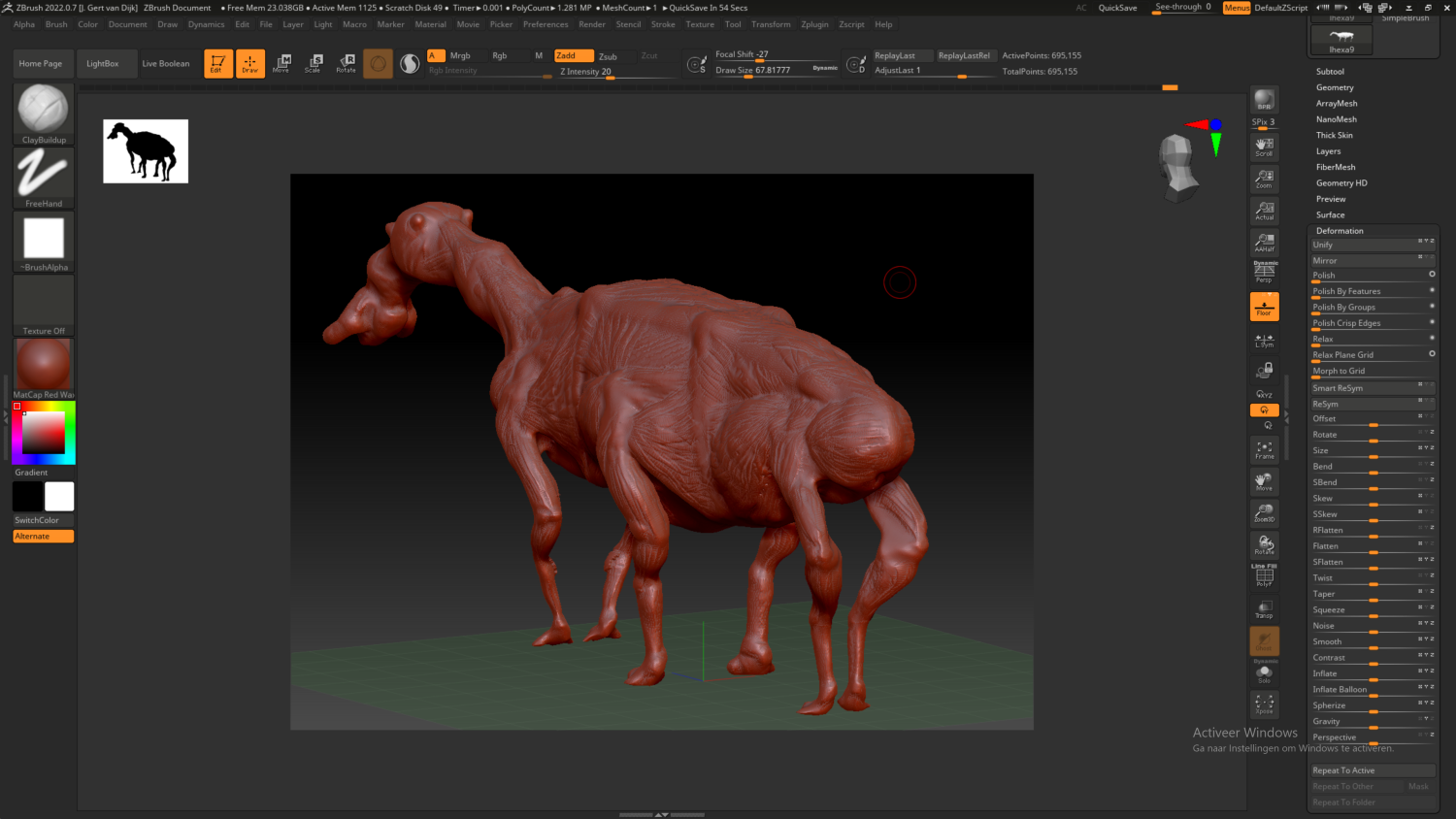
Click to enlarge; copyright Gert van Dijk

The two images above shows the result of some experimental ZBrush sculpting. Here you see a general hexapod with some main muscles shown. I still find ZBrush extremely non-intuitive, but am very slowly feeling my way around it.

This animal is probably the size of a horse. Note that the middle legs are sturdier than the others. That is because that is where most of the mass is! The middle legs are also wider apart, to allow room for a possibly sizeable gut and also for the front and hind legs. Of course,  the scheme underwent substantial changes in particular with those predators that freed their front limbs from locomotion ('centaurism') and turned them into weapons. maybe I’ll show those anatomical changes too, one day.           

Saturday, 31 August 2013

Hexapod evolution in a twist

Just a short post this time, as I am busy painting. The painting in question involves the early evolution of hexapods, something also discussed in a post titled 'The lateral fin theory and mackerel mode'.  

Click to enlarge; copyright Gert van Dijk
Above you see the specimen of 'Fishes II' that was shown in the previous post. It was digitally sculpted and painted in Sculptris. Such sculpts help define the perspective of the undulating fins. Once you have such a shape in your computer, you can go two ways: the first is to  perfect digital sculpting, which at present probably means mastering ZBrush. That road does result in a 2D image, taken as a snapshot of the model, but do do that the models need to be sculpted with much more finesse that the rough ones I produce. Readers of this blog will know the work of Marc Boulay, who does all this at the expert level.

But I chose to stick with regular figurative painting, because there is something about a painterly look that I like. It is not that easy to define 'figurative painting' in such a way that it excludedes digital sculpting. Perhaps it is creating the illusion of a three-dimensional object by placing colours on a two-dimensional surface. This includes digital painting as well as classical painting using oils or water colours or any such technique (I sometimes encounter a resistance against digital paintings in art circles, which must mean they see it something else than it is: just another technique).

In this process, 3D sculpt programs are aids to get the perspective or the lighting right. As with any technique they have their own unique problems. People will accept any perspective on a photograph or computer rendering, but not on a drawing (see here for an explanation).

Click to enlarge; copyright Gert van Dijk
Anyway, I try to produce a painterly effect. The two images above show two versions of the head of the Fishes II species Vexilloscissus. The left one was based on the 3D sculpt. I thought the painting was finished, and suddenly realised that there was no way that the six protojaws seen here could evolve into the typical four jaws of the basic terrestrial hexapod Bauplan. That design involves upper and lower jaws with two rows of teeth each, and two lateral jaws with one row each.  While sculpting I had forgotten that, so I had rotated the ensemble of six jaws incorrectly, with jaws in the midline in the upper and lower positions, and no jaw in the lateral positions. In world building it is hard to keep tracks of all the details, or at least that is my excuse for the mistake.  

So I had to erase the jaws and paint them again in the correct position. The result is at the right. It's a  pity really, as I rather preferred the left one. Oh well, never mind...      

Saturday, 6 October 2012

The 'lateral fin theory' and mackerel mode

I still have no time for posts that take time to read, think and write; well, more than a hour or two. That is a pity, as some ideas need time to do them justice. For instance, there is a post to write on what happens is photosynthesis is less dramatically imperfect as it is on earth (see here); there is also the final chapter of the 'sight is superior series' (see here), and I have at least one other world builder's creations in mind.   

Those will have to wait; instead, here is a short post on where the six limbs on Furahan hexapods came from. On the 'real life' level the answer is easy: 'six limbs will look exotic and therefore help create an alien ambiance'. Within the Furahan world, the logic of science fiction demands an answer that fits within the concept.

 
Click to enlarge; copyright Gert van Dijk

The sketch above is an old one, and the first that showed the first steps in hexapod ancestry. By now, many of the anatomical features are being overhauled, so the number of eyes is incorrect. The overall scheme is still there though: it all starts with a less than impressive little elongated tube with broad fins at its sides. This 'ULF' (unassuming life form) swims by waves that pass from front to back along the fins. Nothing particularly spectacular here: undulating fins may well be a constant throughout the universe. From that start I assumed that the fins might be divided gradually, to provide greater control and flexibility (you cannot suddenly move a part in one direction if it is fixed to parts in front and behind of it). This greater need for manoeuvrability evolved together with jaws; you cold also say that the jaws and the fins helped one another's evolution: without jaws, there is no speed, and without a better propulsion, the jaws do not provide that much benefit. The third stage shows an animal with fully separated fins, just not necessarily six of them; the reduction to six came afterwards.

The origin of hexapod fins therefore lay in a lateral membrane that split up. Many years later I wondered where Earth vertebrate limbs originated. To my very large surprise, the first explanation I came across was something called the 'lateral-fin theory'.


Click to enlarge; Coates MI. The origin of vertebrate limbs. Development 1994; Supplement 169-180 

The images above show an example of what a hypothetical vertebrate ancestor was supposed to look like: it already had unpaired fins along its back and belly, and lateral (sideways) fins along its sides. The theory, apparently first formulated in 1877, states that these lateral fins later gave rise to limbs. I was first a bit irritated, but later pleased that I had stumbled on a principle that apparently was not altogether fictional. That was until I went back for a closer look at current theories regarding vertebrate limbs. It would appear that the lateral-fin theory is now out of date. Other theories held that limbs evolved out of gill branches, which seemed to make sense as the first forelimbs were attached directly to the skull. That theory apparently also now belongs in the dustbin of history.

                   
Click to enlarge; Coates MI, Cohn MJ. Fins, limbs, and tails: outgrowths and axial patterning in vertebrate evolution. BioEssays 20:371–381, 1998

The image above shows an illustration from a recent paper on limb development. It shows that that unpaired fins in the midline ('median fins') existed well before vertebrates had jaws or lateral fins/limb. When lateral fins appeared, the first to appear were the front pair, with as yet no trace of hind limbs. The two pairs did not evolve together, which you would think, given their similarities. Modern discoveries in the field of 'evo-devo' ( embryonic development in light of evolution) centres on hox genes as a sort of overall conductors of embryo formation. A recent theory holds that the genes responsible for limb formation were co-opted from a previous use, one that involved formation of the gut through the 'lateral plate mesoderm'. The paper from which the image above was taken  mentioned the possibility of a third pair of limbs in vertebrates, the kind of nice exotic happening that we like in speculative biology. Here is what Coates and Cohn wrote:

"Finally, the absence of vertebrates with more than two sets of paired appendages has often been used as an illustration of evolutionary constraint. Developmental mechanisms responsible for this anatomical limitation remain unclear. Arguably, the nearest approach to a third pair of lateral appendages may be the lateral caudal keels of certain fishes, such as tuna and various sharks."


So there are in fact three pairs of lateral, well, outgrowths in vertebrates? Fascinating. But the test continues:

"Even the most elongate lateral fins of primitive fishes terminate in front of the anal level. Clearly, lateral caudal keels can and do emerge, but articulated endoskeletal paired appendages require the lateral plate mesoderm, and this is linked intimately to the extent and pattern of the gut."

Curiouser and curiouser. It does not look as if vertebrates will surprises us by evolving a third pair of legs, though. For three pairs of legs, you need to turn to insects, and for big hexapods, there is always the fictional universe.

But does all this mean I should give up on my 'lateral fin theory'. Actually, I see no reason to do so. In fact, it is rather nice that the lateral fin theory remains in place on Furaha, as the explanation of the origin of six legs in Furahan hexapods.

 
Click to enlarge; copyright Gert van Dijk 


To celebrate that I stole another two hours and used Sculptris to sculpt two quick ULFs. The first is shown above: no jaws, four eyes, two lateral undulating membranes and two long gill tubes running along the belly connected to the sea by a number of spiraculae. I still need to name it, and I think I need something that does justice to its pivotal position in evolution. Suggestions are welcome. Latin or Greek only though, please.

Click to enlarge; copyright Gert van Dijk

And here is its successor. As you can see, the membrane has developed indentations and the animal is longer and bigger. It has six claspers in front that can already deal with soft prey quite well. Note that the body is stiff, very unlike the very flexible body in the old sketch. The body can flex up and down, but sideways movement are almost impossible, thanks to he two stiffening rods that lie buried in the body at the root of each lateral fin. The stiffness is a consequence of this early body plane, and is a feature of all later hexapods.

Click to enlarge; copyright Gert van Dijk

I could not resist quickly daubing one in Sculptris with colour to show one in 'mackerel mode' (I still prefer painting, but the 3D process certainly is a very quick way of producing an illustration).    

Thursday, 11 February 2010

Avatar's 'Walking with hexapods' or 'Don't walk this way'

I guess everyone will have seen Avatar by now. If you haven't, and if you like speculative biology, go out and see it now. You can read this post before you go, as it will not spoil the storyline. The film is an amazing spectacle. I loved it, and was fascinated by the computer generated graphics. There is a short 'featurette' in the form of a short documentary on the internet that you should all watch, because it explains some of the basic tenets of the film. Here it is, but remember that there is a much better version on YouTube.

Before Avatar appeared in cinemas, there was this rumour going around that it would be solidly grounded in biology. For a film with floating mountains in it, coherent biology may not be the first thing you would expect. Still, let's look a bit closer at that claim, and start with the natives. As narrated in the 'featurette', the Na'vi (the natives) look very human and have four limbs while all large animals have six. The reason for this apparently has nothing to do with biology and everything with economics. The director, James Cameron, made that quite clear in an interview with Playboy magazine:

Playboy: How much did you get into calibrating your movie heroine’s hotness?
Cameron: Right from the beginning I said, “She’s got to have tits,” even though that makes no sense because her race, the Na’vi, aren’t placental mammals.

So biology did not have to make sense, and in Hollywood facts and fiction do not seem to be regarded as fundamentally different, as they are in science. Oh well, perhaps we should just embrace the natives (the hero does) because there would otherwise not have been any film at all. So let's hope the rest of the Pandoran biosphere is more plausible. The first job at hand has to be how to squeeze four-limbed humanoids into a evolutionary tree in which every big terrestrial animal has six limbs; hm.

Prolemuris from 'featurette'; click to enlarge

The book 'Avatar, an activist survival guide' presents some notes on the Na'vi's presumed evolutionary background. There is an animal, the Prolemuris, that 'has two arms that bifurcate into four forearms; the upper bones of the arms have fused... Biologists believe that this may be an evolutionary precursor to the two-armed Na'vi'. There are two difficulties with this: I suspect that this arrangement would not function at all well, but, more importantly, 'limb fusion' as an evolutionary process seems utterly incredible. If you want to lose limbs, have them gradually decrease in size (the insectoid aliens in 'District 9' did have such minuscule middle legs, if I remember correctly). You might expect the resulting 'fused limbs' to look different from our own, but the natives' arms are so human that you might as well assume that human arms are the result of limb fusion. As a joke you could argue that the presence of two bones in our forearms suggests this to be true... But I really wonder how the film's biological advisors reacted to 'limb fusion'. I doubt they invented it, and surely they raised similar objections?

Thanator from book; click to enlarge

On towards the hexapods. I was not the first to design large alien animals with six legs and won't be the last. But I did think hard about how such animals might walk, and wrote computer programs to explore gaits in a six dimensional phase space to prove it. I know this sounds a bit pedantic, but the Furaha page shows I did. Just go to the land page, or directly here. One of Avatar's stars is the thanator, a large predator, as sleek and supple as a panther. Its middle and front pairs of legs are very close together, as can be seen on the image above, from the book mentioned above. The anatomy and the movement pattern of the first two pairs of legs are virtually identical, which is very odd. Other Pandoran hexapods have this same peculiar arrangement, as can be seen on the following images from the same book (the white triangles here and there are due to the fact that the images on the book were printed at an angle to the page, and I tried to rectify that).


Hammerhead from book; click to enlarge

Sturmbeest from book; click to enlarge

Viperwolf from book; click to enlarge

One result of having the front and middle legs so close together is that there is no good way to connect the shoulder girdle to the torso. The images above show that the animals have typical mammalian shoulder blades; the thanator image even shows typical mammal muscles. One such, the latissimus dorsi, can be seen running from the shoulder blade of the middle leg backwards to the torso. There are typically other large muscles running in all directions from the shoulder blade. How do you solve having two such sets in the same space?

Fragment from 'featurette'

Another result is that such legs almost certainly have to move in unison or they will collide. You typically do not get a long view of anything in Avatar, so here is a small video in which a fragment of direhorses is repeated a few times. The front and middle legs on one side indeed move in tandem. Not always, but generally they do. Mind you, there are two other solutions to avoid clashing legs that I will not go into here, but neither seems to be in use on Pandora. Anatomically these animals have six legs, but functionally they are tetrapods. I do not think that leg clashes can be prevented completely with this anatomy. With that in mind, the scene of the thanator chasing the hero could have ended quite differently: just when the thanator is about to grab the hero, the poor beasts trips over its own legs and crashes to the floor...

Again, you wonder why this design was chosen. According to one internet site one of the advisors, Wayne Barlowe, had this to say: "There was some concern as to the biomechanics of the six legs but my guess was that if they were grouped four towards the front and two in the rear locomotion issues would be solved. Those worries were pretty much put to rest after some informative motion tests were run."

But why should there be any concern about the biomechanics of six legs to start with? Six legs are part of the standard insect design, so six-legged locomotion isn't exactly a novel concept. I am not aware of any insects moving like Avatar's hexapod animals. The insect standard gait is a double tripod, a perfectly sensible solution for slow movement. Insects of course make good use of the fact that they have six legs, and, unlike Pandoran hexapods, do not pretend to have four only. The given explanation has an odd ring to it coming from someone with biological acumen, almost as if there was another, nonbiological reason for this clumsy and implausible arrangement. Perhaps the producers felt that the animals would look too alien if the animals moved in too unfamiliar a manner. I have no idea.

Go see Avatar; I loved most of it. But not for the biomechanics. Surely it would not have been that difficult to make better use of easily accessible knowledge; facts are not expensive. Not many people may notice or care, but the ones that do notice are probably the ones who care a lot.