Sunday, 13 January 2013

Monopods: getting off on the wrong foot?


How many legs can animals have? That is a subject that has been discussed more than once in this blog and its comments. A first gross division of 'leggedness' could be whether the number of legs is even or odd (for odd numbers see here and here), and a second one whether the overall pattern is one of radial or bilateral symmetry. Last week Petr commented on the Xenohox Gazelle, an animal on the doubly odd side of this classification, in that in combines a radial design with an odd number of legs. For those of you who are well-versed in such things, the difference between the radial design of animals such as my tetropters and the Xenohox gazelle is that the axis of symmetry is vertical in the former and horizontal in the latter.


 Fragment from The Future is Wild

Getting back to the topic at hand, Petr asked what I thought of animals with just one leg. I realised that I had omitted walking with one leg or with no legs at all (whether the latter is possible may be a matter of semantics, but there are aspects of moving without legs that resemble those of true walking). Are there many such beasts in speculative fiction? The first one to come to mind is the 'desert hopper', an animal evolved from snails in 'The future is wild'. The DVD is easily available. There is also the Eponan springcroc; there are undoubtedly more.

What should be the proper term for this mode of locomotion? There is a choice between  Greek and Latin equivalents. Examples are the Greek 'tetrapod' and the Latin 'quadruped'. For one-leggers, the words could be 'uniped' (Latin) or 'monopod' (Greek). I prefer the rhythm of the Greek one, so let's stick to that one.      

Monopods have biomechanical problems. The first can be demonstrated easily by hopping on one leg. You will it fatiguing. One reason, but not a major one, is that one set of muscles does the work normally done by two. Fair enough, but the bigger problem has gravity as its cause. Any walk cycle has a stance phase in which the leg pushes against the ground and a swing phase in which thee leg swings forwards, free from the ground. During that swing phase the body will of course fall down, unless another leg supports it. Monopod animals, not having another leg, must deal with the tendency of the body to fall. Do not underestimate this: a normal human biped walk cycle lasts about 1 second, and each leg is off the ground for about 40% of the cycle, meaning about 0.4 seconds. In that time the other leg s supports the body, but what if there wasn't one? Under Earth gravity a time of 0.4 seconds is long enough time to fall 78 cm, much too far to catch up easily with the next step. That unsupported phase should therefore be as short as possible: for 03 second the fall will be 44 cm, for 0.2 seconds it will be 20 cm, and for 0.1 second it will be a mere 5 cm.

During running there are periods in which no leg touches the ground, resembling the monopod problem. Still, our bodies do not move down a long way during the unsupported phase: the unsupported phase does not last long because we do have two legs and because the rate of cycling is much higher than during walking; also we actually jump up enough to combat the falling tendency.
 
Let's turn the biped human into a monopod human. If you keep the leg moving at the same rate as if you were walking with two legs, the unsupported phase will be about 0.4 seconds as shown above. The only way not to fall 80 cm during that time would be to jump up in each step. This is a sizable jump, costing lots of energy. Of course, speeding up the rate of movement helps, but that calls for high acceleration and deceleration, also costing lots of energy. There is probably an optimal balance in there, minimizing the energy for forward movement. The balance would, as holds for any gait with any number of legs, depend on speed. Monopod animals might not be good at low speeds, because gravity does not allow for a slow jump.

A monopod animal is like a human on a pogo stick. 'Pogoing' (we need a verb) would cost less on a low-gravity world, so perhaps they should be sought there. There is probably an optimal mass for pogoing animals. Jumping is not a good idea for animals with a large mass, because they then need disproportionately heavy skeletons. There would be lower limits too: you might think that falling is irrelevant for animals as small as insects, as they would not hurt themselves much by doing so. Then again, the short distance means that there is no time to break the fall, and whatever your size, during a fall control of the body is lost, never a good idea.

Click to enlarge; copyright Gert van Dijk
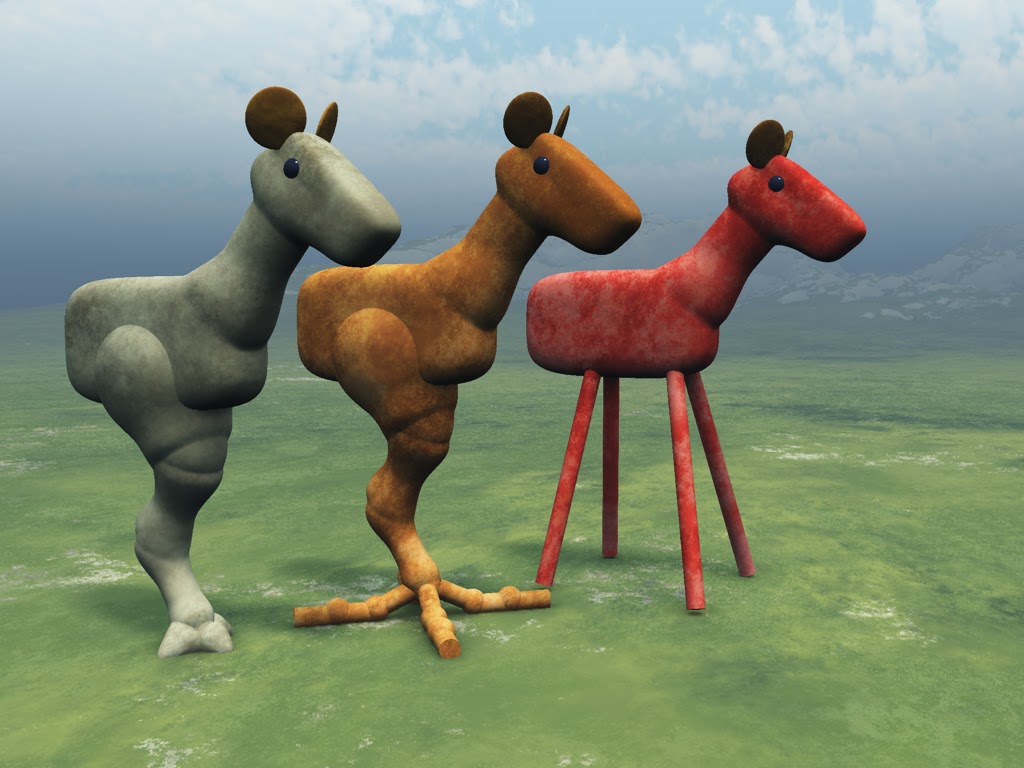
Another big problem for a monopod would be stability, as shown above. Standing on three legs or more is easy, because there is little skill involved in holding the centre of gravity over the support area on the ground, defined by the points where the feet touch the ground. Bipeds can only stand upright with a sophisticated neural control system. For a monopod such as 'Unipes disneyi', on the left,  the support area is small, requiring an even more sophisticated control system. Sideways forces would pose a very large problem for monopods. Wind is more likely to blow very small animals over than larger ones, and for insects and the like it pays to splay their legs: it produces a large support area. So, alien monopods perhaps should probably not live on planets with very dense atmospheres. The obvious way to solve that problem would be to have long toes sticking out in all directions: the middle monopod in the illustration. They would have to be very strong to counter a tendency of the body to move. In this respect the toes would probably be inferior to legs that stick out towards the same points on the ground but starting from the body, shown on the right. But if the starting point is one leg, the toes would probably be the answer. I do wonder about the body scheme of an animal with just one leg; would that preclude the presence of other paired limbs or organs?        

Finally, having one leg results in no redundancy whatsoever: a monopod with a leg injury is probably doomed, whereas a biped might limp away, and a millipede would simply continue on its way.

Click to enlarge; copyright Gert van Dijk
Are there workarounds? I am tempted to think so. Take the large-toed animal at the left above and make it stand on the tips of its toes. Evolve it a bit to get the animal at the right: the toes get bigger and the upper part of the leg shrinks. Now that animal could just swing one toe forwards while keeping the other ones on the ground. By repeating this movement for the other toes it would no longer need to jump up. But what that does, obviously, is upgrading the status of the toes to that of legs, and then the animal is no longer a monopod but a secondary tetrapod. And a very silly one at that.   

Sunday, 30 December 2012

Tetropters V: a livelier animation

Regular readers may know that I return to the subject of tetropters from time to time, in a slow and fragmented effort to produce a documentary video showing the little beasties hovering through the air as if they were real, perhaps with an appropriate narrator (as I wrote earlier, David Attenborough would be perfect).

New readers may however respond by saying "What on Earth is a tetropter!?". Part of the answer lies in rephrasing that as "What on Furaha is a tetropter!?" Well, tetropters are small exoskeletal insectoids with a radial base-four Bauplan using a double clap-and-fling wing movement. That is about as short a description as can be given, I think. Those who wish to read more can find the latest instalment ('Tetropters IV') right here, with links to the previous three chapters.

'Tetropters IV' had reached the stage where I could simulate tetropter wing movement, resulting in animations showing a completely immobile body in a completely immobile environment and a fixed camera position. To get there had required a lot of work, but so much more was needed: the animals' bodies should be detailed -and should probably have internal movement as well-; there should be a larger variety of wing shapes; the animal should tilt a bit in the direction of movement, and larger tetropters with slow wing beats should bob up and down in flight, like a butterfly does when flying. And to mimic the effect of a macro lens the scene the depth of field should be narrow, with blurring of nearby and far objects.

 Copyright Gert van Dijk

I used some time in the holiday season to work on the animation, pushing against the limitations of time and capability. The first result of that push stage is shown above, and had the animal moving about freely in three dimensions. To do so I wrote a program in Matlab to define a 3D path in x, y and z-coordinates. The movement is based on the number of frames per second and the numbers of seconds the film should last for. To keep the wings moving there is the number of frames per cycle to consider. I added a little tremor to the vertical component of the movement, so the animal bobs up and down a bit, in phase with its wing beats. All this resulted is a text file with a lot of numbers stipulating where the animal is and at which phase its wings are. The more difficult part was convincing the rendering program 'Vue Infinite' to accept all these numbers and produce a nice image per frame. I had to work on a program in the language 'Python', which I am hardly familiar with, but which can be used to control almost any function in Vue Infinite. I got over that and made the animation above. Not too bad, is it? In an earlier version Evan Black commented that an improved animation might have the effect that the coarser aspects of the design, such as wing attachment, would be less noticeable if the animation would be developed more. I think that that now proves to be true. By the way, the three axes and the balls are there to tell me whether the animal is with regard to local space. I also did not bother to set the wing cycle to match with the movement; in a real scene the wings should beat much more often over the course of such a movement.

Copyright Gert van Dijk

The next stage, shown above, involved 'lens blurring' and body tilting. After various tries and errors Vue Infinite could do lens blurring, but in a very complicated manner: there was a variable that had to entered as a percentage, so I stopped at 100%. The blurring only worked as intended when I set it to 2000%, something I learned after having received help from the Vue Infinite forum at E-on software.
  As for the body tilting, that involved rotations around all three axes. I wrote the program so i could control the rotations by hand, but added an automated feature that differentiated a position path. There should probably be a time delay in that the body should probably start to tilt in a given direction slightly before it starts to move that way, but the lack of such a delay is not noticeable. There could be various way for tetropters to change direction; they could change the aspect ration of specific wings or during specific phases of wing movement, or they could bend their bodies to change their centre of gravity. Regardless, I think the tilt adds a nice touch, rendering the flight a bit like that of a helicopter.

Copyright Gert van Dijk 

The animation above shows where I am now: camera movement. The camera follows the tetropter. As all this is a simulation that could be done perfectly, so every bob up and down would be followed, and the body would stay centred on the image with mathematical perfection. That would look very artificial: a human camera operator would lag behind the movement and would not follow tiny variations. I mimicked that by having the camera follow a smoothed path rather than the actual one, but I do not think the smoothing is good enough yet; it probably needs a delay function as well.

Oh well, there are enough things left for the next stage, such as adding a suitable body. I will probably sculpt one in Sculptrix or build one in Vue itself. The latter option will result in an artificial technical look but has the advantage of colouring the animal with ease. The Sculptrix option will produce a much more biologically looking body, but requires colouring in some other program, another new task to learn (apparently Photoshop can be used to paint 3D objects). So, do not hold your breath, but 'Tetropters VI' will probably be the final documentary, adding all the items mentioned earlier.

Except for the narrator, I am afraid...

Sunday, 16 December 2012

From the Archives (VI): the woolly-haired shuffler

It is time to delve in the crypts of the Furahan Archives once more. There are body plans there that have never seen the light of day, and remnants of species long forgotten. Scribbled notes in a mixture of languages show that names of continents, animals or even the entire planet evolved as did the animals. The more prosaic version boils down to an unsorted stack of paper of all possible sizes and types.


Click to enlarge; copyright Gert van Dijk
This post will deal with how the woolly-haired shuffler (Gigatheron inexorabilis) came into being. The two small doodles on the left show running animals with big heads that seem to have overlapping layers of skin or armour on their body. Their overall shapes suggest a warthog or a ram, and perhaps that is where the inspiration came from. The one on the right was done with felt-tipped pen, and mostly shows a head with interesting horns or teeth as well as a nice neck shield. There certainly is nothing resembling the overlapping dermal plates that came to characterise the shuffler.


Click to enlarge; copyright Gert van Dijk
This one is rather similar, and the fact that it is a colour sketch means that I had starting thinking about elevating the idea to a full painting. The head has not changed much, but does not work well: the eyes are above the horns in the middle. Those horns have already developed the split tips that I still like, making the horns look as if they developed from entwined separate cores. The colours suggest dawn on a very cold plain, with some direct light coming in horizontally from the left. That colour scheme would probably have worked quite well, as it would have allowed the bits of snow that are scraped aside by the animal as well as the mountain in the background to be highlighted in pure white.

Click to enlarge; copyright Gert van Dijk
Some developmental sketches must be missing, as the head of the next one has already evolved to its final shape: the eyes have moved down and the lower teeth now form a perfect shovel. The shield and the face below the horns together form a triangle, while the shovel and parts of the contour of the horns form an oval framing the face. You often see such ovals, circles and spirals around major parts of the composition in art books. I have never consciously used such design elements while drawing, and am always a bit amazed that they are in fact there. Drawing involves rummaging around with many shapes until they sort of 'click in place', so i guess that the 'clicking in place' involves an unconscious search for lines and shapes.

What this drawing reveals is that I am not a painter at heart: I do not think in blobs of colour or light and dark, but in lines. This drawing was done on transparent paper, something I used to transfer a drawing onto the prepared board, ready for painting. I traced the final design with pencil on transparent paper, and then laid that, reversed, on the board. By tracing the lines once more with a soft pencil the tracing was transferred. Here, I cannot have been happy with the animal's body, which is clearly still being developed: the overlapping skirts are there, but they do not reach down very far, and the body is rather small.

Click to enlarge; copyright Gert van Dijk
Here is another colour sketch. This became the final design. The head is exactly the same, but the body has grown, making the animal much more impressive. There isn't much of a background: just a peak mimicking the shape of the shuffler's shoulders. The bits of colour show that I was thinking of using bits of unexpected colour here and there, something I had seen in the works of Frank Frazetta and that I wished to experiment with.

Click to enlarge; copyright Gert van Dijk

And here is the final painting again. The shuffler's story probably does not end here though. When I will have the time in a month or two to pick up the project again, I will continue the digital make over of old paintings. The eyes may change, and so will the fur, I think. Some of you may remember that I mentioned a film in which Furaha would feature. That project is still alive, although progressing slowly, and the final version should feature a shuffler...

Saturday, 24 November 2012

Thomastapir’s Xenohox Gazelle

Readers who have followed my Furaha work and this blog will know that I take a strong interest in biomechanics and locomotion, resulting in studies and animations of concepts such as six-legged gallops, radial walks and tetropter flight. There is of course another drive at work, and that is the wish to create something new, something truly alien. Given the immense diversity of life of Earth I used to feel that there probably was not that much that blind evolution had not yet stumbled upon, but later I felt that the limited number of basic animal shapes on Earth does in fact pose limits on the shapes we see, varied as they are. Hence forms such as spidrids and tetropters that I consider among my most original animal schemes. But at heart I am a bit conservative, which is why I hesitate to depart from known and tested body schemes.

Luckily, not everyone lets himself be restrained in this way, and that is why I would like to draw your attention to the work of thomastapir, whose work can be seen at deviantART. Like me, he likes locomotion and biomechanics, and he has produced some truly original creatures. I will only focus on one of his aliens here, but his dinosaurs and mythical beasts are well worth an visit. I will very likely revisit his page one day to discuss the 'Moebius inside out animal'.

Click to enlarge; copyright thomastapir

Xenohox Triphidian
I should perhaps jump right in with the Xenohox gazelle, as starting there will give you the full sense of wonder, but it would need a lot of explaining at once. Starting with this forerunner, here in its original place, has the advantage that its shape can be taken in fairly easily. Now this shape is new. One way to look at body shapes is to smooth the surface of animals until the shape cannot be reduced further, revealing its topology. Limbs, as simple protrusions, disappear, and our own vertebrate shape reduces to a blob with a hole through it, i.e. a torus: our digestive tract forms the hole. Jellyfish have no such hole, and can be reduced to a blob, or probably even a sheet. Thomastapir's animal represents three half tori mashed together.

Click to enlarge; copyright Gert van Dijk
That is what you see above: the blob on the left with a hole through it represents humans and our Earth kin us reduced to our basic topology, whereas the more complex structure on the right is the triphidian. The points where the three half tori join would be natural spots to place the machinery of an animal, meaning its digestive, respiratory, cleaning and neural tracts, along with other odds and ends that need not be universal, such as spleens. The legend on the deviantART page does state that the 'bodies' indeed house the organs. One is called the head and the other the body, which is almost a pity: departing the beaten track should perhaps be accompanied by more original anatomical names as well.


Click to enlarge; copyright thomastapir


Xenohox Gazelle    
The animal above, the 'Xenohox Gazelle', has the same topology as the triphidian. To develop it, we can pull at the surface to produce extrusions, in the same way we can pull at a single torus to sculpt a human or a millipede. The result of this sculpting are three strong limbs. 

You will probably need time to work out how this animal is built, and understanding how it moves will take more study. Thomastapir's remarks on his deviantART page explain how it works. He has chosen to keep the triradial anatomy fully intact. Others -well, me at any rate, see here and here- might have decided to let two of the half tori develop into weight-bearing structures, freeing the other one for other uses such as manipulation. Thomas kept all three as equally functional locomotor limbs, which inevitably leads to the conclusion that the animal must turn along its body axis to bring each limb towards the floor in turn. That is very interesting but also very complex. You will need a good ability to visualise movement in your mind's eye to understand it. This is the task: the animal is running across your imaginary field of vision, its body spinning like a screw as it does so. Each leg rotates along with the body, and when it is pointed downward, it also moves backwards pushing at the ground. When it moves up again it also moves forward. If you manage to visualise that, add the two other legs, of course with the proper phase difference. Got it?


If you did not, never mind, as I prepared an animation to help you see how it works. I am fairly pleased how it turned out, although it seems to move more ponderously than the name 'gazelle' suggests. Perhaps I stumbled along the analogue of a heavy eland antelope instead of a slightly built gazelle. 

I do see one problem with this way of movement, and that is that it adds complexity to sensing the world around you. The eyes turn with the animal, so the visual field continually turns around as well. That cannot help vision one bit. This is very similar to the problem I encountered in 'cernuation'. There was a solution though: the head would turn against the movement keeping the eyes still (of course, after one turn the head would have to snap back to allow a new counter turn). When I mentioned the vision problem to thomastapir he answered the following:  

"On the complication of vision due to rapid rotation about the long axis--it could be a matter of, let's say it has three eyes, that each eye takes a sort of "snapshot" at specific point in its motion cycle--say, when the given eye reaches the top of its rotation.  So then a composite or gestalt image is built up sequentially from those single snapshot images, almost like a flip book or film strip.  The rate of rotation is rapid enough that it should create a fairly smooth, uninterrupted stream of visual information. And certainly it could keep one or more eyes continuously open when it's motionless or walking slowly." 

That would probably work, but is not ideal either, as visual information would be lost some of the time.

 
Anyway, above is another animation with added drama. Nice, isn't it? The topic of how such animals stand still or walk slowly also came up in our conversation, and it appears there are several solutions for this. Would evolution leave the animal this way, or would it evolve towards a simpler 'same side up' form? Would its particular set of hox analogue genes even allow such an evolution? I do not know, nor do I care much, while enjoying the creativity of the Xenohox gazelle and its mode of locomotion. 

Saturday, 10 November 2012

Let's bag some Venusian animals while we can, what?


I visited Greg Boadmore's Venusian Bestiary in April 2011, which is not that long ago. It is quite possible you have all been visiting the Dr Grordbort site or Greg Broadmore's own site regularly, but if not, perhaps the following images will lure you to them. What you should understand about Dr Grordbort is that it is a place where hunting gentleman of the Victorian steampunk variety feel right at home. No wishy-washy 'preservationism' here; a sporting gentleman kills game, all in the natural order of things, of course!
 
It is obvious that the Dr Grordbort universe is thriving: there are more rayguns than ever, as well as some new books, but those are not the reason to visit (although I admit that I am tempted to buy one of the metal rayguns, but the more sensible -or humourless- part of my brain insist that I should not spend that much money on what is basically just a display object (so far that part is winning, but the boy in me really wants to hold a 1.5 kg raygun...).

Anyway, we are here to visit Venus and its menagerie. First, let's have a look at one or two insectoid specimens, nicely pinned and prepared in their own display cabinets.


Click to enlarge; copyright Stardog and Greg Broadmore

This is Gumbolt's wind rat (Xenodefugio subtiltus). It is obviously a flying animal, although it is a bit difficult to see how its parts function as a whole. If the blue parts are its body, the centre of mass would seem to be placed very far near the front, perhaps too much for the wings to keep it balanced. Unfortunately, the underside cannot be seen, nor is there a side view. Perhaps the brilliant blue lateral flaps at the front are very thin, so the centre of mass is placed somewhere between the attachment of the first pair of wings. Then again, the accompanying text describes Xenodefugio's locomotion as follows: "To ascribe the characteristic 'retarded' to it movement would not be unfair, as these simple little beasts move unpredictably in a manner akin to an unhappy grasshopper with mild brain damage." Well, its behaviour certainly seems to be in line with its anatomy.


Click to enlarge

The blue-sacked pillock (Simpletonius indigum). This one is accompanied by some intriguing remarks: the odd little blighters apparently attack themselves to the corneae of Royal Toops, providing them with the means to travel. It also has functional wings, and is a ballont to boot! The sac at its rear end helps it aloft, where it is 'suspended by its inflatable gas sack posterior'.

As you may know, my studies into ballooning life forms were rather disappointing as far as small animals were concerned, simply because the surface to volume ratio of the sac weighed against the balloon rising into the air (the last post on that is here, and you can find the others from there). It is jolly good to hear that things are rather different on Venus, where gentlemen need not bother with boffin types spoiling all the fun.


Click to enlarge; copyright Stardom

Ah, that's better, something large at last! All these silly little sissy animals do not warm a hunter's heart. Milton's Drunken Fussock is certainly large enough for sport!
   Intriguingly, the fussock has recognisable eyes, in contrast to many of its relatives. The lack of apparent eyes does not mean that Venusian animals do not have eyes. In my previous post on the subject, Mr Broadmore commented on just that subject, and said that the lack of visible eyes added to the alien feel. It does, too.
   That does not mean that I think 'eyelessness' is at all likely. In fact, writing about Venusian wildlife set me on the path to explore vision in some depth (here, here, here and here). No doubt, such critical musings would lead Dr Grordbort and chums such as Lord Coxswain to consider me a 'socially inept boffin' (comments on that are NOT required).


Click to enlarge; copyright Stardog

Now, here is Lord Coxswain himself -I assume that this is him- knows how to have fun; after bagging the fussock, he has set up the cadaver for a good laugh. Ha ha!


Finally, a video. The Grodbort universe is a clear source of inspiration to many people, and this video shows a splendid example. It was created by students from the Media Design School. I copied the one above from YouTube so you can have a quick look directly, but if you wish a much larger view, there is a much better version at Vimeo right here. 'The Deadliest Game' is all about the proper gentlemanly attitude towards 'sport'. The hero's beliefs are challenged by a young woman, but he is not fazed by such silliness. The film contains some wonderful animations of Venusian animals. I love the way in which modern software allows people to visualise what they imagine with more ease than ever before. Do watch the end titles, as they offer a glimpse of how the film was made. If I had to choose a career now, that is what I would like to do.

Friday, 19 October 2012

Big Bad Flashy Fish (BBFF): the final answer to echolocation

This is -probably- the last of my series of posts on the comparison of vision with echolocation. Previously, I discussed disadvantages of echolocation (here and here).First, an animal using echolocation must send out very loud noises, and in doing so makes its presence known over a much larger distance than at which it can detect objects itself. Second, echolocating animals  have to provide their own signal limiting their range, while sight takes advantage of sunlight or moonlight. Third, sight -and hearing- are passive senses, not betraying the presence of animals using them. Instead, echolocation boils down to shouting "WHERE ARE YOU!?", which probably means that only the Big and the Bad can afford its use.

I ended by assuming that the darkness of the deep sea would make it a perfect habitat for echolocators. Of course whales do exactly that, and they fit the job description of being Big and Bad. But they have not been around all that long, and the seas have been full of fish and squid for much longer, so you would think that they would have had the time to evolve echolocation. So where are the marine echolocators? Nothing. Silence. 

So I asked a biologist, Steve Haddock, who was kind enough to enlist a colleague, Sonke Johnsen. Here is their conversation, Steve Haddock first: "I don't know of any examples. Lots of fish make sound (the midshipman), but it takes a lot of energy and seems to be largely for mating. Maybe the distance between their 'ears' is too small to be effective? Even humans underwater can't tell what direction sound is coming from. That doesn't explain bats, but different speeds of sound in air vs. water? Not sure, but it is an interesting question!"

I had not thought of that, but sound certainly travels faster through seawater than through air. At a depth of 2 km, sound travels at a speed of over 1500 m/s. Compared to about 333 m/s in air at sea level, the speed of sound in the deep sea is about 4.5 times faster. That matters, because you can tell the direction of a sound by measuring the differences in arrival time between two ears. Immersing those ears in water immediately makes the difference in arrival time 4.5 times smaller and therefore more difficult to detect. Could it still work? To find out,  I first assumed a distance between the two ears of 20 cm. With that, a sound coming in from the side will arrive 0.6 ms later at the farthest ear in air, and 0.13 ms later in the deep sea. That does not seem like a lot, but Wikipedia informs us that humans can detect differences in  arrival times of sound of 0.01 ms. So, given some good neural software, it should be possible to use this trick in the deep sea.

Anyway, Sonke Johnson added the following to Steve's reply: "There seems to be no good reason why fish don't echolocate. There are certainly fish and sharks whose heads are wider than echolocating dolphins. It's also not a marine mammal thing, since seals don't echolocate. Many fish and mammals eat the same things, so it's not that either. Cetaceans have great hearing, but that's sort of a chicken-egg thing and there's nothing preventing fish from having better hearing. You can't even say it's a warm-blooded-only club, because certain large fish (e.g. swordfish, tuna) actually heat up their brains and eyes so that the work faster. It's probably just one of those things. One possibility is that early cetaceans may have started in muddy rivers. Muddy river animals sometimes evolve interesting sensory systems (e.g. electroreception) because it's impossible to see. Even today, some cetaceans inhabit murky rivers and lagoons. Of course, many fish do too...." 

I thanked both through email, but would like to repeat my gratitude to them here.

Back to the light

So far, we have to conclude that we do not know why the deep seas are not filled with Big Bad Echolocating Fish (BBEF) or Squid (BBES).

Click to enlarge; from this source

The sea is full of bioluminescent animals, and the image above shows the ways it can be used for offensive purposes, something we will focus on. An amazing array of life forms, from bacteria to many diverse major groups, have bioluminescence. They use it for a wide variety of purposes, that can be basically divided into defensive and offensive ones. Steve Haddock has written a very comprehensive review, that can be obtained free of charge, and which is very readable for non-biologists. There is also an excellent website. I will focus on just one of the many uses of bioluminescence: to illuminate prey using photophores.

Click to enlarge; source here

First, what are photophores? Well, the word simply means 'light bearers', so they are organs producing light. Without ever having studied them, I thought they would be just sacs with bioluminescent chemicals in them. But as the image above proves, showing a squid photophore, they turn out to be much more complicated than that. Perhaps you recall the reasoning that the physics of light quickly led to the evolution of a camera-type eye, with a retina, lens and diaphragm? Well, there are lenses and shutters in photophores as well. There must have been a process very similar to that of evolution of the the eye, but here the question must have been how to produce the best biological flashlight possible. The image above shows a photophore from a squid. At the centre there is a light producing mass, surrounded by a mirror, reflecting light until it exits the photophore through a lens. I have unfortunately not found a review paper comparing the optical design of photophores, but this should be enough to prove how complex they can be.

Click to enlarge. These are 'loosejaw' fish.The one on the top right sends out red light, and is called Malacosteus niger. Note that these animals have various photophores on their heads. The one it is all about is the suborbital one ('so'). 
From: Kenaley CP. J Morphol 2010; 271: 418-437

Now, finally, we are ready for the final twist in the comparison of vision and echolocation. There are fish, shown above, using well-developed photophores as searchlights to find their prey. This use of light is very similar to echolocation: the animals have to provide their own signal, resulting both in a limited range and in becoming rather conspicuous.


Click to enlarge. Photophores from the dragonfish Malacosteus. In the two images, 'c' is the light-emitting core, 'r' is the reflector surrounding it, and 'f' is a filter to give the emitted light a red colour. The light bounces around until it exits the photophore through the aperture 'ap'. Form: Herring and Cope, Marine Biology 2005; 148: 383-394

The fish best known for this behaviour are so-called dragonfish, and their use of photophores involves the kind of wonderful bizarre features that only real evolution produces. These fish send out red light, which is unusual because red light doesn't carry very far in water. Most bioluminescent signals therefore use blue light, and accordingly most animals in the deep sea cannot see red light. They also cannot see the red light emitted by the dragonfish, which is rather cunning and makes the searchlight invisible. The snag is that some dragonfish species do not have a pigment in their retinas to see red light either...

Instead, they use a trick: there is an antenna protein in their eyes that is sensitive to red light, and this transferred the energy to the pigments sensitive to blue and green light that the fish does have. That transfer pigment works like chlorophyll, not a protein you expect in an animal at all. That's because the fish obtain it from their food and somehow transfer it to their retina. All this can be found on the website I mentioned. I certainly would not dare to use such outrageous traits in my fictional animals!

The oceans may not be filled with predatory BBEF, but there aren't many Big Bad Flashy Fish (BBFF) either. Neither option seems to have gained evolutionary prominence. Perhaps their characteristic conspicuousness makes these options too risky. I must say I like the option of equipping animals with flash lights.

Click to enlarge; copyright Gert van Dijk

So here is a quick and rough sketch of a possible Furahan animal with searchlights, which has just spotted a tetropter. Would the edge of better prey detection outweigh the increase in its own predation risk? I do not know. There are other worrying thoughts: why is bioluminescence on Earth so rare outside the oceans? It is hardly found on land, and does not even seem to occur in fresh water either. Are there reasons for that? Is the poor animal shown above doomed already?
Saturday, 6 October 2012

The 'lateral fin theory' and mackerel mode

I still have no time for posts that take time to read, think and write; well, more than a hour or two. That is a pity, as some ideas need time to do them justice. For instance, there is a post to write on what happens is photosynthesis is less dramatically imperfect as it is on earth (see here); there is also the final chapter of the 'sight is superior series' (see here), and I have at least one other world builder's creations in mind.   

Those will have to wait; instead, here is a short post on where the six limbs on Furahan hexapods came from. On the 'real life' level the answer is easy: 'six limbs will look exotic and therefore help create an alien ambiance'. Within the Furahan world, the logic of science fiction demands an answer that fits within the concept.

 
Click to enlarge; copyright Gert van Dijk

The sketch above is an old one, and the first that showed the first steps in hexapod ancestry. By now, many of the anatomical features are being overhauled, so the number of eyes is incorrect. The overall scheme is still there though: it all starts with a less than impressive little elongated tube with broad fins at its sides. This 'ULF' (unassuming life form) swims by waves that pass from front to back along the fins. Nothing particularly spectacular here: undulating fins may well be a constant throughout the universe. From that start I assumed that the fins might be divided gradually, to provide greater control and flexibility (you cannot suddenly move a part in one direction if it is fixed to parts in front and behind of it). This greater need for manoeuvrability evolved together with jaws; you cold also say that the jaws and the fins helped one another's evolution: without jaws, there is no speed, and without a better propulsion, the jaws do not provide that much benefit. The third stage shows an animal with fully separated fins, just not necessarily six of them; the reduction to six came afterwards.

The origin of hexapod fins therefore lay in a lateral membrane that split up. Many years later I wondered where Earth vertebrate limbs originated. To my very large surprise, the first explanation I came across was something called the 'lateral-fin theory'.


Click to enlarge; Coates MI. The origin of vertebrate limbs. Development 1994; Supplement 169-180 

The images above show an example of what a hypothetical vertebrate ancestor was supposed to look like: it already had unpaired fins along its back and belly, and lateral (sideways) fins along its sides. The theory, apparently first formulated in 1877, states that these lateral fins later gave rise to limbs. I was first a bit irritated, but later pleased that I had stumbled on a principle that apparently was not altogether fictional. That was until I went back for a closer look at current theories regarding vertebrate limbs. It would appear that the lateral-fin theory is now out of date. Other theories held that limbs evolved out of gill branches, which seemed to make sense as the first forelimbs were attached directly to the skull. That theory apparently also now belongs in the dustbin of history.

                   
Click to enlarge; Coates MI, Cohn MJ. Fins, limbs, and tails: outgrowths and axial patterning in vertebrate evolution. BioEssays 20:371–381, 1998

The image above shows an illustration from a recent paper on limb development. It shows that that unpaired fins in the midline ('median fins') existed well before vertebrates had jaws or lateral fins/limb. When lateral fins appeared, the first to appear were the front pair, with as yet no trace of hind limbs. The two pairs did not evolve together, which you would think, given their similarities. Modern discoveries in the field of 'evo-devo' ( embryonic development in light of evolution) centres on hox genes as a sort of overall conductors of embryo formation. A recent theory holds that the genes responsible for limb formation were co-opted from a previous use, one that involved formation of the gut through the 'lateral plate mesoderm'. The paper from which the image above was taken  mentioned the possibility of a third pair of limbs in vertebrates, the kind of nice exotic happening that we like in speculative biology. Here is what Coates and Cohn wrote:

"Finally, the absence of vertebrates with more than two sets of paired appendages has often been used as an illustration of evolutionary constraint. Developmental mechanisms responsible for this anatomical limitation remain unclear. Arguably, the nearest approach to a third pair of lateral appendages may be the lateral caudal keels of certain fishes, such as tuna and various sharks."


So there are in fact three pairs of lateral, well, outgrowths in vertebrates? Fascinating. But the test continues:

"Even the most elongate lateral fins of primitive fishes terminate in front of the anal level. Clearly, lateral caudal keels can and do emerge, but articulated endoskeletal paired appendages require the lateral plate mesoderm, and this is linked intimately to the extent and pattern of the gut."

Curiouser and curiouser. It does not look as if vertebrates will surprises us by evolving a third pair of legs, though. For three pairs of legs, you need to turn to insects, and for big hexapods, there is always the fictional universe.

But does all this mean I should give up on my 'lateral fin theory'. Actually, I see no reason to do so. In fact, it is rather nice that the lateral fin theory remains in place on Furaha, as the explanation of the origin of six legs in Furahan hexapods.

 
Click to enlarge; copyright Gert van Dijk 


To celebrate that I stole another two hours and used Sculptris to sculpt two quick ULFs. The first is shown above: no jaws, four eyes, two lateral undulating membranes and two long gill tubes running along the belly connected to the sea by a number of spiraculae. I still need to name it, and I think I need something that does justice to its pivotal position in evolution. Suggestions are welcome. Latin or Greek only though, please.

Click to enlarge; copyright Gert van Dijk

And here is its successor. As you can see, the membrane has developed indentations and the animal is longer and bigger. It has six claspers in front that can already deal with soft prey quite well. Note that the body is stiff, very unlike the very flexible body in the old sketch. The body can flex up and down, but sideways movement are almost impossible, thanks to he two stiffening rods that lie buried in the body at the root of each lateral fin. The stiffness is a consequence of this early body plane, and is a feature of all later hexapods.

Click to enlarge; copyright Gert van Dijk

I could not resist quickly daubing one in Sculptris with colour to show one in 'mackerel mode' (I still prefer painting, but the 3D process certainly is a very quick way of producing an illustration).