Showing posts with label giants. Show all posts

Saturday, 4 August 2018

Is it cruel for giants to ride mammoths in Game of Thrones?


In season 4, episode 9, of Game of thrones (GoT) there are several scenes of tame mammoths: in one, a mammoth is being ridden by a GoT giant, much as a man would ride a horse.


Click to enlarge; still from GoT; colours changed for clarity
When I saw that scene anew, my mind immediately came up, uninvited and unasked for, with the question whether a mammoth could in fact carry a giant. Is that a silly question? Of course it is, but this entire blog is to a large extent about serious answers to silly questions, so there you are.     

Unfortunately, an internet search for questions such as 'How many giants can you fit on a mammoth?'  did not provide anything useful. That was disappointing, but perhaps publishing this post will change that sad state of affairs. Forced to come up with an answer myself, I divided the problem in parts. The first asks 'What is the mass and weight of a GoT giant?', and the second concerns an educated guess at the load-carrying capacity of a mammoth.

What are the mass and weight of a GoT giant?
I had already answered that question in a post built on well-known animal scaling laws, but a later image made me think that the giants were well over twice as tall as a man, so I looked at the question again.

The basic principle is simple: if you scale an animal up with a factor x, its weight will by multiplied by the third power of x, but the cross section of its bones is only multiplied by the square of x, not enough to deal with the increased mass. Bones of large animals must be relatively thicker than of small ones. In that post, I scaled the height of a 1.8 m man weighing 80 kg up by a factor 2, but the width and breadth had to be multiplied not by 2 but by 2.8, which I rounded up to 3.0. The giant's weight became 80 x 2 x 3 x 3 = 1440 kg.

Click to enlarge; still from GoT; colours changed for clarity

In the new scene, shown above, the giant certainly seemed more than twice as high as the men around him, but foreshortening made it difficult to be certain. But if you understand perspective a bit you know that you can use vanishing points to put things into, well, perspective. The troops are standing in fairly orderly lines, allowing some lines to vanishing pints and a horizon to be drawn. Vertical lines indicate the height of the giant and a man. Once a man and the giant could be placed on the same set of lines to a vanishing point, the job is nearly done. The height of the man is given by the line AB. Using the perspective lines AB can be projected as A'B' onto the height line of the giant. All that is needed then is to estimate how much taller the giant's is than A'B'. That was about 2.8 times, so if we take a 1.75 m tall man the giant becomes an incredible 4.9 m tall. The range of 2.0 to 2.8 times a man is very large; either my estimates are off, or giants are very variable, or the makers of GoT were not too consistent with their special effects. I suspect the latter; the image at the top suggests that the giant is fairly small relative to the mammoth. Let's pretend otherwise.

Click to enlarge; copyright Gert van Dijk

Does that affect the giant's mass to a relevant degree? Yes, very much so. The graph above shows the mass of a giant for a range of scaling factors, from 1 to 2.8. Note that the scaling factor of 1 represents the original man at 80 kg. In these estimates the height of the giant is 1.75 m multiplied by the scaling factor, and the factors for width and breadth are adapted as explained before, but without rounding up (for the mathematically inclined, their factor is the height scale factor to the power of 1.5). For a giant twice the height, we get a value of 1280 kg (less than the earlier 1440 kg because I did not round up). A factor of 2.8 results in a staggering mass of 4917 kg. That is a lot of giant...

But my estimate may have been off, so let's also consider height scale factors of 2.0 and 2.4, resulting in masses of 1280 and 2654 kg. Gravity in GoT is probably the same as on Earth, as people move just as they do on Earth, so we step from mass to weight as we do on Earth (meaning without thinking about it).

Click to enlarge; left part: Gert van Dijk; right half: Mauricio Antón

I assume that GoT mammoths are the same size as Earth's woolly mammoths, because I could not find a scene that had mammoths standing conveniently still next to a group of people. Scenes of mammoths with people around them in GoT do not suggest that the mammoths were larger than elephants. I took an excellent scale drawings of extinct elephants, done by the illustrator Mauricio Anton, and put the modified giants next to them. The image was copied from this book. Mr Anton often poses animals next to another, with a background of squared giving the scale. That works very well so I copied the idea, with gratitude, and made a similar image for giants to the same scale as Antón's picture of elephants. Mind you, the left elephant is your prototypical mammth.

The giants are very, very large, aren't they? They can actually look over a mammoth. It makes you wonder whether they could in fact push them over if they wanted to...

How much weight can a mammoth carry?
The only way I could think of to answer this question was to see how much weight living elephants can carry. African elephants are not very cooperative in this regard, but there are data on Asian elephants. Apparently some people are worried that putting tourists on elephant's back harms the elephants, and I found a detailed defence by a company doing just that, saying that their elephants, with a weight range of 2081 to 5000 kg, carry tourists and gear that together make up 4.9 to 13.0% of their body weight. They also state that elephants can carry up to 25% of their weight without discomfort, but that percentage is based on studies in horses. If you look up the article on 'pack animals' in Wikipedia, you will find numbers for camels, yaks, llamas, mule, horses and reindeer. If you try to compare those with typical weights of these animals, you end up with values of about 20-30% of the animal's weight. My guess is that the percentage should be lower for larger animals, because the safety margin might be smaller, seeing how their own skeletons already make up more and more of their mass as their size increases. So it is probably wise to restrict the load on a mammoth to a maximum of 20 or perhaps 25% of their body mass.

Actually, most species of mammoth were only about as large as a modern Asian elephant, and the maximum weight of those is around 5000 kg. Several sources state that the woolly mammoth was about the size of an African elephant, so male 'woollies' must have weighed up to 6000 kg.

Putting two and two together
So we have a 6000 kg big male woolly elephant, and we make it carry 20-25% of its weight, or 1200-1500 kg. Come to think of it, it may be wise to ask the mammoth to do that rather than 'make' it do so. A discontent mammoth might cause all kinds of unpleasantness. Our giants with height scaling factors of 2.0, 2.4 and 2.8 weighed 1280, 2654 and 4917 kg respectively. Obviously, only very small giants should be allowed to ride mammoths ('small giants'??). Putting a really large giant on a mammoth would definitely constitute cruelty to mammoths. This must not be allowed to continue!

Mind you, with only one season left for GoT, and with the state of general carnage we have seen so far, all giants may by now have been recruited as soldiers in the army of the dead. Without mincing words, they are all zombified; it's sad, actually. Mammoths may all be zombified too, to the very last calf, which I personally find even sadder.

But the good news is that zombified mammoths probably are beyond suffering, so animal welfare concerns probably do not extend to dead mammoths. That's a relief!     

Saturday, 11 June 2016

The anatomy of giants in 'Game of Thrones': did they get it right?

Every now and then a giant shows up in the television series Game of Thrones. Obviously, GoT is not a nature documentary so there is no reason to be difficult and analyse it scientifically. After all, it has dragons that cannot fly but do. But as their eggs only hatch after having roasted in a funeral pyre there is magic involved, and that should do the trick. Still, every time a giant ambles across the screen, the science routines in my mind spring into action and start wondering about its anatomy.

Click to enlarge
The giants do not just look tall but broad as well, and that makes sense. Their legs seem extremely broad and columnar, as wide as the feet. The feet do not even stick out much in front, unlike ours. The outer shape of the clothing suggests that the giant has feet like an elephant, with toes and a big elastic pad in the sole, all encased in a cylinder. But all those rags and furs hide the giant's shape so it is hard to tell. Perhaps the actor is standing on high heels or stilts to add some height, and the wide trouser legs are meant to hide that. The leg/foot assembly does look rather long.

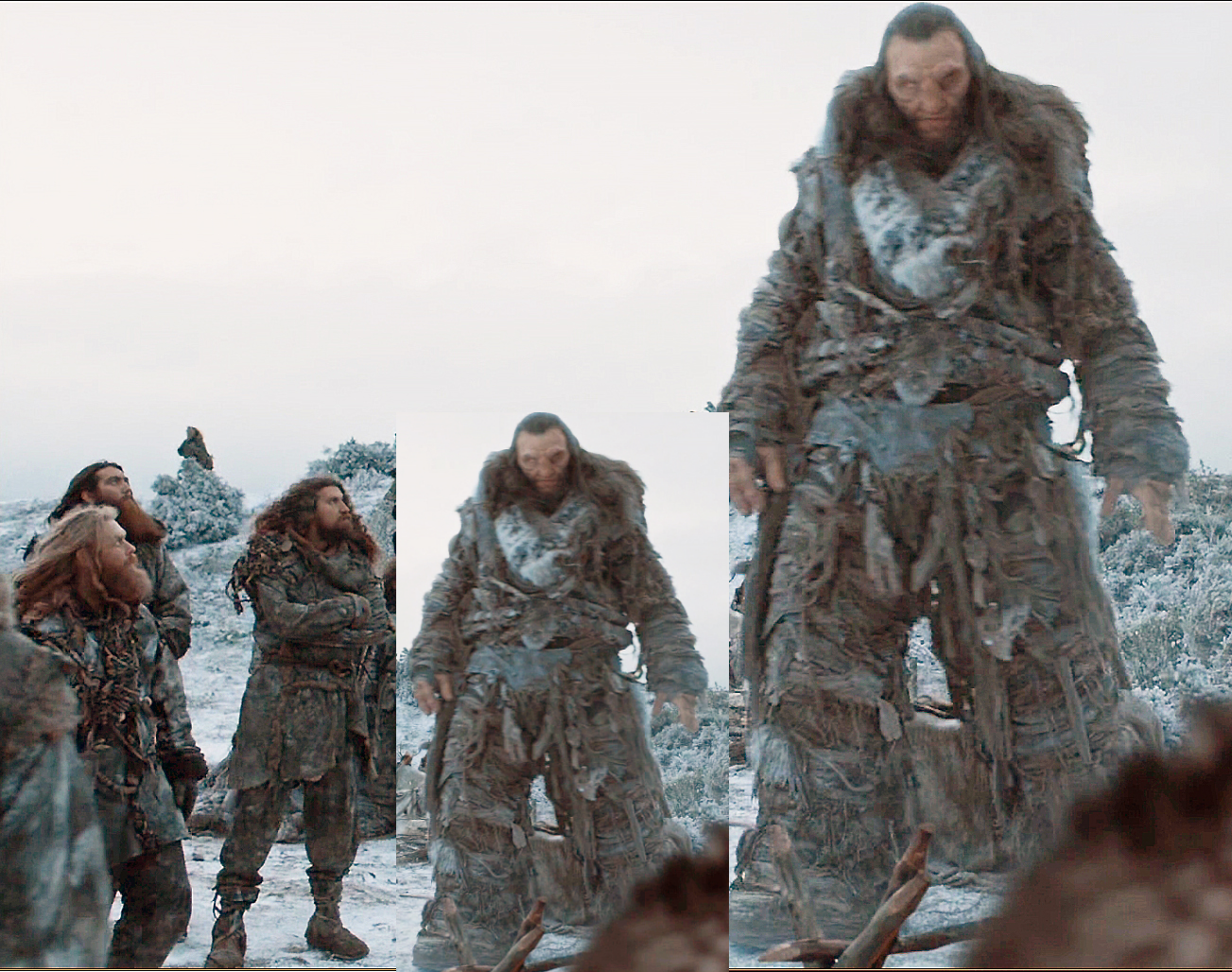
So every time I see a giant I think: 'That looks convincing; I wonder whether they asked some biologist how to make a giant'. And then of course my attention is diverted away from that by someone being murdered unexpectedly in a gruesome manner; it's GoT, after all. In this series people die all the time, and with some recent story developments they might even do so more than once. Recently (series 6, episode 7) a giant stood still in one shot, together with some puny humans. His name is apparently 'Wun Weg Wun Dar Wun', in case you wonder, or 'Wun Wun' for short. I thought I should get that frame to have a closer look, after the killing would be over (temporarily, that is).

Click to enlarge
So here is the shot in question. The giant appears twice as tall as the man on the left, who I suppose is normal height. I estimated that man's height to be 1.8 meters, so the giant would be 3.6 m. tall. Some internet searching revealed that the actor playing Wun Wun is over 2.1 m tall. What the producers  did was to use low camera angles to simulate his size. Here is a video of that, but be warned: Wun Wun is visible for only a few seconds.

Click to enlarge
I copied the giant, and reduced his size to what should be about 2.1 meter, compared to the 1.8 m man. I stuck him in again to get a feeling of what the actor may have looked like without special effects. Here is the result of that, including doing away with the blue overcast. It does not look as if he is walking on stilts, so the cylindrical shape of his legs is probably there to suggest just that: big legs. He looks very broad; should he? What should the proportions of a 3.6 m tall giant be like?

To find out, please read the first and second post in this blog on why body size matters. In short this is what happens if you double the length, width and height of an object or animal: its mass and hence weight will not become twice the original amount, but eight times as much. But the strength of a bone is given by its cross section, and if you only double the radius of a bone, its cross section becomes four times as large. But the bone needs to be able to support eight times the weight. This means its radius has to increase disproportionally: if the weight increases eight-fold, then the cross section needs to increase by a factor eight too. The radius needs to increase by the square root of eight, which is 2.83 times. In case you are dazzled, it boils down to this: increasing bone length by a factor of 2 means that bone radius has to increase by a factor 2.8.

Mind you, in real life that is probably not enough ('real life'?; what am I thinking here?). Muscle strength also depends on its cross section, and to keep the same relative strength means muscle cross section has to increase by a factor 2.8 as well, meaning more muscle mass. All these extra increases in bone and muscle will add mass, so the bones have to be even thicker and... You see where this is going. At some point there is no mass left for lungs, guts or brain (judging from Wun Wun's speech patterns, some savings were indeed made in the latter department). Say we use a factor 3.0 to accommodate for all that.

Click to enlarge
Here is a nice schematic human anatomy image found on the internet. I cut it up in sections and increased the width of the sections appropriately. Well, mostly: I reasoned that the increase should certainly apply to the thickness of weight-bearing bones, such as legs and the vertebral column. I did the same for the arms as well, or the result would look silly. But in principle pelvic and thoracic width do not need an additional increase beyond the factor two we started with. I did increase them some more, if only to give thigh muscles some room.

Click to enlarge
Here is the result of this simple attempt. Do not forget that he is twice the size of the man we started with. The resulting giant certainly looks large as well as stocky, and so he should. Note that I increased the feet a bit more, to allow all the thicker foot bones to lie next to one another, as they must. But I did not alter foot anatomy any more. Before we discuss that further, let's approximate the giant a bit more by using the body outline and adding a suggestion of clothing.

Click to enlarge

 
Here it is. This is what a morphologically reasonably sound giant, twice the height of a normal man, might look like.

Click to enlarge
And to get a feeling for size, here is the giant next to a normal-looking human on the left, half the size. The giant is not that different from Wun Wun, confirming my intuitive guess that the designers got it right. The hands look quite good. The actor must have been covered in very thick layers of padding to get the stocky look. It is not often I get to write that the television or film industry got their biomechanics right. Regular readers will know that there was little reason to be happy before; see the posts on Avatar and John Carter of Mars.

Click to enlarge

The one remaining matter is whether the giant should have his feet examined: can he stand on human-type feet or must he have elephantine feet, as shown above? If a 1.8 meter m. tall man has a mass of 80 kg, then simply doubling the height, depth and width wil ensure that the mass becomes 8 times as much (80 x 2 x 2 x 2), so 640 kg. But remember that we chose to increase the depth and width by a factor 3, not 2, so the mass becomes 80 x 2 x 3 x3, or a colossal 1440 kg. Wow. Being bipedal, one leg will have to be able to withstand all that weight. Mind you, we already have taken that into account as far as bone strength is concerned. Still, it is a lot. But Wikipedia tells me that draft horses weigh up to 1000 kg and giraffes weigh up to 1930kg, and these animals do not have elephantine feet at all. While running just one of their legs may be on the ground at a point in time, with a lot of dynamic forces acting on the bone as well. So I do not think a 1440 kg humanoid needs elephantine feet, but that does not mean he cannot have them. All this brings up the topic of whether very large bipedal animals should have elephantine feet with embedded toes, or whether they should have free toes, sticking out. I am in favour of the latter, but that is something for another post, on toes.    

Unless the GoT designers tell us what Wun Wun's feet look like, we will never know.  Unless... unless of course we get to see a naked giant. GoT is not afraid of nudity and there have been calls for nudity to be more equally divided among male and female cast members. Perhaps that equality should include not just sexes but species, too. So let's have a naked giant; purely for scientific reasons, obviously. Actually, just the feet would be enough, thank you so much.   

Note (March 2018): I had made a mistake by stating the weight of the corrected giant as 640 kg, but that was without taking into account the additional increases in cross sectional area, as pointed out by a commenter. 

Note (September 2018): you may wish to have a look at a later post asking whether it is unethical to let giants ride on mammoths...