Showing posts with label scalates. Show all posts

Monday, 22 June 2026

The 'spietskip', or 'impaler poultry' (Tabulae mortuae VIII, Archives XVIII)

 The ‘spietskip’ is mentioned in the Furaha book; the book contains a short section about the prehistory of the Furaha project, showing old paintings. The word ‘spietskip’ is a made-up Dutch word (the Dutch language allows everyone to make new words by stringing together existing ones). ’Spiets’ means to skewer or impale, and ‘kip’ means ‘chicken’: a ‘spietskip’ is therefore literally a ‘skewer chicken’, although ‘impaler poultry’ sounds more dramatic. 


Click to enlarge; copyright Gert van Dijk

The painting shown above is really old. Over time the animal, with it bird-like plumage and overly reptilian head, fitted less and less within the evolving hexapod scheme. One solution in such cases was extermination, and the other was a redesign. The idea behind the spietskip appealed to me: a small carnivore, hunting from a hiding place among reeds, and catching prey with front legs that are fishing spears. I also thought at the time that The Book needed more scalates. There is ample room for adaptive radiation within every scalate group. Carnivores definitely needed more radiation, to show their range from mouse-sized squigglers to slow massive carrion eaters specialising on dead rusps.

So I had wondered whether redesigning the spietskip might work. An animal clinging to reeds need to have legs with a large movement range, and feet that can grab a reed from about any angle. That should not pose to much of a problem for the general scalate design.


Click to enlarge; copyright Gert van Dijk

Here is a simple Zbrush sculpt showing a spietskip following the scalate redesign, including the distal and proximal neck with the neurocranium in between. I now think it is too bulky. It is often difficult to get a good idea of the mass of small mammals and birds, because their fur and feathers make them look much bulkier than they really are. If you see a wet cat, you can see how little mass it really has. Let’s just pretend that the Zbrush sculpt already includes its covering. As you can see, the limbs are very simple; that is because such sculpts were only made to help with perspective and composition, and details can simply be drawn later.

Click to enlarge; copyright Gert van Dijk
 

After importing the body into Vue, I played with limb positions, here simple cylinders, and the overall viewing angle, which was similar to that of the original painting. 

Click to enlarge; copyright Gert van Dijk
 

I could easily have take this image as a rough background and could have started drawing over it, before finally sitting down to paint.

Click to enlarge; copyright Gert van Dijk

However, sometimes drawing without any such 3D aids resulted in livelier images, perhaps at the cost of some perspective mistakes. That’s why I also did a very quick sketch right over the adapted old oil painting. This sketch could also have been the starting place for a new drawing and painting. 

But around that time I realised that I could keep on designing new radiations forever, and that there already enough material for a book already. And that is why the evolution of the spietskip stopped. 

Perhaps I will pick it up again, some day. But first, I am preparing for DinoCon, where I will be selling The Book, images and some other stuff. There are also posts to write on the ever-intriguing theme of how many legs animals should have in speculative biology projects, and on colour changing

And for people in the USA, don’t forget that The Book will finally be sold directly in the USA through Simon and Schuster, starting on 28 July, 2026.    


Sunday, 10 September 2023

What's a head? Or a neck...

Yes, it's a silly title. Isn't a head, rather obviously, that part of an animal where vision and hearing are gathered, along with their associated neural processing units, as well as air and food intakes, along with whichever specialised organs that takes? For air intake, you could read 'nose', and for 'food intake' there is the whole complex assembly of jaws, teeth, a tongue as well as an oesophagus. 

That seems right for humans and other terrestrial vertebrates, but a few moments' thought reveals that 'obviously' does not belong in this 'definition'. Fish have heads but take in water, not air, so the 'air intake' should become an 'inlet for gas exchange'. The hearing organs of many arthropods are not in their heads, and so the associated bits of brain need not be in the head either. The description supposes that the rest of the animal is distinct from the head. But in octopuses there is no distinction between head and body, with the limbs ('arms' that are not accompanied by 'legs') attached directly to the head/body unit. For spiders a similar point can be made that the head is merged with part of the body. 

I could go on, but the point is that a 'head' is not as clear an entity as you might think. A 'head' is the result of 'cephalisation', described by Wikipedia as 'an evolutionary trend in which... the mouth, sense organs, and nerve ganglia become concentrated at the front end of an animal, producing a head region.' I like 'head region': it provides the looseness we apparently need to describe what a head is. 

Furahan 'Scalates' certainly underwent cephalisation, and their heads definitely contain eyes (four of them) and ears, in terrestrial forms (also four) along with enough brain to do the heavy duty processing these organs require. But the 'intake for gas exchange' is not in the head at all. The intake for food is there, with jaws (originally six, later four) at the front of the animal, so clearly these are in the head. Well, that depends... 

Click to enlarge; copyright Gert van Dijk

A clade of Furahan Fishes ('Fishes V') developed a 'neck' in the form of a two-bone articulated connection between the body and the 'head region', allowing the latter considerable freedom of movement relative to the body. The thing is that a similar 'neck' also evolved between the 'head part' housing eyes and ears, and the mouth region. Are there then two heads, or is the entire region one head? 

The two necks, usually called the proximal (closest to the body) and distal (farthest from the body) neck, each consist of two long bones with a joint in between. The two 'heads' are the 'sensocranium' and the 'orocranium'. The image above shows a fragment of a painting showing a species of Fishes V with just that arrangement. You cannot see the joints in the necks clearly in these streamlined Fishes, but they are there. Those long neck bones form a big difference from the kind of vertebral columns we are used to, with their string of many small bones. Early Scalates never had a central string of small bones for evolution to play with; instead, they had a 'ladder'. The resulting neck movements look rather like those of a vertebrate arm or leg, with sharp angles, not at all like the curves of a lizard tail or a giraffe or sauropod neck. But that ungainly look need not be a functional handicap; despite the sticklike nature of human arms, baseball and darts players manage to land small objects with incredible precision quite a distance away. Of course, the trick is having a good brain in control.

We now only need to discuss bending of other organs in those necks, such as the oesophagus. An oesophagus relies on peristalsis making it flexible and elastic, so the structure itself should be able to withstand folding for a while. The nerves and arteries in our shoulders and elbows have to withstand bending too and usually do so fine. (Admittedly, if you spend too long in one position local pressure may pinch blood vessels, so people occasionally find that an arm or a leg, or just one nerve, has 'gone to sleep'.) If the oesophagus would be folded, it would probably be incapable of propelling food. If so, the distal neck has to be straightened between bites to allow the animal to swallow which is not a problem and looks interesting. Perhaps a different problem is that the length of the oesophagus may have to vary with neck position. If the oesophagus lies in front of or below the neck bones, as it does in humans, bending the neck backwards and upwards requires the oesophagus to lengthen. It has to be elastic anyway, so some degree of lengthening should not be a problem. 

Click to enlarge; copyright Katrina van Grauw

There is another solution though. In birds, the trachea (windpipe) and oesophagus do not commonly lie in front of the neck vertebrae, but to one side. This is not the exception but the rule, in fact, as shown by this paper. Most often the trachea and oesophagus lie toon the right side, but that can differ between individuals, with recorded examples on the trachea on one side and the oesophagus on the other. If birds bending their generally long necks, the oesophagus does not have to follow the bones. The oesophagus literally cuts corners. 

Click to enlarge; source here

The two images above show this odd anatomy very clearly, with a heron as an example. One is from the excellent work 'The unfeathered bird' by Katrina van Grauw, and the other is from the paper mentioned above. The oesophagus runs almost in a straight line when the neck is curved, which also means that the oesophagus is then much shorter than when the neck is fully extended. It has to be very elastic. The explanation for this arrangement is that the trachea and oesophagus can move so freely because they are not restrained by muscles as is the case in mammals. Some birds can swallow enormous prey (herons again) which also requires that the oesophagus has freedom of movement. 

Click to enlarge; copyright Gert van Dijk

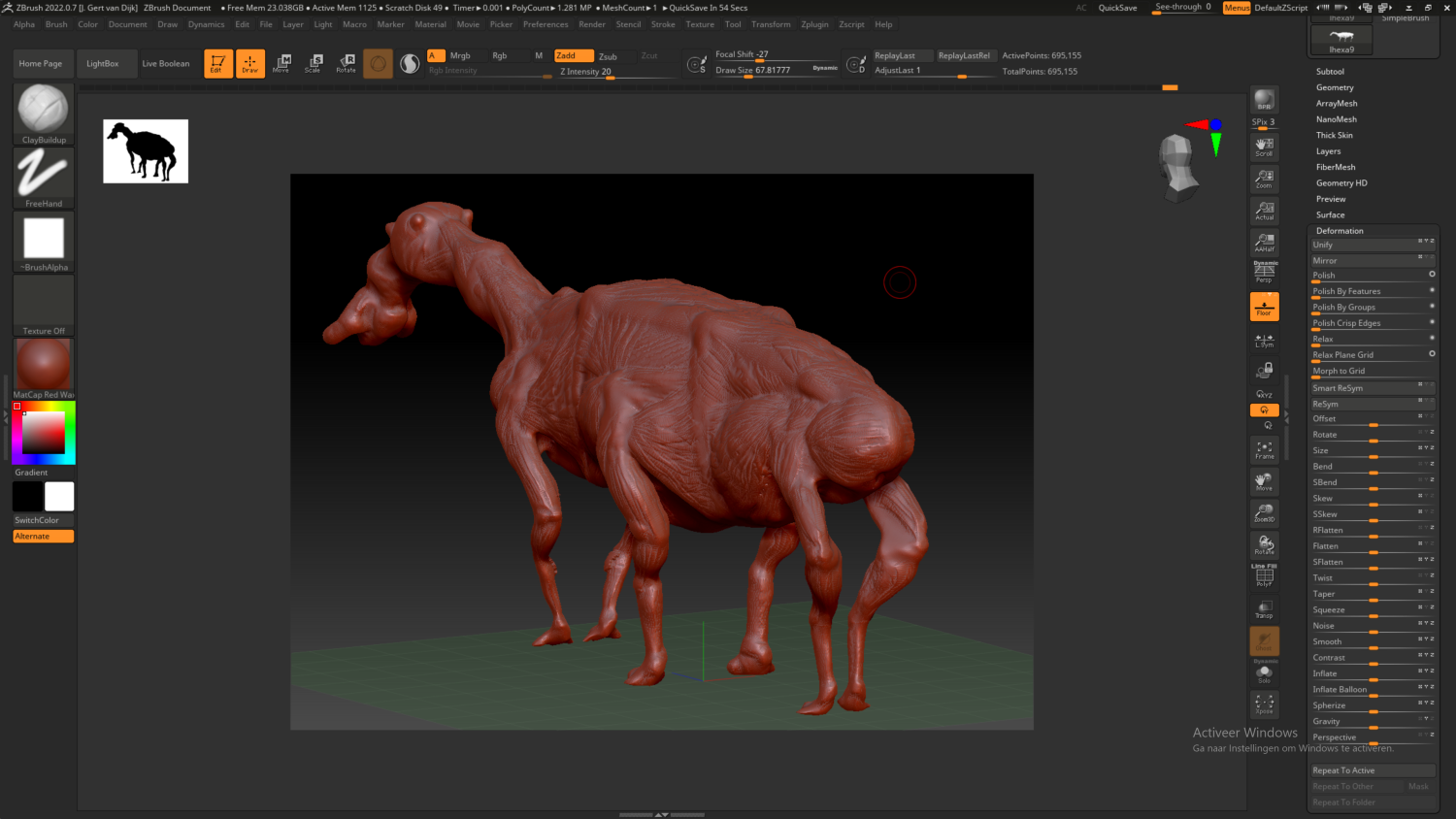
I am revising an older image of a herd of large hexapods thundering into view. To get a better idea of their heads, I sculpted one in Zbrush. 

Click to enlarge; copyright Gert van Dijk

 
Click to enlarge; copyright Gert van Dijk
 

As you can see, I played with a lateral position of the oesophagus. The oesophagus forms a distinct bulge on the left side of the distal neck, cutting corners in bird fashion. The sensocranium sports shields and horns to impress others of its own species. When the animals start bashing one another's heads and necks, the necks should be protected too, so the middle joint of the proximal neck also bears some shields. So here is the somewhat baroque Latifrons augustus ('elevated broad-brow').

Saturday, 25 February 2023

A hexapod muscle study

Some time ago I wrote about the Great Hexapod Revolution, which I might also have called the Quite Considerable Hexapod Revision. At any rate, that particular revolution or revision has conceptually been completed for quite some time, so I am busy revising old paintings as well as coming up with new ones. The latter are not really necessary as The Book is basically done.

Yes, The Book is done.

Basically.

The 'done' part means that there are easily enough double pages to fill a book, so rather than producing more I am shifting emphasis towards finding a publisher. I do not expect immediate success, which explains 'basically': I might meanwhile just as well keep on thinking about Furahan creatures.

Let's review the hexapod revision. Their skeleton still reflects that of early representatives of the clade. There is no vertebral column, here defined as many short similar bones placed end to end running from front to back in the vertical plane dividing left and right halves of the animal (technically, the sagittal plane). The most bare bones version of that skeleton (sorry for that one) would remind you of a foldable ladder. As the clade started with animals without legs, it would be strange to use the name Hexapods ('six-leggers') for all of them. I chose the new name 'Scalata' instead, based on the Latin word 'scala': ladder. The word 'Scalata' is technically correct while 'scalates' is suitable for colloquial use. Hexapods then become a subgroup, consisting of scalates with legs. 

Click to enlarge; copyright Gert van Dijk


The next big step was deciding the shape of the legs. I built on the zigzag principle, in which successive major leg segments bend one way at the topmost joint, the other way at the second joint, and so on. By reversing direction, no joint is ever really far away from a line perpendicular from the hip down. Being close to that line reduces the force needed to keep the joints in those positions, meaning muscle power. have a look at these posts here and here. The image above was taken from these earlier posts and explains that principle.

The least force to keep the segments in place is needed when all segments are stacked vertically, making the leg into a column. That is a fine way to conserve energy but does not produce athletic animals. Vertical leg bones are typically found in large non-athletic animals: think of elephants and sauropods. In smaller animals all segments can be closer to the horizontal than the vertical position, because fighting gravity costs relatively much less (for scaling effects, see here and here). The actual position of the leg bones will depend on mass and athleticism.
             
I suggested in earlier posts (here and here) that it wouldn’t really make a difference whether the legs started by being angled forwards ('zig') or backwards ('zag') at the hip joint. Mammals are peculiar in having their front legs start with a zag and hind legs with a zig. This is a consequence of how they re-engineered their original sprawling posture: front legs rotated backwards, with elbows pointing back, and hind legs forwards, with knees pointing forwards.

Should that reversal be seen as a natural 'law' or as an evolutionary coincidence that became locked in place? I could not think of any physical reason for this pattern and so had freedom to decide what to do with scalate legs. All three pairs of legs underwent the same rotation, which is simple and keeps them out of each other's way. The top segments all point backwards.   


Click to enlarge; copyright Gert van Dijk


Another decision was how to join the legs to the scala. Should the hip joint allow movements in all directions, or should they restrict movement in one or more directions? Should the joint be so 'open' that all positions need to be controlled by expensive muscle activity, or do we let bones and ligaments take up some of the stresses? I decided to give the joint surface a 'roof' in the hip to push against, transferring weight. The image above shows three possible patterns: in A, the bone sits directly underneath the spherical joint, allowing three-axial rotations and simple weight-bearing. In B, the joint does the same, but the shaft of the bone is shifted a bit to the side, allowing room for gut, eggs, or whatever. In C, the joint restricts rotations around the axis running down the bone and the bone extends a bit past the joint. That sturdy upwards spur can be used to attach muscles to; that's the hexapod hip joint.  

The main propulsion force involves swinging the upper leg segments thighs backwards: retroflexion. The thigh has a limited range of motion, from an angled pointing just a bit forwards to a much larger backwards angle. To work over that range, hexapods have one large muscle starting behind the joint and attaching to the hip bone below the joint, exactly like human buttock muscles. But another big muscle originates in front of the hip and inserts on the spur above the joint. These two muscles act in concert to pull the leg back: they are 'agonists'.

That range of motion has consequences for where muscles can produce the most force. The force exerted by muscle fibres is most effective if these fibres make a right angle with a line from the insertion site to the axis. If that angle is not 90 degrees, only the component of the force that is at a right angle is useful to rotate the bone; the remainder just presses the bone into the joint or pulls it out of it. When the bone rotates, the effective force component changes with the rotation angle. You would want to place a muscle in such a way that most muscle fibres do useful work over most of the movement range. 


This animation shows a muscle placed to the front (at left) of the bone, inserting at the spur above the axis of rotation. The bone rotates through its working range, which is shown three times. The four  panels show fibres at different sites of origin. The red lines show the parts of the force that do the actual rotation. It is obvious that fibres starting high above the spur are not much use and can even pull in the wrong direction. The most useful fibres start at the level of the joint or lower, so this is where the muscle should be. I have not shown the other muscle, the one pulling on the thigh below the axis while starting behind the joint (at right). The principle is the same, but now the most useful part lies at the top.      

As I like Latin anatomical nomenclature for its simplicity, I named these muscles ('simple' is here based on the premise that the names are in another language you have to learn anyway). For the front legs, the front muscle is the musculus retractor artus primi anterior, and the hind one is the m. retractor artus primi posterior. For the middle and hind legs, replace primi with secundi or tertii.
 
There are of course muscles that work in the other direction, the 'antagonists', but these are weaker and run the other way, lying underneath the big 'retroflexion' muscles.

Click to enlarge; copyright Gert van Dijk

The two images above shows the result of some experimental ZBrush sculpting. Here you see a general hexapod with some main muscles shown. I still find ZBrush extremely non-intuitive, but am very slowly feeling my way around it.

This animal is probably the size of a horse. Note that the middle legs are sturdier than the others. That is because that is where most of the mass is! The middle legs are also wider apart, to allow room for a possibly sizeable gut and also for the front and hind legs. Of course,  the scheme underwent substantial changes in particular with those predators that freed their front limbs from locomotion ('centaurism') and turned them into weapons. maybe I’ll show those anatomical changes too, one day.