Showing posts with label legs. Show all posts

Monday, 13 July 2026

How many legs should animals in speculative biology projects have?

By Sigmund Nastrarruzzo and Biblaridion

We recently published the first of two posts in response to comments on Biblaridion’s YouTube review of Sigmund/Gert’s book ‘Wildlife on the planet Furaha’. The number of legs of Furahan creatures evoked many comments, in particular Furahan scalates. Scalates are animals with some similarities to Earth vertebrates, such as a comparable size range and bilateral symmetry. But the six legs of Scalates urged some people to argue that larger animals should always have at most four legs. The previous post dealt with limits posed by a Bauplan: the genetic building plan that defines an animal’s main anatomical features. In this post, we start with discussing Bauplan effects some more and then try to work out what effects the number of legs may have on animals. 

Bauplan limitations 

The odd thing about a Bauplan is that its contents are largely locked and cannot be modified through evolution, and yet that same Bauplan can only have come into being because its contents were at one point highly malleable! If the number of legs is locked in a Bauplan, that number stays fixed. The four limbs of Earth vertebrates are locked, so vertebrates will not have offspring in which the basic pattern jumps to two, six, or eight legs. There are three major lessons here. 

  1. The fact that ‘four legs’ is part of the vertebrate Bauplan does not mean that this number works significantly better or worse than another number; all we can conclude from the long history of vertebrates is that four legs work well enough. 
  2. The number of legs does not have to be locked in a Bauplan in each and every animal clade! The number is in fact variable in Earth millipedes, and speculative biology creators can use that fact to decide whether the number of legs in their creations is fixed or malleable (it is variable in Furahan rusps). 
  3. The basic instruction ‘make four limbs’ still allows anatomical modification of those four limbs. Evolution can find other purposes than walking for front legs, a principle baptised ‘centaurism’ in this blog; examples are the front legs of mantises, wings in birds, the hands of primates and theropods, and mouth parts in just about any arthropod. The result is that the animal gains new functionality at the cost of a pair of walking legs. Such centauric evolutionary changes probably starts with animals using their front legs both for walking and for a new purpose, and over time the new function takes over completely, so the walking role is lost. Some commenters on Biblaridion’s video felt that many-legged animals would lose legs until they arrived at four legs, without a new function. But in an evolutionary process each step has to bring an advantage. To make their scenario work, animals would have to start using only four of their six legs even though all six were fully functional; we see no clear advantage in that, and evolution is not driven by future goals, but by advantages here and now. 

Building costs 

If a leg is only a weight-bearing cylinder, then each leg can be more slender the more legs there are. But what is the total mass of many slender legs, compared to that of a few stout ones? The calculations on that question (here and here) showed less total weight with fewer legs, with the least mass for just one leg! But you only have to think about how fatiguing it is to hop on one leg to realise that building costs cannot be the only consideration. In evolution, many factors usually play a role, and the best solution then is a compromise between conflicting demands. For example, factors such as stability and surviving harm may outweigh saving weight. 

Surviving harm

If a one-legged or two-legged animal breaks a leg, it will be unable to eat or drink, and will quickly become someone’s dinner. Four-legged animals are probably also doomed (dogs and cats can adapt in amazing ways, probably because humans help them through the critical phase). A six-legged animal can probably limp away after the loss of one leg, and the consequences of injury become less severe with a larger number of legs. Do millipedes even walk slower after losing a leg? In short, multiple legs allow better chances of surviving injury than four or fewer legs. 

Speed 

Animals that walk fast use four principles to speed up. The first three are simple: steps become longer, step frequency increases, and the fraction of time a leg is in the air increases, while time on the ground decreases. The fourth factor is gait, meaning phase differences between legs. During a slow walk, the body has to be supported at all times, which is best done by having all legs move at different times, so no two legs move in synchrony. For slow walks, this works best with four or more legs. However, fast running works best if the gait contains jumps, meaning periods in which all legs are off the ground at the same time. To achieve that, leg movements have to be synchronised to a degree, which can -in principle- be done regardless of the number of legs. For instance, take a Furahan rusp with 24 legs. When such animals run, all right-sided legs move in unison, and so do the left-sided legs, but exactly 50% out of phase. 

Bipedal running cockroach; click to enlarge. From Full and Tu 1991
 

However, that is not how many-legged animals run on Earth. Cockroaches, crabs and lizards may use just two legs when running fast. Why do they not use all their legs and run like rusps? Well, rusps have their feet close to the midline, which makes it easier to support the body with legs on one side only; cockroaches, crabs and lizards have splayed legs, which makes one-sided support difficult. Another part of the answer appears to be that the preferred legs for bipedal running in cockroaches and lizards are longer than other legs, so the other legs are less useful for speed. Note that, even though crabs may need only two legs for maximum speed, this hasn’t resulted in crabs with only two legs! The other legs are useful at other speeds. For instance, crabs need good stability when walking slowly, helped by having more legs, and their life may depend on their ability to cling to a rock using all legs in heavy surf. 

For large animals, it is less likely that one pair of legs provides enough power for maximum speed, so they need more legs to achieve that. Perhaps another factor weighs in too, such as the animal not achieving stability with only two legs while running. 

Stability and size 

We will use ‘stability’ essentially as the likelihood of not falling, while standing or walking. Animal size is extremely important here, because the effects of gravity are relatively much more important for large than for small animals. In contrast, sideways forces such as wind and water currents are more important for small animals.  

Gravity always presses large animals firmly to the ground, so their feet do not have to cling to the ground or grasp it. Stability primarily means keeping the centre of gravity over the area defined by where the feet touch the ground (a support diagram), and secondarily being able to keep the body orientation the same. 

Small animals, say insect size, do need to cling to or grasp whichever surface they reach, regardless of whether that is vertical (as in the illustrations below), horizontal or even upside-down. For them, stability is keeping the body position and orientation stable regardless of where the footholds are. 

What happens to stability and position for large and small animals when the number or legs increases?

Click to enlarge; copyright Gert van Dijk

  • One leg allows a large animal to stand and to hop, with gravity ensuring it always returns to the ground. One-legged standing and hopping amounts to a continuous balancing act, which in turn needs very sophisticated nervous and muscular systems. Animals that are just learning to walk on dry land will not yet have evolved such sophisticated systems, so it is doubtful that one-legged animals could even begin to evolve the skill of walking. For a one-legged small animal, hanging from its one leg, life is simple: if it relinquishes its grip, it falls away from its support surface; not a good idea. 
Click to enlarge; copyright Gert van Dijk
  • Two legs means fewer directions to fall in, which helps. Birds, some other dinosaurs and people all walk well with two legs. It is not easy though: faster walking requires dynamic stability, meaning the centre of gravity needs to kept over a continuously changing support diagram. To do that, you will again need exquisite control, so we advise bipedal animals that aim to become terrestrial walkers, but cannot do so yet, to not bother. Very small two-legged animals could theoretically hang from one leg while moving the other, but it would be very difficult to prevent the body from just hanging down from one leg: not a good idea. 


Click to enlarge; copyright Gert van Dijk

  • Three legs, for larger animals, allow a neat support triangle; that is all you need to stand still, and you do not need complex control for that either. But walking with three legs will require excellent control. Very small animals can hang from two legs, but it will still be difficult to control body position. 


Click to enlarge; copyright Gert van Dijk

  • Four legs, in larger animals, do not make standing easier than with three legs, except when there are strong sideways forces such as water currents or strong winds. If there are, it helps to have a leg sticking out in the direction of that force. Walking with four legs offers a fundamental advantage over walking with three legs: you can lift one leg and still remain stably supported by the other three. This is still not exactly easy: tortoises, moving slowly, have stability problems, as they tend to fall in the direction of the lifted leg. It takes a specific order of moving the legs to prevent that, so here’s that neural control again. Small animals with four legs can maintain their body position using three legs, while one limb moves to a new foothold. 


Click to enlarge; copyright Gert van Dijk

Click to enlarge; copyright Gert van Dijk
  • Five and more legs will not improve stability much, for large standing or walking animals. This probably holds for small animals too: with many legs, they can choose which ones grab a surface and which ones move to the next foothold, all while nicely keeping the body in position. However, many legs may help to grasp objects better: the eight legs of crabs may act as fingers, making a crab a sort of hand to grab rocks with; insects walking uphill may keep more feet on the ground than they do on a horizontal surface; the many legs of millipedes may help them bulldoze through dead leaves or soil. 

Stability becomes easier with more legs, at least up to a point; we guess that stability will not increase much beyond, say, six or eight legs. We suspect that ‘beginner walkers’, animals that are just learning the art of moving on dry land, will find the task easier if they have more legs, say six or more. If you are just learning to walk and have only four legs, don’t expect to be able to lift the body at all times at first! Start by crawling on your belly, and only try to lift the body when your control system can guarantee stability. However, if you start with six or more legs, you’ll learn to walk in no time! 

Planetary effects 

Many of these effects will depend on local gravity. On a planet with low gravity all legs can be spindly, and falling won’t hurt as easily. With a very strong gravity, legs have to be very strong and as many legs should be on the ground for as long as possible, which is easier the more legs there are. With a high gravity a lifestyle clinging to branches and twigs is asking for trouble, unless there are always lots of legs keeping a secure grip. 

Conclusion 

The number of legs plays a role in stability, building costs, surviving harm, locomotor efficacy and probably factors we didn’t consider. The number is restrained by evolutionary aspects and may be locked genetically. Whenever there are many factors determining an outcome in biology, it is usually impossible to identify one factor as the sole determinant of success or failure. We think that this holds for the number of legs too. The optimum number of legs is like most biological optima: a summation of many functions with lots of compromises. 

However, this can only be true if the number of legs can in fact vary freely, in which case evolution can modify the number as the outcome of such a summation. But if the number is locked, which seems more likely, then evolution has to work with what it was given. The number may then constrain evolution: for instance, an animal with just two legs would find it difficult to combine flying with walking. 

With all these factors weighing in, we do not think it likely that all large animals in the universe must have four legs (or six, for that matter). There are too many variables at play, so we expect the usual evolutionary mixture of Bauplan constraints and many factors weighing in. That seems to be how biology works, and for that reason speculative biology should work that way too. Are we certain of that? No, we aren't; it’s all speculation, remember? 


Short reading list


  • Büschges, Ache. Motor control on the move: from insights in insects to general mechanisms. Physiol Rev 2025; 105: 975–1031
  • Full RJ, Tu MS. Mechanics of a rapid running insect: two-, four-and six-legged locomotion. Journal of Experimental Biology. 1991; 156: 215-231
  • R McNeill Alexander. Optima for animals, Revised edition. Princeton 1996 
  • R McNeill Alexander. Principles of animal locomotion, Princeton, 2003
  • Riiska CA, Harrison JS, Thompson RD, Nina JQ, Gallice GR, Rieser JM, Bhamla S. Katydids shift to higher-stability gaits when climbing inclined substrates. Integrative and Comparative Biology. 2025 Dec;65(6):1667-77. 
  • Weihmann T. The smooth transition from many-legged to bipedal locomotion—Gradual leg force reduction and its impact on total ground reaction forces, body dynamics and gait transitions. Frontiers in Bioengineering and Biotechnology. 2022; 9: 769684  

Friday, 6 March 2026

‘Cambriform Ignitions’; does every planet with life have its own Cambrian Explosion?


 By Sigmund Nastrarruzzo and Biblaridion

This post was inspired by Biblaridion’s recent YouTube review of my Furaha book. Biblaridion focused on the numbers of limbs of various Furahan clades. This inspired many comments, touching on so many aspects of legs that Biblaridion and I felt that the subject deserved attention on this blog. The present post deals with the Cambrian Explosion and how body plans may affect leg counts. The second one will deal with functional aspects of the number of legs.


Opabinia, a Cambrian oddity; copyright Quade Paul;  source here

 A ‘Cambrian explosion’ usually does not refer to something blowing up in Wales. It could, because ‘Cambrian’ means ‘Welsh’, but we mean the radiation, diversification and quick evolution of life in the Cambrian period, around 500 million years ago. Before this explosion, in the Ediacaran period, the ocean floor was covered in bacterial mats. There were also odd tubular or flat quilt-like organisms; they were slow, soft, and had eyes nor teeth. Compare that to the radically different world at the end of the Cambrian: almost all modern phyla had evolved and animals had hard parts to help them crawl, burrow and swim. They used eyes, teeth and armour to find lunch or avoid becoming dinner.
Although all this took place half a billion years ago, it is relevant for speculative biology: should we expect events similar to the Cambrian explosion on other planets too? Are the consequences in terms of phyla and building plans similar too?

Self-reinforcing evolution
Let’s start with an Ediacaran sea floor, covered in microbial mats with some slow, soft and mostly sessile organisms here and there. If you enter a new trait that allows animals to form hard materials, they can, for the first time ever, tunnel beneath the mats. The early Cambrian saw a huge proliferation of burrowing animals (sometimes called the ‘Cambrian substrate revolution’). All this burrowing helped to mix and churn the seabed, releasing the nutrients that had until then been sequestered in the sediment under the microbial mats. And these extra nutrients allowed for the evolution of larger and more complex burrowers, which further increased the circulation of nutrients, and so on.
    Those hard tissues provided anchor points for muscles, allowing skeletons and crawling toothed animals. Once the owners of those teeth developed a taste for other grazers, the race to grow defensive armour began. All this activity became more efficient when the animals’ light-sensitive pits developed into proper eyes. In turn, those eyes needed a nervous system to process signals. Teeth, speed, vision and brains all helped one another develop in a mutual reinforcement.
    Environmental changes such as a rise in oxygen levels would accelerate such a self-reinforcing evolution, so both environmental and evolutionary factors may have been involved in a positive feedback loop.  
    If some of these elements were absent on another planet, the process might be much slower, resembling a slow fire rather than Earth’s explosion. In fact, it’s now believed that the Ediacaran fauna that preceded the Cambrian itself first appeared following the Avalon explosion, which occurred about 30 million years before the Cambrian. The path to complex active multicellular organisms may see several spurts of increased complexity rather than a single sudden jump.
However, whether over a short or long term, a self-reinforcing tendency towards more activity seems inevitable, provided there is energy to spend. We therefore think that an evolutionary spurt in early life is likely elsewhere. Mind you, as other planets through no fault of their own cannot be expected to have a Wales on them, we hereby introduce the general term ‘Cambriform Ignition’ to describe this early phase of evolution.

Click to enlarge. The scheme show that most phyla originated early. Source: Zhang et al 2013.


From fast and fluid evolution to a fixed Bauplan
We haven’t mentioned a very important aspect of the Cambrian explosion yet, one that sets it apart from other periods of large evolutionary change. This is the emergence of many phyla, each with its own Bauplan (a German word literally meaning ‘building plan’). A body plan describes anatomical aspects including symmetry, segmentation, and, yes, it can include the number of limbs.
    A phylum’s body plan is genetically determined and is produced in every animal of that phylum by a precise genetic control over the formation of an embryo (notably the famous Hox-genes). The products of these genes diffuse through the embryo and tissues respond to their concentrations, for example by forming a limb bud.
   At present, body plans are basically immutable, which means that you should not expect a simple mutation to result in a fundamentally different body plan with, for instance, a different number of limbs. And yet those immutable body plans all came about in a short time, so at the time those body plans must have been remarkably fluid, the opposite of their current fixed nature. Some plans disappeared again, such as the one producing Opabinia, with a midline eye and an odd proboscis. That genetic fluidity later froze the body plan in all those phyla that were already genetically quite distinct. This parallel trend to fixate body plans in separate lineages only makes sense if fixating a body plan makes good evolutionary sense, in each and every surviving phylum.
   What was the advantage of fixating the body plan? Well, remember that a body plan reflects instructions on how to grow an embryo. If that process is not tightly controlled, many embryos will be malformed and die because the changes are detrimental. Making embryogenesis more reliable would definitely be worth passing on. So-called ‘complex regulatory gene networks’ evolved that make embryogenesis more reliable. Once this protective embryogenesis system was in place, there was no turning back and the body plan stayed what it was.

Click to enlarge; levels of protection of bady characters; Source He & Deen 2010 

There are different levels of gene fixation. The core level of protection is a ‘kernel’, and it defines genetic traits that correspond to characteristics that define a phylum. Slightly less well protected genetic units are more open to genetic and evolutionary change, defining traits that correspond to orders and families. At the bottom rung of this classification are very mutable traits, conforming to genus and species levels.
Animal breeders can easily select for the most mutable traits, such as a shorter nose or a longer body. But other traits, such as having four limbs in a tetrapod, are fixed, and no dog breeder will succeed in getting a functional six-legged dog.    

Cambriform Ignitions elsewhere
As said, we think that evolution is likely to produce Cambriform Ignitions on other planets. But must that process always include a fixation of body plans? Probably: if such a fixation is beneficial, then body plan fixation is very likely to happen elsewhere too. But we can still speculate about this scheme and play with it. Here are a few thoughts:

  • If the fluid phase of forming body plans lasts a short time before the plans are fixated, the result might be a planet with just a few different body plans. If those plans all include respiratory or circulatory systems that are not suited for large size, that planet may never develop large animals.
  • In reverse, a long fluid phase might result in hundreds of different body plans, many more that the thirty-odd we have on Earth. Those worlds would be astonishing!
  • Even if an alien biology involved a radically different mode of inheritance, such as horizontal gene transfer or a coding molecule that allows for a greater degree of genetic flexibility, there would still be a benefit in ‘locking’ certain features that couldn’t afford to be altered. Generally, evolution favours genetic diversity (hence the evolution of sexual reproduction), but species that can ensure that no inherently maladaptive traits come about will still have a sizeable advantage. This boils down to a degree of shape consistency, meaning that shapeshifters and their ilk do not seem very likely.              
  • And finally, if the leg number happens to be stored in the most protected kernels of the genome, the number of legs will be fixed. If, however, that number is stored less securely, the number may be open to mutation! Such a ‘leg number fluidity’ would only work if the resulting legs are fully functional, including the neural machinery to provide sensory and motor integration of the additional legs. (Such integration doesn’t have to take place in the brain. Remember that the primate brain is a very centralised control freak, and control of a leg can also be delegated to a local brain -octopuses!- or to a spinal cord analogue -cats!-.)

    
Mind you, the number of legs can vary considerably between Furahan rusp species and can even vary within rusp species (that’s in The Book!). If you are not convinced, please consider Earth’s millipedes or velvet worms. In millipedes, the number of legs can vary throughout life and between individuals. In some millipedes the number varies in steps of 11 segments, which again has to do with genes and embryogenesis. Velvet worms can have anywhere from 13 to 43 pairs of legs depending on the species, and females tend to have more legs than males. This strongly suggests that the leg count in these animals is not immutably locked in the best-protected part of their body plan but is stored in a less protected part. They are fluid in this respect.


Reading material

The Cambrian Explosion: The Construction of Animal Biodiversity. Erwin DH, Valentine JW. Roberts and company Publishers 2013.

Zhang X L, Shu D G. Current understanding on the Cambrian Explosion: questions and answers. PalZ (2021) 95:641–660 https://doi.org/10.1007/s12542-021-00568-5

He J, Deem MW. Hierarchical evolution of body plans. Developmental Biology 337 (2010) 157–161

Willmore KE. The Body Plan Concept and Its Centrality in Evo-Devo . Evo Edu Outreach (2012) 5:219–230 DOI 10.1007/s12052-012-0424-z

Enghoff H. The Size of a Millipede. Berichte der naturhistorisch-medizinischen Verein Innsbruck 1992; suppl 10, 47-56

Minelli A, Edgecombe GD. Zoology: The view from 1,000 feet. Current Biology 2022; 32, R213–R236 doi.org/10.1016/j.cub.2022.01.072


Saturday, 25 February 2023

A hexapod muscle study

Some time ago I wrote about the Great Hexapod Revolution, which I might also have called the Quite Considerable Hexapod Revision. At any rate, that particular revolution or revision has conceptually been completed for quite some time, so I am busy revising old paintings as well as coming up with new ones. The latter are not really necessary as The Book is basically done.

Yes, The Book is done.

Basically.

The 'done' part means that there are easily enough double pages to fill a book, so rather than producing more I am shifting emphasis towards finding a publisher. I do not expect immediate success, which explains 'basically': I might meanwhile just as well keep on thinking about Furahan creatures.

Let's review the hexapod revision. Their skeleton still reflects that of early representatives of the clade. There is no vertebral column, here defined as many short similar bones placed end to end running from front to back in the vertical plane dividing left and right halves of the animal (technically, the sagittal plane). The most bare bones version of that skeleton (sorry for that one) would remind you of a foldable ladder. As the clade started with animals without legs, it would be strange to use the name Hexapods ('six-leggers') for all of them. I chose the new name 'Scalata' instead, based on the Latin word 'scala': ladder. The word 'Scalata' is technically correct while 'scalates' is suitable for colloquial use. Hexapods then become a subgroup, consisting of scalates with legs. 

Click to enlarge; copyright Gert van Dijk


The next big step was deciding the shape of the legs. I built on the zigzag principle, in which successive major leg segments bend one way at the topmost joint, the other way at the second joint, and so on. By reversing direction, no joint is ever really far away from a line perpendicular from the hip down. Being close to that line reduces the force needed to keep the joints in those positions, meaning muscle power. have a look at these posts here and here. The image above was taken from these earlier posts and explains that principle.

The least force to keep the segments in place is needed when all segments are stacked vertically, making the leg into a column. That is a fine way to conserve energy but does not produce athletic animals. Vertical leg bones are typically found in large non-athletic animals: think of elephants and sauropods. In smaller animals all segments can be closer to the horizontal than the vertical position, because fighting gravity costs relatively much less (for scaling effects, see here and here). The actual position of the leg bones will depend on mass and athleticism.
             
I suggested in earlier posts (here and here) that it wouldn’t really make a difference whether the legs started by being angled forwards ('zig') or backwards ('zag') at the hip joint. Mammals are peculiar in having their front legs start with a zag and hind legs with a zig. This is a consequence of how they re-engineered their original sprawling posture: front legs rotated backwards, with elbows pointing back, and hind legs forwards, with knees pointing forwards.

Should that reversal be seen as a natural 'law' or as an evolutionary coincidence that became locked in place? I could not think of any physical reason for this pattern and so had freedom to decide what to do with scalate legs. All three pairs of legs underwent the same rotation, which is simple and keeps them out of each other's way. The top segments all point backwards.   


Click to enlarge; copyright Gert van Dijk


Another decision was how to join the legs to the scala. Should the hip joint allow movements in all directions, or should they restrict movement in one or more directions? Should the joint be so 'open' that all positions need to be controlled by expensive muscle activity, or do we let bones and ligaments take up some of the stresses? I decided to give the joint surface a 'roof' in the hip to push against, transferring weight. The image above shows three possible patterns: in A, the bone sits directly underneath the spherical joint, allowing three-axial rotations and simple weight-bearing. In B, the joint does the same, but the shaft of the bone is shifted a bit to the side, allowing room for gut, eggs, or whatever. In C, the joint restricts rotations around the axis running down the bone and the bone extends a bit past the joint. That sturdy upwards spur can be used to attach muscles to; that's the hexapod hip joint.  

The main propulsion force involves swinging the upper leg segments thighs backwards: retroflexion. The thigh has a limited range of motion, from an angled pointing just a bit forwards to a much larger backwards angle. To work over that range, hexapods have one large muscle starting behind the joint and attaching to the hip bone below the joint, exactly like human buttock muscles. But another big muscle originates in front of the hip and inserts on the spur above the joint. These two muscles act in concert to pull the leg back: they are 'agonists'.

That range of motion has consequences for where muscles can produce the most force. The force exerted by muscle fibres is most effective if these fibres make a right angle with a line from the insertion site to the axis. If that angle is not 90 degrees, only the component of the force that is at a right angle is useful to rotate the bone; the remainder just presses the bone into the joint or pulls it out of it. When the bone rotates, the effective force component changes with the rotation angle. You would want to place a muscle in such a way that most muscle fibres do useful work over most of the movement range. 


This animation shows a muscle placed to the front (at left) of the bone, inserting at the spur above the axis of rotation. The bone rotates through its working range, which is shown three times. The four  panels show fibres at different sites of origin. The red lines show the parts of the force that do the actual rotation. It is obvious that fibres starting high above the spur are not much use and can even pull in the wrong direction. The most useful fibres start at the level of the joint or lower, so this is where the muscle should be. I have not shown the other muscle, the one pulling on the thigh below the axis while starting behind the joint (at right). The principle is the same, but now the most useful part lies at the top.      

As I like Latin anatomical nomenclature for its simplicity, I named these muscles ('simple' is here based on the premise that the names are in another language you have to learn anyway). For the front legs, the front muscle is the musculus retractor artus primi anterior, and the hind one is the m. retractor artus primi posterior. For the middle and hind legs, replace primi with secundi or tertii.
 
There are of course muscles that work in the other direction, the 'antagonists', but these are weaker and run the other way, lying underneath the big 'retroflexion' muscles.

Click to enlarge; copyright Gert van Dijk

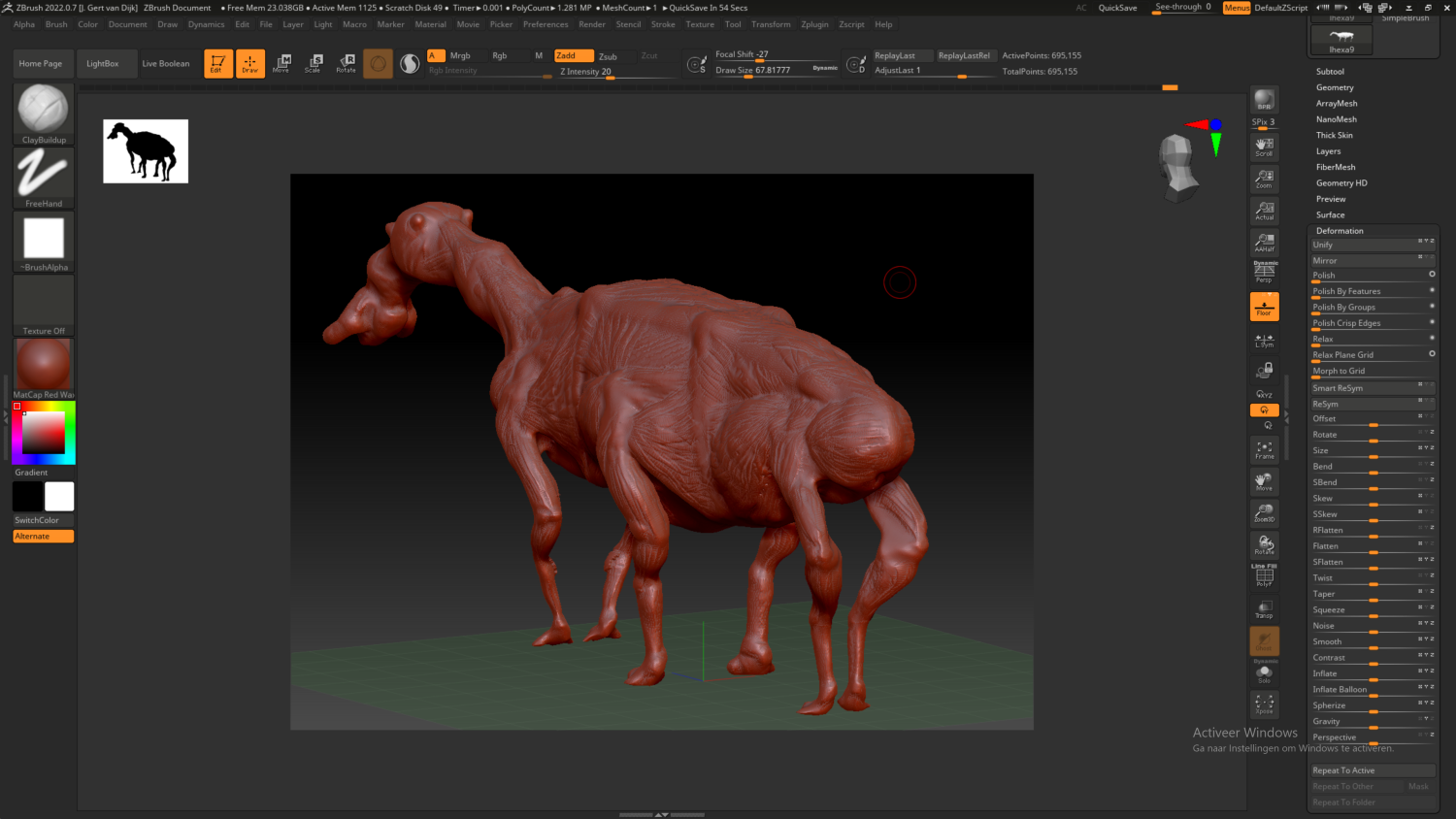
The two images above shows the result of some experimental ZBrush sculpting. Here you see a general hexapod with some main muscles shown. I still find ZBrush extremely non-intuitive, but am very slowly feeling my way around it.

This animal is probably the size of a horse. Note that the middle legs are sturdier than the others. That is because that is where most of the mass is! The middle legs are also wider apart, to allow room for a possibly sizeable gut and also for the front and hind legs. Of course,  the scheme underwent substantial changes in particular with those predators that freed their front limbs from locomotion ('centaurism') and turned them into weapons. maybe I’ll show those anatomical changes too, one day.