Showing posts with label rusps. Show all posts

Wednesday, 20 January 2021

Explaining tetrapter flight (Tetrapters/tetropters X)

Just a short post this time. 

The Book will not only contain paintings of animals, plants, mixotrophs and people, but will also contain explanatory diagrams. These are usually much more boring to produce than texts or paintings, but they still have to be done... I had postponed writing and illustrating the flight of tetrapters for quite some time, and have now decided to get to work and not to look up until it is done. 

The challenge here was how I could capture the complexity of tetrapter flight in static diagrams, although I already had videos dynamically showing how tetrapters move their wings. The two diagrams above form part of a set of eight. Together they depict one complete movement cycle. I decided that I would show the path of the tip of the wing in the diagram, and that a portion of the path would be shown with a bold line, to indicate the movement since the preceding diagram. I hope that works.

Click to enlarge; copyright Gert van Dijk

 
Click to enlarge; copyright Gert van Dijk

The two diagrams show the point in time where the wings are moving apart after the 'clap' phase, when they touch or nearly touch. When they then 'fling' away, they create the 'clap and fling' mechanism that provides part of the lift. For more on that, you may read some older posts indicated by their year of publication: 2009a, 2009b, 2011 and 2018


Click to enlarge; copyright Gert van Dijk

 By the way, I have started to update the main Furaha website. I will gradually add some new material, but do not want to give away too much of the content of The Book. Still, some newer paintings will creep in here and there. I changed the image on the welcome screen, and do not think I ever published that particular rusp image before. So there you are.

Saturday, 28 July 2018

Postcard from Furaha

It took longer to get back to blogging than I thought, for several reasons. As usual I had less free time than planned and a shoulder problem made painting and other computer work unpleasant. Last but certainly not least, we had such a long hot spell here in the Netherlands where I live that heat records were shattered one after the other. A few nights ago we officially had the warmest night in the Netherlands since official records started in 1854: 23.6 degrees. The temperature in my computer room reached 29 degrees... If I can't sleep, I can't write, paint, or even think properly. If the climate continues in this direction, we should stop calling ours a 'temperate' climate. Global warming anyone?


Anyway, I have worked on a painting, but extremely slowly. As I save the files often, I thought I could produce a quick post in the form of a 'making of' video. I will let the video do its own talking.
 
Click to enlarge; copyright Gert van Dijk
The video is small, so here is the last frame at a larger size. The painting is not finished! The potator ('Amnesialata blansjarii') still needs much work. I think I will morph it into a microrusp. Rusps do not actually have necks, but I thought it would be useful for a tree climbing animal to be able to move its head around freely. The rusp's snout will of course solve that problem to a large extent, but another way might be to recruit the first several body segements: they could become slender and lose their locomotor function, with perhaps some tiny dangling remnant limbs. I'll see. The bioluminescent stayways may reappear in the from of tetrapters. It is fun tying the various Furahan clades together, while keeping room for new developments.     
 
The sooner the weather normalises, the sooner I will be back with more posts. 

Saturday, 17 February 2018

Rusps turn out to follow biological rules about the weaponisation of tails

I recently came across an interesting paper on the evolution of the use of tails as weapons in Earth animals. This turns out to be a fairly rare occurrence, and perhaps that rarity helps explains why animals with tail weapons are so spectacular. After all, we take the common for granted, and it is the departure from the common that attracts attention.

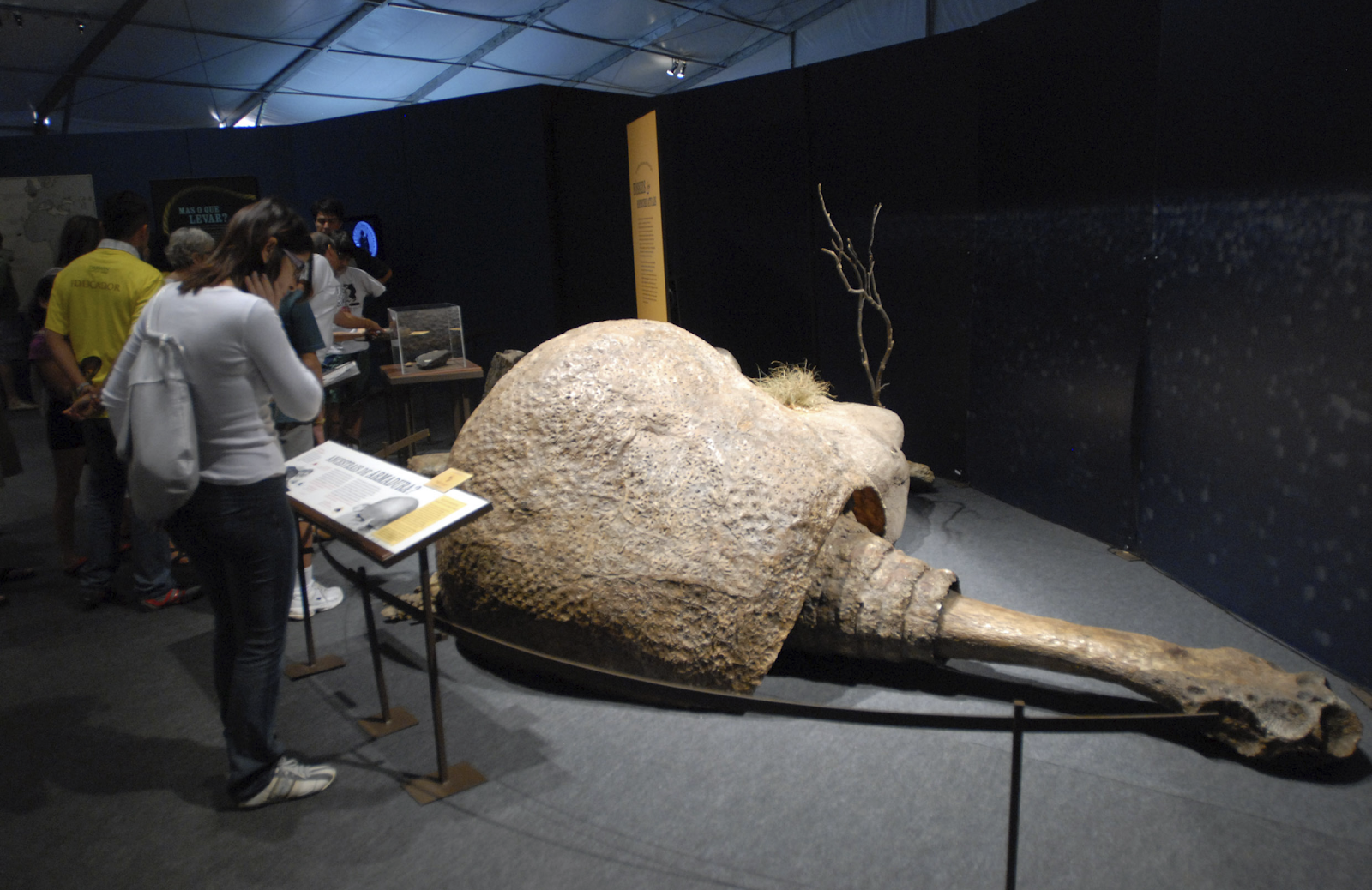
The glyptodont Doedicurus; click to enlarge. https://en.wikipedia.org/wiki/Doedicurus

A nice example on an animal with a tail that is obviously useful as a weapon is the glyptodon genus Doedicurus, a giant armadillo-like mammal, the size of a small car. Doedicurus was encased in strong armour and endowed with a tail with an impressive thickened club at the end.

Click to enlarge; Pinacosaurus Grangeri; Copyright Gregory S. Paul. Princeton field Guide to Dinosaurs, second edition
Ankylosaurs had the same idea, but much earlier. As far as their design was concerned, they went overboard in adding an array of large sharp spikes to their armour.

Click to enlarge; Spinophorosaurus nigerensis; Copyright Gregory S. Paul. Princeton field Guide to Dinosaurs, second edition
Some sauropods may also have had body armour as well as similar thick knobs on the end of their tails. Only one sauropod (Spinophorosaurus nigerensis) apparently sported pointy spikes on its tail, shown here as a juvenile, and drawn by Gregory Paul (I do not think I have to urge dinosaur enthusiasts to get his book 'The Princeton field guide to dinosaurs'). If these long tails were swept at high speed, the transfer of all that kinetic energy should do some real damage. But perhaps a simple threat, along the lines of 'Make my day, punk' would be enough to prevent an actual fight.

The paper in question has the title "The evolution of tail weaponization in amniotes" and is written by Victoria Arbour and Lindsay Zanno. The paper describes which features are the evolutionary precursors of the evolution of tail weapons. The authors performed a thorough statistical analysis of many body traits, and looked separately at four aspects of tail weaponry:  tail lashing, bony terminal tail spikes, a stiff distal tail, and an expanded tail tip.

Click to enlarge. Arbour & Zanno 2018

Here is a figure of the paper, showing these four aspects and the features they are associated with. The result of all this is that you are not likely to find tail weaponry in agile quick-footed predators. If you were designing just such an animal for your speculative biology project, you should probably pause to consider its likelihood. Tail weapons seem to be a last resort for large slow herbivores who already invested in body armour. The authors make the point that equipping heads with weapons occurred much more often. This seems odd because heads are already filled with important structures that should not be damaged, whereas damage to a tail is probably much less risky, so you would expect 'anterior armatification' to be less common that 'posterior armatification'(I could not resist latinising 'weaponisation'). The authors do not speculate why this should be so, but I wonder whether the effective use of weapons requires excellent motor control, something that in turn depends on excellent sensory control, meaning sight. If so, the animal's body may simply be in the way, so it cannot see well enough where to place the sting in its tail.
   At any rate, the authors state that armour in mammals evolved in those animals that are neither small enough to hide nor large enough to deter predators by size alone, and that live in open environments. Close combat with a predator must be a risky business, so the best strategy may simply be running away faster than a predator. And if flight is your main strategy, heavy armour is not going to help. But  a wholly new set of constraints must come into play if you have no chance to outrun your predator to start with. Defensive features such as large size and armour then may become useful, and it seems that active weaponry is the last feature on the list to evolve.

Click to enlarge; copyright Gert van Dijk

So glyptodons, ankylosaurs, stegosaurs  and some sauropods all fit the 'big slow armoured' description to various degrees. And so do Furahan rusps! The image above shows half a rusp from an unfinished painting (for more on rusps, use the blog's search function). From my very first rusp sketch on, rusps were large, had thick hides and used their whips as active weapons. Of course rusps have front as well as hind whips, so the word 'tail' is not applicable at all, but the point is clear; rusp whips are analogous to the 'weaponised' tails of Earth. Those early rusp sketches predated the paper as well the posts in this blog about rusps by many years. I do not remember exactly how much of the rusp body plan came about consciously. I think that I started with a long body shape. Add to that some wondering why many Earth animals are so vulnerable at their rear and sometimes along their middle as well. As the earliest sketches show eyes on middle rusps segments as well, rusps must have started with a weak encephalisation tendency. From there on the double encephalisation seems natural. Note that the posterior whip is well controlled by its own ring brain, with excellent visual information available to direct the strikes. But part of all this may have come about through largely unconscious associations while sketching. Once a design is on paper, it is often hard to say where it came from. Regardless, it is nice that the meme 'rusps have whips' can now be attributed to a firmly established biological principle.

Much as I like the paper, there is a minor matter that might have made it even nicer. Rather than 'tail weaponisation', the authors could easily have used a word that is both relevant and fun: a tail weapon is a 'thagomiser'.

Click to enlarge; copyright

The first use of 'thagomizer' is shown above (this blog uses British spelling, so I assumed the word would become 'thagomiser' in the UK; the rules aren't always clear...).
   It was published as one of Gary Larson's Far Side cartoons in May, 1982. Actually, this colour image stems from a later luxury edition of all Far Side cartoons. Poor Thag Simmons. For 'Far Side' fans, a caveman called 'Thag' occurs at least once more, and one cartoon, taking place in modern times, featured a 'Mr Thagerson'.
  At first glance the word thagomiser seems to indicate 'to turn an object, animal or person into thag', but the real meaning is obviously a 'structure to kill animals or persons, in particular Thag Simmons'. The word has later been picked up in the scientific community to describe the tail weapons of stegosaurs, and apparently of stegosaurs only. I propose to widen its use to all tail weapons.
   As an author of scientific papers myself I realise that the use of humour in scientific papers can be tricky as it is often frowned upon, and you never wish to harm your chances of getting a paper accepted. (I once inserted the phrase 'This resistance is futile' in one of my own scientific papers as an irreverent reference to Star Trek, but I do not think anyone ever noticed).

If we use 'thagomiser' as a word for 'tail weapon', the paper could have been called "The evolution of thagomizers in amniotes", which would be clear, succinct and elegant, but admittedly probably too flippant for a serious paper. Once 'thagomiser' is an accepted word, can we resist to stop there? The tendency to evolve a thagomiser then might become 'thagomiserificability', and the transition process from 'nonthagomiseriness' (not having a thagomiser) to 'orthothagomiserity' (having a proper thagomiser) is 'thagomogrification'. Obviously. 

Sunday, 24 December 2017

Run, rusp, run!

I keep coming back to rusps because their basic centipede shape allows me to play with gaits and movements more than I thought at the start. So far, I have only shown very large rusps, 'megarusps', having a mass equalling or surpassing that of sauropods. If you need to brush up on your crambology (yes, I invented a word to describe the knowledge of rusps), start with some earlier posts: one, two, three and four (there are more, but these will do). Of course, you can also learn about rusp gaits on the main Furaha page.  

Now, megarusps are immense, and you should not expect them to hop and jump around a place like a rabbit on speed. Instead, expect them to move ponderously and solemnly. Still, megarusps must have evolved from smaller ancestors, and that by itself suggests there could be lots of medium and small rusp species, and indeed there are. And then I wondered whether their multilegged nature might keep them from running fast?

Click to enlarge; copyright Gert van Dijk

Here is my earliest sketch of small rusps again. I have not done any full paintings of such minirusps yet, but I do envision a fruitful adaptive radiation, including arboreal and burrowing species.  I have finished two paintings showing metriorusps ('metrio-' indicates medium-sized), and to do so I had to think about their gaits and in which way these would differ from those of megarusps.

    
Digging rusp. Click to enlarge; copyright Gert van Dijk
Varkrusp. Click to enlarge; copyright Gert van Dijk
 Here are some sketches of metriorusps, that did not make it to 'evolved' status. I played with the idea of differential leg development, so I could have digging species. That design has not made it to a painting, but running and armoured rusps did make the 'evolved' status, though.     

Millipedes and centipedes on Earth can move pretty fast, but they do not really run. Can rusps run?  The answer lies in what exactly is meant by 'running'. On the one hand you can simply interpret the word as 'walking quickly', but there are more complex biological connotations too.
  Walking consists of cyclical strides, and each stride consists of two phases. In the stance phase, a leg is pushed down onto the ground and backwards, providing upwards and forwards force. In the swing phase, the leg is lifted and moves forwards so it will be ready for the next stance phase. During the lift phase the animal should not fall, and preventing that is usually accomplished by having other legs on the ground at that time. To walk more quickly there are few options: increase stride frequency and increase stride length. The latter can be done by having long legs and by swinging it over the largest distance possible, and to get that working, the time a leg is on the ground will have to be shortened.

copyright Gert van Dijk
 This is precisely what happens on Earth. Here is an old animations of mine showing a horse walking. When walking, each leg is on the ground for more than half the time, so there are likely to be multiple legs on the ground at any one time. The slower an animal moves, the more the situation resembles standing still, and for an animal standing still its centre of gravity must fall within the area described by the feet: that is static stability. The stars in the animations represent the corners of that area. The order in which the leg moves ensures that the area has the shape of a triangle under the body.
copyright Gert van Dijk

For a galloping horse, each leg only touches the ground for a short fraction of its movement cycle. The result is that the chances are low that many legs will touch the ground at any time. In fact, there may well be no legs on the ground at all at some times, so the animal is in fact making a series of jumps. At high speeds static stability gives way to dynamic stability, meaning the animal is kept from falling through inertia and a footfall at the correct time and place.

Running is regularly defined as walking with each leg touching the ground for less than half a walking cycle. On earth, all really fast animals use these principles. Having said that, it is time to go back to centipedes and rusps. Centipedes do not run: their stance phase typically lasts much longer than their swing phases. This increases the chance that there are many legs on the ground at any one time, and, seeing how many legs rusps have, this is almost a certainty. This adds up to there being no jump phases, which seems a bad idea if we want a fast rusp.


The answer, I thought, would lie in the gait. The animation above shows a rusp with a slow gait: each foot is on the ground more than half the time. In real life, the animation may have to be sped up for a more realistic effect, but at least the movements are well visible. To support the body well, no region of the long rusp body should be unsupported for a long time, and that is achieved by choosing specific phase differences between the legs. In this case, these seem to work reasonably well. Mind you, rusps have typical 'zigzagzig' legs (see here, here and here for what that means).


The next step, above, is to equip the rusp with a different movement cycle for its legs; the legs now swing further and touch the ground less than half the time. I kept the phase differences the same for comparison. Fortunately for this rusp, its legs do not kick one another with this setting, so the result is not at all bad. There are always legs on the ground though, and that may limit a further increase in speed.


So the gait is the next parameter to tweak. Here, the phase difference between successive legs is much less than before, so the legs on one side move almost in unison. Still, at the moment the last leg on one side leaves the ground, there is already a leg just touching the ground on the other side.            


That can easily be amended. Now the phase differences are almost gone, and there are two periods in the movement cycle when there is no foot on the ground at all. Again, you will have to imagine a proper film speed. This rusp is going so fast, its feet hardly touch the ground!  

So yes, I think there are ways to have rusps run. Actually, they might be able to change phase differences very subtly and continuously, giving them a 'continuously variable transmission', unlike Earth's large mammals, that typically have up to three gaits to choose from (walk, trot and gallop), each with a specific preferred speed.  But that will also depend on energy requirements, something I haven't studied in any detail. 

Click to enlarge; copyright Gert van Dijk

So here is the scale diagram of the runrusp, one of the metriorusps that has already been painted. To close with, it may be interesting to know that I leave hexpods for last, because I am not fully satisfied with the animation of their middle legs yet. But I must say that exploring all the nonhexapod lineages on Furaha is perhaps not a bad idea: it gives more attention to designs that are least Earth-like.  

Saturday, 7 March 2015

Blog halts after nearly seven years...

I thought I might as well convey my main message in the title, so there you are: The blog 'Furahan Biology and Allied Matters' will not see new posts with regular intervals.

There will be the occasional post now and then, but those will be limited to announcements of something interesting, such as me giving a talk somewhere, a conference with speculative biology in it (perhaps Toulouse later this year). I will definitely provide a review of my French friends' work as soon as I have the book in my possession, which will be four to six weeks from now. But there will no more posts on biomechanics and no discussion of exobiology in films or the work of other artists.

The reason is not that the well has dried up. There are many interesting artists who display their work on the internet, and I could write about the consequences of more effective photosynthesis, or why Furahan trees have a 'clastocyte' layer of cells that breaks down wood. Of course, my 'long thought experiment' on the purpose of toes would deserve a post, and a comparison of Boston Dynamic's Big Dog and the apparent new Chinese equivalent provide an interesting comparison on whether legs of alien animals should have zigzagzig or zagzigzag patterns. But no...

The reason is time. My job requires 50% of my waking time, so there are not many hours left. A simple blog post such as this one takes over two hours to produce and put up. However, the really complex ones, the ones that required me to read books, study papers and provide additional illustrations, could run up to more than eight hours. The blog competed with painting and writing, so progress on The Book was slow. The Book is about one third finished, and a two-page spread usually shows one main painting, and additional illustration, a size sketch and text. Of all these things, writing is by far the fastest element. A two-page spread probably takes 20 hours, and The Book is supposed to have up to 140 pages. It dawned on me that giving up blogging would allow me to increase my painting output considerably.

There is another element involved. Painting is –obviously- an acquired skill, and you have to keep doing it simply to avoid losing your skill, and to become better requires even more work. I have blogged in the past about crossing over to digital painting. Its main advantage is the enormous increase in speed of production that also translates to an increase in learning speed. But you still have to keep doing it. For years I found it difficult to start up again after a hiatus, and because of that I needed to be relaxed to do it well; hence the low output. I reasoned that, if I painted something every week, my skill level might not deteriorate so I could put in an hour here and an hour there. That seems to be working, and I now plan to produce at least one spread a month. When will The Book be out? An optimistic count would be three few years, an a pessimistic one never (in which case I will dump all the material on the internet) I guess. There is a chance that it may appear in French... Any news on that will certainly merit a post.

So there you are. I would like to finish by thanking all the readers who showed enthusiasm for my work over the years. Their comments often made me think again, or more, about any subject. And once in a while those comments produced a new Furahan animal. The Book will have six pages on rusps (already finished).  I will show one species to be shown on one such page, born from a discussion of high-feeding rusps. That particular discussion mostly featured Jan and Petr, but they are not the only ones providing inspiration. Thank you all! 

Click to enlarge; copyright Gert van Dijk
The grey outline shows the brontorusp for size. The new species, provisionally named 'Giraffacrambis sp.', is much narrower and less massive than the brontorusp. It still is a formidable animal, though. 

Saturday, 18 January 2014

Furahan biology and one of its allied matters: origami. Yes, origami!

My series of rusp posts have created something I never expected: an origami rusp. For more on rusps, simply start at the previous post in this blog. Regular commenter Petr (Petr Stuchlý) has sculpted four models of Furahan animals in what for me is a novel medium: origami. He posted photos of one of them, the brontorusp, on DeviantArt under the title of Xenorigami, which I rather like. Petr was kind enough to send me all four models in a neat package, which I appreciate very much.

Click to enlarge
Let me show you the models. Here are all four of them along with a prototypical matchbox  for size. Let me close in on all of them.

Click to enlarge
 First, of course, the origami model of the brontorusp (Brontocrambis brucus). I have never published a complete image of the brontorusp, so Petr could not know that the front and hind heads are not identical. If you take a look at the image of the origami brontorusp on his DeviantArt page, you will see that the front and hind heads are identical. Once we got to talking about that he has made some changes to the model, and now the hind head no longer has a rostrum (snout). Before you ask about two-headedness (the Janus effect), here is an explanation. The basic ancestral rusp design involves developed segments with eyes on each one. When the lineage increased in complexity, 'cephalisation' set in, so nerve clusters, eyes, whips etc., concentrated in one spot leaving the animal with a head... Actually, no!. That may be what happens usually, but in rusp evolution there was not just an increase in complexity, but cephalisation also involved a loss of some functions, such as visions in middle segments. That, probably coupled with a need for defence on both ends of the rusp, stopped the loss of vision there, so there are eyes there, with a fully functional whip capable of giving any predator a good wallop. There is also a circular secondary brain, the neurannulinus, communicating -we assume!- with the neurannulus in front. There is no hind mouth though, so no rostrum there, and rusps definitely have a front and a hind part.

Click to enlarge

Let's look at the details. I think that Petr caught the shape of the brontorusp's head very well. I have only a very vague idea of how you would go about to create such an intricate design from a square piece of paper of 50x50 cm. From his own comments ("hell on earth to fold!!! XD") it was not exactly the easiest thing to do.
 

Click to enlarge

The many folds at the rusp's bottom are interesting. Petr explained a particular featre as the result of his folding technique, but regardless of the cause the design parallels my rusp design in a surprising way.  Rusps, as large animals, have vertically-orientated legs that swing forwards and backwards under the body, and not sideways, so there is a risk of them kicking one another. That problem was sidestepped (sorry for that one) by having the legs alternately offset to the centre or the side of the animal. The origami rusp has the same feature!


What you see here is the 'crease pattern' of the rusp laid out on a piece of paper. The 'CP' has lines indicating valleys and ridges, and helps the designer shape a flat piece of paper into a remarkably solid and three-dimensional sculpture.


Click to enlarge; bottom : copyright Gert van Dijk

Petr has also made a hexapod neocarnicore, with its typical 'raptorial appendages'. The model captures the form well, which must be difficult as it is a very small model: he wanted to keep the models within a certain scale range. They are not fully in the same range, but I do not think I ever published enough data on exact rusp size for him or anyone else to judge the size accurately. Above is a new scale diagram for The Book, so you can see how large brontorusps are.

Click to enlarge
A marshwallow! It is complete with three horns, and even seems to have the continually irritated expression that humans project on the animal's cranial features...

Click to enlarge
 And finally, two sides of the marblebill, here suspended from a Japanese eating stick, to stay  in style. Origami paper can have one colour on one side and another on the other, and here that principle was obviously expanded by having a two-layered sheet of paper with metal foil on one side. Somehow Petr managed to have the dark paper end up on the dorsal side of the upper limbs and the metal side on the palmar side, doing justice to the pattern of the marblebill.

It is obvious that Petr is rather good at origami. If you wish to learn more about his art visit his Flickr pageDeviantArt page or a page at an English origami site. If you like palaeontology, and the chances of that are high with a blog like this one, you should visit his page on origami versions of extinct animals.They're very good.

Tuesday, 24 December 2013

Influence of the rostrum linkage system on forage volume in Brontorusps (Brontocrambis brucus)


A Christmas Special!
Ahead of the normal schedule, and with dinosaurs, rusps and biomechanics!

Click to enlarge; copyright Gert van Dijk
The title of this post sounds like that of a proper scientific paper, doesn't it? Something out of the 'Journal of Astrobiological Biomechanics', I guess. It's time to look at rusps again. My big rusp painting is finished, and as it is meant as a double-page spread, it is large: 7200 by 2700 pixels. A spoiler is shown above showing a fragment of a rusp in the background of the painting. The fragment has been halved in size and its area represents just 2% of that of the entire painting. The painting is based on earlier sketches. For more on rusps, either visit the main Furaha site or look at these posts: sketches, anatomy, predation, concept paintings, etc.  

The evolution of new Furahan animals gets more complicated with time. In the beginning I just sketched a pleasing shape and started painting right away. Now, I worry more whether the animal makes evolutionary, mechanical and ecological sense. Well, up to a point; this is science fiction and supposed to be fun, after all. 

Here are some of the steps in rusp 'ontology': they started with some quick sketches, and then the slow evolution began: successive legs were offset medially and laterally to avoid legs bumping into one another, followed by an arrangement for their skeleton. Their fore and aft whips are long and held horizontally rather like the tails and necks of sauropods, and hence have a similar system of internal trusses as compressive elements at the bottom and ligaments at the top to withstand tensile stress. The whip is held up passively by these forces, so avoiding the high cost of doing that with muscle force only. The last stage involved refining the head of the rusp, and in particular its snout, or 'rostrum'. In an earlier post this rusp species was called Mammoth Rusp / Megacrambis, but now it is the Brontorusp / Brontocrambis; yes, that means 'Thunder Caterpillar'!  The Mammoth Rusp still had some intricate limbs functioning as additional feeding aids under its snout. I was not too certain of that arrangement, and my doubts were confirmed by comments on that post. So the Brontorusp no longer has these additional mouth parts. The thing is, now we have a massive animal with a large head. How does it feed itself?

The mouth of the rusp is in its head, which seems obvious but in speculative biology not many things are obvious. Also note that rusps are large herbivores: they need a lot of food and spend much of their time eating. Moving about is costly, so it would be best if they moved the least possible amount to get their food, which does not sound as if there is much room to save energy. Let's tackle that by considering the problem of getting an animal's mouth on vegetation; there appear to be four solutions to do so; rusps use the fourth, but we'll come to that. The first solution, always necessary as vegetation will not come to you, involves walking to the food source.

Click to enlarge; copyright Klein et al; Biology of the sauropod dinosaurs. Indiana University Press 2011
But once an animal arrives at its 'foraging station' a nice way to save energy is to keep most of the body motionless and to have a long neck allowing the head and mouth to move about independently of the gut. For very large animals, needing to feed all day, it pays to divide their anatomy in mouth and guts; the rest is just 'other bits'. Sauropod dinosaurs used that method, and the image above is from a study on how far sauropod mouths could reach, depending on neck length and leg length. The idea is that the neck can move in a horizontal plane 90 degrees to the right and the left, and in a vertical plane straight up and down. If the animal is lying on the ground the volume of space that it can reach is one quarter of a sphere. If the base of the neck is higher up, when the animal is standing, the volume increases. The authors assume that the bottom part of the volume then is cylindrical whereas I would assume that to be spherical as well, but never mind.

Click to enlarge; copyright Gert van Dijk
Swans and geese have very flexible necks and can probably reach every point within that envelope, but if an animal has a neck less flexible than a swan's, only part of the volume is accessible to the mouth. If this is the first time you realised that geese and sauropods might have long necks for a similar reason, good!

The image above shows an adapted 'forage volume' for a sauropod: the outer red sphere is the outer limit of where it can reach, and the inner blue sphere represents the inner limit, assuming that the neck is too stiff for the animal to reach a point closer to its body. The human ('Marlene') is just there to keep the sauropod in its proper place. 

The third solution to get the mouth near food is to use an appendage to shovel food towards the mouth. The best example I can think of is the elephant's trunk, which greatly increases the elephant's reach. The erstwhile rusp mouth limbs were short and not at all good as harvester limbs, and I did not wish to elongate them tenfold; they are gone. I also did not wish to turn the whip into a grasping organ. Rusp whips are not built for that, although in a pickle they can probably be used to knock a branch off a tree. Instead, rusps use a fourth system which is really just a combination of the last two: they carry their mouths towards the food without moving the rest of the head. The 'mouth extender' is extensible and based on a mechanical linkage system. In itself this is certainly not a new idea: Earth fish have such systems in abundance.

Click to enlarge; copyright Gert van Dijk
This image shows a schematic view of the rusp rostrum. Start with the red shape in the foreground: it consists of two V-shapes starting from a vertical axis. All places where elements meet are in fact joints. The pink axis shows that the whole ensemble can rotate, but it can do other things as well: if the two Vs rotate towards one another, the whole shape will become longer and narrower. At its right end, the shape ends in two points on a horizontal line. Now copy the shape, rotate it by 90 degrees, and you get the blue shape in the foreground. The two points where the red shape ends act as connection points for the blue shape. Once connected, some movements from the red shape are connected to the blue one, but not all, and that makes the rusp rostrum quite versatile. In the back you see how the rostrum is formed by stringing red and blue shapes together. In reality the trusses are not formed by straight bones, but by curved ones, so the section of the rostrum is circular rather than rhombic. The cylinder on the right attempts to show the outlines of the bones on a cylinder.


Click to enlarge; copyright Gert van Dijk
And this image shows an as yet unmentioned aspect of movement: if the two starting points are brought closer together, this changes the section of the rostrum as well as its length. The right one is extended, the middle one shortened, and the right one is in neutral position. I expect rusp rostra (yes, that's the plural) to be able to double in length.

Click to enlarge; copyright Gert van Dijk
But we need more flexibility, and that is achieved by rotating the shapes and using the angle between the Vs for additional control. The stylised skeleton in the back shows what can be achieved. So there we are: an extensible and steerable system to get rusp mouths where they would otherwise not reach.


Click to enlarge; copyright Gert van Dijk
Here are two views of an adapted Sculptris model of a rusp head. I take it you will recognise the system of trusses under its hide.

Click to enlarge; copyright Gert van Dijk
And finally, a schematic rusp foraging volume, rather like that of the sauropod (the whip of this model is truncated). Note that the rusp can access a larger portion of the outer foraging volume than the sauropod. The volume itself is smaller though, as rusps are smaller than sauropods, and their rostra extend their reach, bot nearly as much as the sauropod's neck does. Marlene is standing in the forage volume, something I would definitely NOT recommend! In practice, rusps are ground feeders, not bothering about high branches. Have I told you about the ecology of the spotted plains where they live, where post of forests alternate with plains and how rusp feeding habits are to blame for that? No? Oh well, that is another story.  

Saturday, 8 June 2013

Spidrids and rusps: works in progress

The main Furaha site hasn't seen any significant change for quite some time now, which makes me feel a bit irresponsible. I have devoted the time I spend on this project wholly on the blog and on new paintings. As for the site,  I will get around to a complete 'redecoration' one of these days, and the blog is what you are reading right now, so there.

I am keeping the new paintings for the book but can show you bits of works in progress now and then, both of paintings and of blog material. In this post I will show progress on two themes, not that odd as I usually work on several themes at once (a major interest at present is working out which aspects of plants can be tweaked on other worlds, and what the results would look like; that is progressing nicely).

Copyright Gert van Dijk

I have discussed spidrids here several times, the last time here. That post showed them walking on uneven terrain in a variety of gaits. Those animations, done in Matlab showed how an animal with radial symmetry changed direction without turning. Although the animations showed that well, a proper 3D animation would be better. I am not aiming to achieve the quality of Avatar or Walking with Dinosaurs, but getting to a point in that general direction would be nice. The challenge then was to translate sets of coordinates of one system (matlab) into rotation and translation values for objects in a completely different format (Vue), and then controlling Vue to make an animation one frame at a time (Python). I won't bother you with the details. As you can see above, I am now at the stage where I can control the legs and have them end up on the right orientation and position. It really looks much better at a larger size, but blogger does not allow that. The low light was chosen so I could see whether the feet end up on the correct spots of the surface: their shadows just touch them, so that works! But when the innermost segment moves beyond the vertical, that segment flips around, so my rotation subroutine isn't quite right yet. I'll solve it. Meanwhile, it's starting to look real, isn't it? Now just imagine a body in between, texture on the ground, plants and shrubs with leaves swaying in the breeze, the sound of spidrid legs on the floor, and the occasional 'chikking' of the spidrid itself. I can see it already; perhaps imagination is better than animation...

Click to enlarge; copyright Gert van Dijk
Rusps! After my last encounter with them I thought some more about a possible painting. I decided it would look good as a double page spread, occupying the top of both pages. That results in a very wide format, just the thing for an animal that is itself long and horizontal. I decided to 'stagger' successive legs: segment x has the legs placed a bit to the inside, and segment x+1 has the placed to the outside, x+2 to the inside again, etc. In that way the stride might be long without the animal knocking its legs together. As there are so many legs, each one can be skinny. So I took the 3D model of a segment I did earlier, strung them together and starting playing in Vue with positions and curves. But I also needed a head, so I sculpted one roughly in Sculptris. I do not need a detailed sculpt as the sculpt is only a simple aid to produce the painting, not an end in itself. (Then again, if I did that, I could perhaps sell you models of spidrids and rusps). That is what you see above.

Click to enlarge; copyright Gert van Dijk
Here is another view of the rusp head. You cannot see the inner design of the snout, but the story is as follows.This particular rusp species, Megacrambis brucus, is very large and has an accordingly large head. It always pays to conserve energy, so moving that massive head or even the entire body to eat one bite is wasteful. It is better to stick a small head on a long neck (sauropods) or extend the reach in another way (arms, trunks, hooks). Inside the rusps' snout, technically a  'rostrum', there are rings connected to one anther at right angles to allow pointing the rostrum in all directions. Then there is one of those intriguing linkage systems that fish in our world excel at. Putting that in action extends the reach of the rostrum two- to threefold. Finally, at the end there are some grasping mouthparts. I put some more conventional mouth parts underneath; they are probably part of the overall rusp design.

Click to enlarge; copyright Gert van Dijk
Anyway, I put all he 3D parts together in Vue and played some more, seen at the top. Below you see  a quick over painting of the result. I was aiming for an overall diagonal effect in the composition, of which the shadow falling over the rusps's body is a part. I am not certain whether I will keep it though. I will keep the strong light against the dark clouds, as it helps to highlight the front whip. Megacrambis' English name will be 'Mammoth rusp', but I am not certain yet. Furaha was first discovered by Swahili speakers, so some of their names survived. I am also considering 'Mdudu Mzee' , roughly translated as 'respected elderly bug'. Any preferences?


Saturday, 16 June 2012

Moebius, Major Gruber, and Rusps (Rusps II /Archives V)

Click to enlarge; copyright Casterman 1995

Click to enlarge; copyright Casterman 1995

Click to enlarge; copyright Casterman 1995

Jean Giraud (also known as Moebius or Gir) died on March 10 this year. I first encountered his work in the seventies, probably in the magazine 'Métal Hurlant'. I do not think anyone disputes that he was a Grand Master of what the French call the Ninth Art ('Neuvième Art'): 'bandes dessinées', or 'comics'. You might that, regardless of his qualities, his work does not really belong here; while he did draw alien animals and plants, you could see that they were never meant to be realistic. The ones above prove that point, I think, while also underlining the facility with which he drew. To get another view of that, here is a YouTube take of him at work.

'
Click to enlarge; copyright holder unknown to me

The image above appeared on the cover of Métal Hurlant in 1976. Such images came as a welcome shock at the time. The way had perhaps been prepared by underground comics, but there still was else nothing like it; remember that science fiction films were not mainstream at all, and that computer-generated imagery was in fact science fiction. The cover impressed me so much that it stayed in memory to the present day. Major Gruber, the main character, just exudes character (stiff upper lip anyone?), as does his alien assistant. But look at that 'wall' behind him: it is part of the head of an animal slain by the 'great human hunter' Major Gruber. You cannot see the head well, partly because it is such a large animal, and partly because it is obscured by lettering, which does not hurt the design. This seems to be a magnificent example of telling a better story by not telling all of it.

So when does the major meet rusps? Well, he doesn't really, but just wait. Once rusps had evolved their imaginary existence, their place in the ecosystem required attention, so specialised armoured predators started ramming their way through the rusps' carapaces, keeping their heads tucked away below their bodies to avoid being blinded or decapitated by the rusp's whips. But after imagining this first onslaught, the question came up why rusps would stand still while attacked in this way? Could even a troupe of such predators bring a rusp to its many knees? Perhaps, but the losses to the predators would probably be unacceptable. An obvious solution would be to introduce a mega-predator, so large and strong that it could attack an adult rusp and expect to win. For reasons unclear to me I do not find that concept appealing; for now, adult rusps do not suffer from predation. But rusps die anyway, and a dead rusp constitutes a mountain of succulent meat.

Click to enlarge; copyright Gert van Dijk

Above is my first image of an animal working its way into a rusp carcass, at left. The right panel shows a specialised rusp predator, or perhaps a scavenger. It is not fast but very sturdy, and its two 'raptorial appendages' have developed into two different shapes. The left one is the prototypical blunt instrument, while the right is more useful as a scraper, to reach those parts where other scavengers cannot.

Click to enlarge; copyright Gert van Dijk

My sketchbooks show more versions of this particular scene, in between a variety of other topics. Here are three different versions from different periods. Do you see the influence of Moebius' scene in the back of my mind? The scavenger looks back towards the camera in the same way as the major looks into it. As for the dead rusp, I contemplated showing it as a wall of carapax over a tangle of collapsed legs, directly facing the camera; but would anyone understand what they were looking at? In Moebius' case, the wall was recognisable as a head. The three-quarter views represent moments where I thought I should provide more clues, while the straight-on views were more daring in this respect: the viewer would not know what kind of animal was dead here.

Click to enlarge; copyright Gert van Dijk

I later felt that perhaps the perspective of the predator was too complex. To see if I could improve on the sketches, I recently did a quick rough sculpt of such an animal in Sculptris (above).

Click to enlarge; copyright Gert van Dijk

I then imported the model into Vue Infinite (left), and exported the image into Painter 12 to paint over. Some very rough brush strokes indicate the structure and legs of the rusp. It is not too bad, but still definitely needs more work; perhaps the design works better on a square canvas. Once I feel that I can do the idea justice I will finally paint that scene, and I will be glad and than to have been inspired, as have many others, by Jean Giraud / Gir / Moebius.


Click to enlarge; from 'Faune de Mars'; copyright Moebius.
This is from a small book only available through Moebius' official site here.

Saturday, 26 May 2012

An aside about rusp insides (Archives IVb)

This post is an additional one: having decided that rusps must have an endoskeleton, I started wondering what its structure might be, and here are some sketchy results.

Click to enlarge; copyright Gert van Dijk

In principle rusps have segmented bodies, just like Earths arthropods and vertebrates. But just like those animals on Earth, that basic structure is no longer visible in all aspects of their biology. In the rusp case the skeleton still shows strong evidence of segmentation. Each of the twelve pairs of legs should carry its own portion of the animal's weight, and the skeleton should reflect that. What you see above is one segment of the middle part of the body; the heads and whips are not shown. The legs are greenish in colour, and the beige ring is the main skeleton of the body. Note the two arched bones, situated directly above the hip joints. They meet in the middle high up near the animal's back. The mass of the animal is slung underneath these arches. There is a secondary arch in the belly of the animal acting as a sort of load-bearing floor. In the back a bone extends forwards and backwards, joining the segmental rings together in the form of a 'dorsal column'. The ensemble looks suspiciously like a vertebral column with ribs, but appearances are deceiving! In vertebrates, ribs are suspended from the vertebral column and do not transfer the weight of the animal to the legs. Instead, these rusp arches function exactly like arches in architecture, and transfer weight to the legs.

Click to enlarge; copyright Gert van Dijk

Here you see are twelve locomotor segments together. The sort of orange coloured bones at the sides provide another link between adjacent segments on the level of the hips. There is a joint in the middle, normally held in position by strong tendons,. Their purpose is explained in the next image. The skeleton of the anterior and posterior heads is not shown, and neither are the whip skeletons. However, you can easily imagine the dorsal column giving rise to the fore and aft whips.

Click to enlarge; copyright Gert van Dijk

Here is the animal bent sideways. The orange hinge bones at the sides are pulled together on ne side and extended on the other. I suppose the animal can flex more than this, but not really that much.

Click to enlarge; copyright Gert van Dijk

And finally another possibility. Here, the main weight-bearing structure is also a curved beam, but this one sits much lower in the body. The beam again supports a central column, that now gives rise to a vertical 'mast' supporting the body. The sides are linked in the same way as previously. I am less certain how to support the whips with this design; perhaps the central column simply rises up through the skulls to form the whip skeleton. Alernatively, it could find its origin in the top of the masts.

I haven't decided which design will be the final say on rusp anatomy, and in a certain sense it is not necessary to settle on a specific design, as not all of it is necessary to paint a rusp. Then again, thinking about what makes an animal work certainly will have its effect on a painting and is likely to add details. Those details do not serve to explain everything about an animal there is to know. Instead, they make viewers think that there is more than you can see. That work best if there really is more than meets the eye...