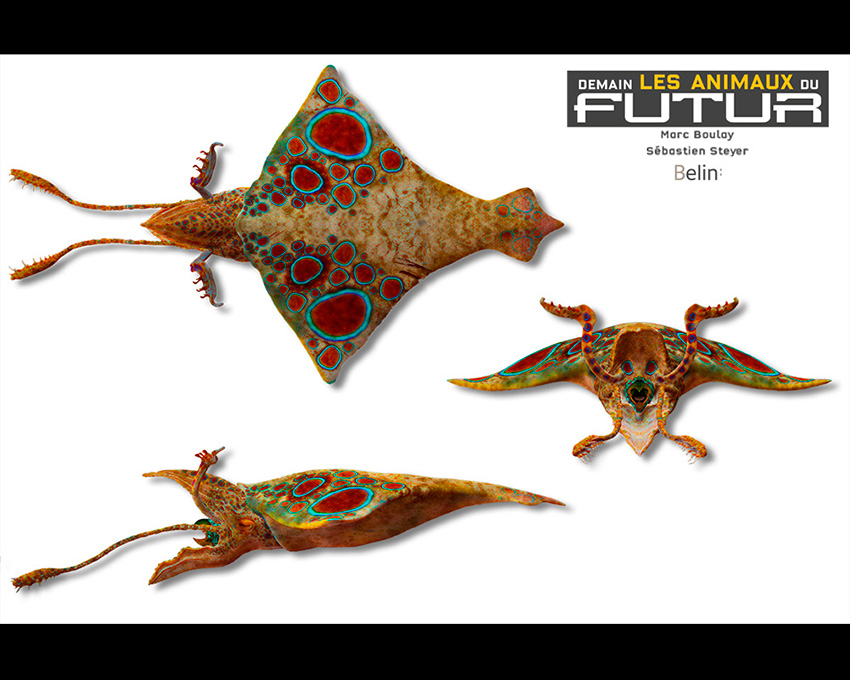
Showing posts with label Demain: les animaux du futur. Show all posts

Sunday, 9 April 2023

More alternate evolution in Japan: "What if extinct organisms continued to evolve?"

I am always interested in speculative biology projects, in particular those with well-done art. For some reason I was looking at the Japanese website of Amazon; I think I was looking at the Japanese edition of 'Demain; les animaux du futur', a French book I wrote about here and here. It is about life on Earth some 10 million in the future. As you may know, Amazon shows you lots of other books they hope you will buy. In this case it worked: one caught my attention, so I copied parts of the text into Google Translate so I would get a better idea what it was about. The translated title was: "What if extinct organisms continued to evolve?"

Click to enlarge; copyright Ken Tsuchiya, Masato Hattori

After looking at it a few times I gave in to temptation and bought it. The book was not that expensive, but postage from Japan to Europe more or less doubled the price, so check that first if you are interested. Thanks to Google Lens, I could point my phone at the pages and received an overlaid English translation. I you try that several times, you get different translations, so there is a 'Lost in Translation' sense here. I tried to contact the main author, Ken Tschuchiya, who is a geologist and palaeontologist as well as a science writer but was unable to reach him. However, the illustrator, Masato Hattori did respond, so I asked him a few questions. Unfortunately, but understandably, he redirected any enquiries regarding the reasoning behind the beasties to the writer. That left me to think of possibilities for myself, which is less certain but fun. I had a very similar experience looking at Dougal Dixon's Greenworld in Japanese

I asked Mr. Hattori how he made the images, guessing that he used ZBrush and Photoshop, which indeed he did. He modelled and rendered the animals in ZBrush and used Photoshop to blend the images into photographs. It is tricky to get the lighting, angles and contrast right, but Mr. Hattori certainly knows his business. Have a look at his own website here; there is more alternate evolution to see, in the form of dinosaurs running alongside present-day humans. 

Mr. Hattori was familiar with other works of speculative evolution, such as 'After Man' by Dougal Dixon and 'Demain, les animaux du futur' by Jean-Sébastien Steyer and Marc Boulay. The latter work is still not available in English, I think, but there is a Japanese version (among other translations). Mr. Hattori said he has a collection of such works and was in no small way influenced by them. 

--------------------------------

Let’s have a look at the book. Mr. Hattori said that the setting examines how archaic organisms would have evolved if they had not become extinct and had survived to the present day. In that respect it differs from 'After Man' and 'Demain', both of which describe Earth in the future. 

The cover of the book is shown at the top of this post; I like the composition and lighting very much. We are obviously looking at ammonites. I wonder if they differ much from their ancestors. Should we expect them to have diverged in shape given the very long time since their demise? Or would there be present-day ammonites that look just like their ancestors, as these seem to do? 
 

Click to enlarge; copyright Ken Tsuchiya, Masato Hattori

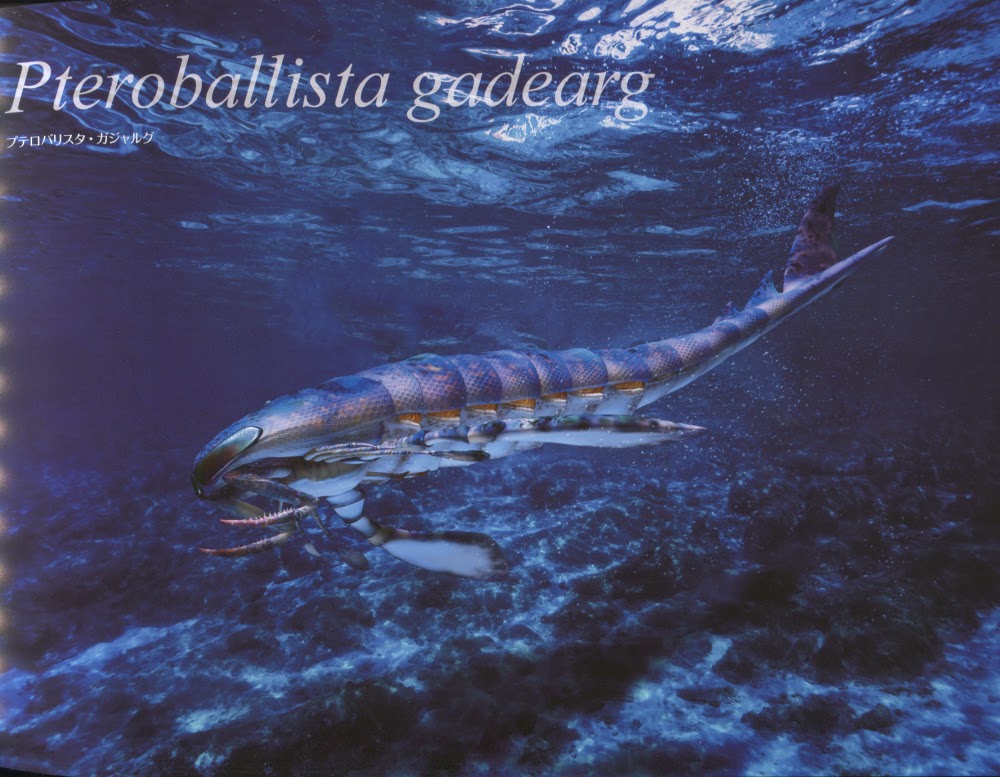
This is an obvious sea scorpion, again not looking that different from its ancestors. The world really needs more very large arthropods (I know, I know; they’re difficult...). I wonder whether such animals would have managed to compete successfully with sharks or bony fish for a long time. They don;y seem to have done so in our timeline. Such thoughts led me to think at first that the theme of the book was that the animals lived for a while beyond their extinction time, without necessarily making it all the way to the present. I also do not think that the authors meant for all animals to be alive at the same time. The book is arranged by geological era, with for some animals a point of departure at the end of the Permian. Later in the book we see alternate mammal evolution starting from recent ancestors, that would not have been there if the Permian extinction had not occurred. Each animal seems to be its own alternate history project. Anyway, I really like the energy of the image and the skilful use of iridescence. That is not an easy effect to achieve, I can tell you from experience. 
 

Click to enlarge; copyright Ken Tsuchiya, Masato Hattori

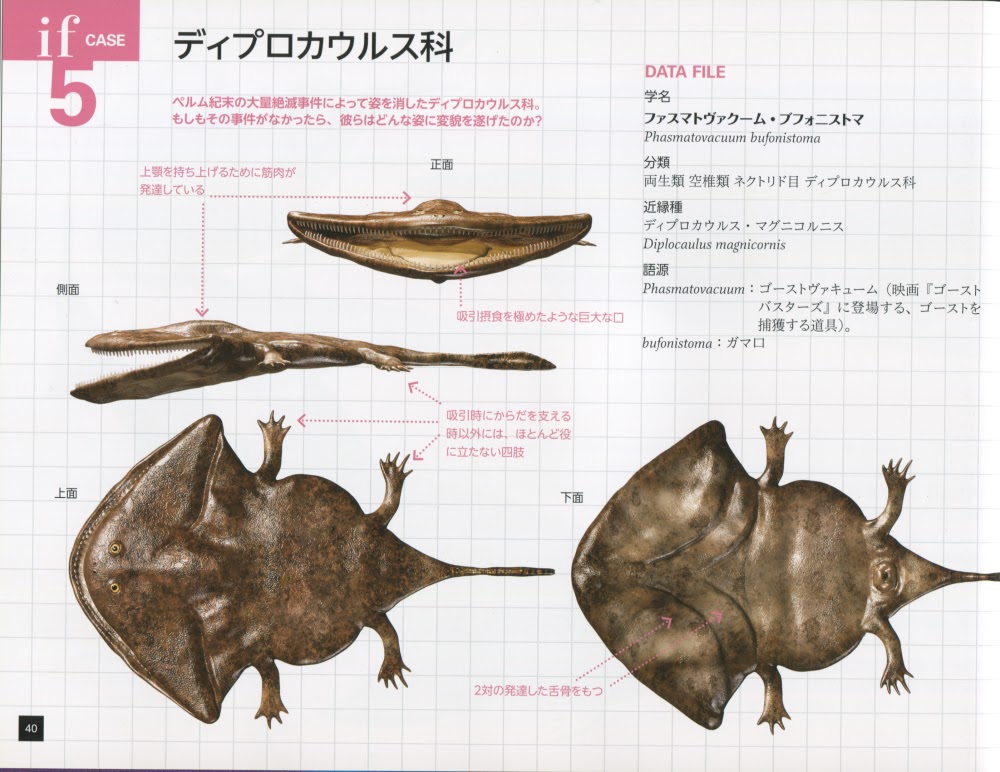
This one is decidedly funny. It is a caricature of Diplocaulus, the famous Carboniferous/Permian amphibian with a very odd 'boomerang' skull. I wondered how broad the lower jaw of Diplocaulus was, so I tried to find accurate anatomical drawings or photographs of Diplocaulus' mandible but couldn’t find high-quality images. The mouth seemed to be small though. According to the book, the extinction at the end of the Permian allowed a descendent to develop in a different manner. Young diplocaulids had no broad 'horns', but these developed as the animal grew. In this descendent, the moth broadened with growth too, resulting in a mouth that is as wide as the skull. It also seems to have gone for complete flattening of the body. Another image shows it lying on a lake floor, opening its mouth. I guess it might suck in prey that way. 


Click to enlarge; copyright Ken Tsuchiya, Masato Hattori

Here we have an animal looking very much like a river dolphin; it even has a 'melon', that bulge on the forehead that apparently helps whales produce sonar. But this is no whale: it's got scales! What is this animal descended form? 

Click to enlarge; copyright Ken Tsuchiya, Masato Hattori

Turning over the page reveals its ancestral line: it’s a spinosaur descendent! You may be familiar with the recent discussion about how well spinosaurs were adapted to swimming: some said they are, countered by some who say they aren’t. The authors of the If-book decided to let it take to the water. I wonder about the melon: could, and would, spinosaurs have developed sonar? I do not know enough about the starting point of hearing in mammals and dinosaurs to have an opinion on that, but it is a nice idea. So here we are: a 'river spinophin'. 

Click to enlarge; copyright Ken Tsuchiya, Masato Hattori

Here is the last example of what the book has to offer: this is obviously a predatory dinosaur, but not an agile one at all. Its genus name 'Megapubis' means you should take a good look at what it has between its legs: yes, that is a massive pubic bone, and it is sitting on it. Also look at the nearly columnar legs, only a bit longer than the pubis. This beast must spend its days resting and doing not much. It can’t even scratch itself, as its arms have atrophied completely: the species name 'acheirus' means 'no hands'. The animal is a scavenger, happy to wait until some animal has the decency to keel over dead. 

I will leave the rest of the book to buyers. There are 25 species in all, with quite a few reconstructions and additional images. The book is great fun, and the images are well worth looking at closely. The text seems quite interesting too; a pity I can't speak Japanese. Will there be an English version? Mr. Hattori would like that, and so would I,  but he wasn't aware of translation projects at present.

Saturday, 13 June 2015

Second part of a review of 'Demain, les animaux du futur' (Future evoluton from France II)

In my first review of the book 'Demain, les animaux du futur' I gave an overview of its contents; this second part will provide a broader view.

I have just spent a pleasant day in Paris with the authors of the book, Marc Boulay and Sébastien Steyer, mostly to talk shop. Their book is doing well, and is the best-selling book at present in the nature category in France. Accordingly, the authors are being approached to give interviews quite often. In fact, while we were at Sébastien's place of work, the Muséum National d'Histoire Naturelle (National Natural History Museum), a journalist showed up from Science et Vie. This magazine is in scope probably the closest equivalent in France to Scientific American. Some of the earlier comments on the book also touched on topics that came up in the interview, such as whether the 10 million years that passed from the present to the time depicted in the book are long enough to account for some of the profound changes in body size, shape and lifestyle to have occurred. To answer that, let's have a look at some of the changes the authors envisaged.

Click to enlarge; Copyright Éditions Belin
Ten million years from now, according to the book, giant bats have emerged from the night, so to speak. They are active in broad daylight and have lost three of their five fingers, which makes them look somewhat like pterosaurs. The wingspan of the largest species, Gigapterus tropospherus, shown above, reaches 15 meters for males. This species has dark spots on its wing that help the animal soak up sunlight during the day to use at night or at high altitude. Mind you, the text states that energy is stored through melanocytes, so this is not photosynthesis, just light and hence to a large extent also heat.

Click to enlarge; copyright Éditions Belin
Another instance of rapid evolution is Benthogyrinus giganteus, an amphibian filling the niche of present-day baleen whales. Compared to its present days amphibian cousins it is absolutely gigantic, even longer than a blue whale. It thrives in the seas, something no present amphibian does. The authors are quick to point out that past amphibians like Ichthyostega tolerated brackish water, and they quote Darwin himself, who described a Patagonian frog living in water too salty for humans to drink. But perhaps its most intriguing feature is that the animal is basically a giant tadpole, meaning it is a larva. It procreates as as larva, in contrast to normal tadpoles that have to metamorphose into adult frogs or toads to do so. This process of retaining juvenile characters in adult life, 'neoteny', certainly occurs in amphibians; the axolotl is probably the best-known example. In fact, some of the peculiar traits of Homo sapiens, that's us, also suggest neoteny: compared to adult apes, we have a large cranium, small and weak jaws and teeth, little hair, etc. To my surprise the Wikipedia article on neoteny almost exclusively deals with neoteny in man. It even suggests that Neanderthal man was less neotenic than we are, so Neanderthals represent the 'adult' version of Homo sapiens more than we do. Hmm; is Homo sapiens then in fact just an adolescent version of Man, let loose upon the world without adult supervision? That might explain a thing or two, but I digress...

So how fast can evolution proceed? Some circumstances seem conducive to quick evolution. The foremost is probably a large difference between the demands posed by an environment on an animal's (or plant's) characteristics and its actual traits. If the gap is small, the eventual changes necessary for adaptation will be small too, but we want impressive changes. The required large gap can be bridged by a series of mutations each bridging a small part of the gap, provided each step conveys an advantage by itself. As an example, consider an aquatic life form faced with an enticing new and fresh world beyond the water's surface. If there is anything to be gained from foraying on dry land, such as cheap food or finding a pool that is not drying out, then a mutation that help the animal to accomplish this task will help it to compete with its fellows. A hypothetical adventurous fish making its first clumsy steps on dry ground certainly merits an epitaph such as 'One small step for a fish, but a giant leap for fishkind'. Of course, such a fumbling fish has no advantage whatsoever if dry land is already occupied by agile predators only waiting for the intrepid fish to venture its naive adventure into their territory. The best circumstances for fast evolution may therefore be a combination of, on the one hand, a large gap between demands and capabilities, and on the other hand an empty stage to stop anything impeding runaway adaptive radiation. Those are exactly the circumstances envisaged in 'Demain'.
   The empty stage in the book is the result of the 'sixth extinction', meaning the sixth time Earth witnessed an extinction of a sizeable part of the world's life forms. All were major assaults on life, and the sixth one is is the one that some authors believe we are witnessing right now. But in contrast to previous ones, caused by natural phenomena, the sixth one is caused by Homo sapiens, going about its business with reckless, perhaps adolescent, energy.
   How large the sixth extinction will be is unknown; we are probably just at its beginnings. The authors' scenario considers it to be at least equal to the mother of all extinctions, the one at the end of the Permian. But with the decline of teleost fish and almost of not all mammals, I would guess it is larger still. A nearly complete collapse of the food chains on land and at sea might indeed provide an empty stage for remnant populations to undergo quick adaptive radiation. The remnants in the book, by the way, are not random, but were mostly taken from species with near-ubiquitous representations: birds, bats and cephalopods.
     

Click to enlarge

Above is a photograph (of poor quality, sorry) showing, from top to bottom, Sébastien Steyer, Marc Boulay, and the journalist of Science et Vie, Elsa Abdoun. The locale is the Muséum I mentioned above, and specifically a hall showing a display of present-day whales skeletons, pertinent to the discussion. But why are whales pertinent to this particular book?

Click to enlarge; copyright where appropriate Wikipedia

Whales present a nice factual example of quick evolution. The genus Pakicetus of about 50 million years ago represents a mammal group thought to be the earliest known 'whales', but here that is a cladistic term only: you would not call this mostly terrestrial animal a 'whale' and would probably not call it 'aquatic' any more than you would call a present-day tapir aquatic. But give these 'whales' some time to evolve, and you will encounter the first fully aquatic whales, basilosauridae and dorudontinae, in the seas of 41 to 35 million years ago. What this means is that whales went from terrestrial tapir analogues to fully aquatic animals in only 9 to 15 million years, similar to the 'Demain' book's 10 million years. Of course, the oceans were not empty during this time, so whale evolution might have been even faster on a truly empty stage; even with other players around, whales exploded onto the scene.

Click to enlarge; copyright Éditions Belin

To conclude, what the book does, and does well, is to explore several biotopes. My personal preferences include what the authors did with squids, a clade also radiating to take up niches left by fish and mammals. Above is a giant one, Rhombosepia imperator. It too underwent impressive changes, including the concept that most of its tentacles fused to form false jaws, lined with suction cups. It is, as it was before, a predator, and now uses modified ink to poison its prey.
  I will not show more images from the book: it would spoil the appetite. I realise that readers would want more images, but a review should leave enough unknown for people to want to read the book (this is also the reason why I withhold new Furaha images). I really like the squid radiation, in particular the dolphin analogue 'Delphimimus jamescameroni' (Oh dear Mr Cameron, please have a look at the kind of speculative biology shown here, because it's pretty good!).

The book is not an encyclopaedia of future life; it provides no clues regarding other biotopes. That may be seen as a disadvantage; in a way it is, but I would probably have wanted more even if the book would have had three times the number of pages it has now. Knowing only too well how long it takes to produce such a work, it's perhaps just as well they stopped, to have it published as it is.

Saturday, 30 May 2015

Future evolution from France: 'Demain, les animaux du futur' Review I

Click to enlarge; copyright Éditions Belin 2015  The bird at the top is a Necropteryx, a vulture descendant. The 'helmet' is found on males only, depends on hormones and signifies rank.


Books on speculative biology are rare, so the publication of a new one is an Event. The long-awaited 'Demain. Les animaux du futur' deserves a place of honour in that small library, right next to Dougal Dixon's 'Life after man'. It's very good!


Click to enlarge. Copyright Éditions Belin 2015. I like the clever use of a fake infrared night image. What you are looking at is a confrontation between a predator and a carrion eater, both large birds. 

The book was written and illustrated in a very close collaboration between Marc Boulay, a sculptor who became a ZBrush expert, and Sébastien Steyer, a palaeontologist. As they themselves describe in the book, the artist and the scientist bounced ideas back and forth to shape their creations. The book is published by Belin and is available from Amazon (for 23 Euros, so it's not expensive). Before you all rush off to order it right now, be aware that it is in French.

The book has its own website and there is lots of other information on Marc's site too. It counts over 150 pages and contains more illustrations than text, which is how it should be. Almost all illustrations were done with ZBrush; that is a 3D sculpting programme that has very quickly become a world leader when it comes to sculpting organic forms. Marc is an expert and former beta tester of ZBrush. I knew how good he was with ZBrush, and drew attention to his ability to produce photorealistic illustrations back in 2009. Still, I was a bit hesitant, as I think photorealistic computer generated images run a risk of becoming somewhat lifeless.

Click to enlarge. Copyright Éditions Belin 2015. The image of the head of a male parrot descendent, Tyrannornis rex, shows the level of detail in feathers, skin etc. 

I should not have worried, because Marc pulls it off. In fact, I now think that at this level of artistry photorealism really comes into its own. Paintings have the unique advantages of easily provoking the viewer into imagining a world, often through not showing every detail. Here, every tiny scale, feather, hairs, wrinkle or glint in an eye is visible, and that has an effect in a way opposite to what a painting can do, but just as good. Marc manages to make all those details add life to his creatures: they are actually there.

The book has four chapters: the oceans of the future, the endless mangrove, a new continent and a 'user guide of the future', which in part describes how they designed their creatures, what the design limitations were, etc. Each of the first three chapters has a main text in which unnamed human observers relate what they see in the world around them, so we read about interactions between animals, hunts and other behavioural aspects. The text at times jumps to another perspective providing insights of the reasoning behind a shape or form. I have not read every letter yet, but the authors provide information here and there of the underlying story. This is a world 10 million years in the future. The main players we are used to have disappeared, so there are no large mammals on land, and not even bony fish seemed to have made it through the extinction event. The chapter on the oceans coolly describes that acidification of the oceans might result in the extinction of many animals that make up plankton: this could start to happen in parts of the oceans as soon as 2030. The book does not make a big thing out of this, and the reader is left to fill in the gaps: in a way the book is about  the results of our own actions shaping future life on this planet, for ever altered. The authors chose a period of 10 million years to allow the ecosystems to swing back to stable states again, and also, pragmatically, because other authors had left this particular slot open.

So which animal groups quickly evolved to fill the gaps? There are some lovely and unexpected creations here, but the main players are squid, birds and bats. I expect that this is where people may become critical, either because it is not made clear why these groups survived, or perhaps because of a feeling that 'this has been done before'. As for the latter matter, well, yes, there is truth in that, but it would not be easy to come up with totally novel 'survivor' groups. Dougal Dixon had that luxury with 'After Man', but that was in 1981, because he was the first. Work on the present book started in 2000 as far as I can tell, and in those 15 years many people became interested in speculative biology. I think that that particular term was probably not even in use at the time. Marc and Sébastien do not seem to be worried about this.

Click to enlarge. Copyright Éditions Belin 2015. A big nocturnal terrestrial bat

In fact, when presenting a blood-sucking terrestrial bat (Nosferapoda kinskii), they directly compare it to Dixon's night stalker and the 'future predator' of the television series 'primeval'. By the way, both featured in one of my earlier posts on echolocation. Marc and Sébastien write that creating a terrestrial bat can be considered a classic of speculative biology, and add detail and reasoning to their version: they explain why their 'night vampire' bears most of its weight on its hind legs, so its gait resembles that of knuckle-walking apes. I like this approach of not ignoring earlier works of speculative biology but of accepting that theirs is not the only one. Dixon's work is mentioned more than once in the book, and I am proud to say that my work is acknowledged too: there is a quadrupedal 'giraffe bird' with the species name 'Giraffornis vandijki'. I am honoured!


Click to enlarge. Copyright Éditions Belin 2015. Giraffornis vandijki... I apologise for cutting off the image at the right, but that is where the book pages meet, and I will not ruin the book merely to get a better scan. The male is on top, and a female interacts with a young at the bottom. They are preyed on by Tyrannornis, I am sorry to say.     

I expect that most readers of this blog would want me to post as many as yet unpublished images of the animals in the book as I can cram in this post. I have included very few such images and will show a few more in a second post on this book, one or two weeks from now. But I will restrain myself, as that would spoil the joy of getting your own book. I had seen images on various websites before, but seeing the large number of fresh images formed a large part of the pleasure of reading the book. I hope that others will also restrain themselves, and that Belin finds an English language publisher quickly, so you can all find out for yourselves.

Sunday, 24 May 2015

Unveiling cloakfishes' cloaked filters

I stopped blogging, so what is this post doing here?

Well, I never said I would stop altogether, and I would return if there was something of special interest to report. Yesterday, I received my advance copy of  'Demain, les animaux du futur' from the authors, Marc Boulay and Jean-Sébastien Steyer. I am quite impressed and will return to write about it, in a week or so. Writing the present post is to get me in the mood again.

A main reason to reduce blogging was to spend more time on producing The Book, and that worked quite well: without blogging, I manage to produce one two-page spread every month, meaning one full painting, accompanying text, scale drawings and usually a minor illustration. At 24 pages a year there is definite progress (and I intend to increase the output). Sadly, Fishes I, II and III together only get one spread, while terrestrial hexapods get many. To illustrate the mechanics of some groups, I have stumbled on a three-spread theme: one spread for explanation, one to show diversity, and one showing a single species in a full painting. Groups that get this treatment are spidrids (half finished), rusps (all done), tetropters (not yet) and cloakfish: half done.

Click to enlarge; copyright Gert van Dijk
The early beginnings of cloakfish are shown here, and the latest instalment of their physique was posted here. Like it or not, that particular form, shown above, has now been scrapped. As you can see I played with putting the mouth in the cone forming the 'snout' of the animal. Well, not anymore. While sketching I drew a cloakfish cut in two and that gave me the idea of making a 'cutaway' version to explain how it works. Unfortunately, that meant that I could use very little 'handwavium'. Without a cutaway drawing I could just write something like this: (imagine an Attenborough-style voice-over) "Hidden from view by the animal's cylindrical body wall, its food rakes, next to the gills, steadily filter the nutritious plankton so abundant in these waters." How they look is left to the imagination.

With filters unhidden, the problem presented itself that I never really understood how filter feeding works, which is no wonder as I never looked it up. Many animals use it, from sharks and rays to bony fish and whales. So it works, but consider a whale shark or a basking shark as a gigantic sieve sweeping through the ocean. After a while, the filter will have sieved lots of food particles, now stuck against the sieve. The animal will have to scrape the food from it, not only to swallow it, but also to prevent the sieve becoming clogged. Remember that the gills are there as well, and you do not want to ruin respiration, not even for feeding. What bothered me is that whales might use their tongues to scrape clean their baleens, or so I supposed, but I was not aware of scrapers inside a whale shark's mouth.

Click to enlarge; Source: Brainerd, Nature 2001; 412: 387-388
Well, reading a few papers later I found out about something called 'cross flow filtration'. Naively, I had imagined the filter as a sieve at a right angle to the flow of water, allowing water to pass while particles get stuck. That's not how all filters work, though. The image above explains the process nicely. In 'cross flow filtration', the surface of the filter is parallel to the flow of water. Behind the filter there is a low pressure area, so water flows there. Apparently, particles move on parallel to the water, staying on one side of the filter, where they are  concentrated more and more. The papers then mention things like 'near the oesophagus', suggesting that the animal then merely has to swallow the concentrated particles and there you are. If you want to read more, I found a site where you can obtain a Nature paper for free here. Mind you, the fact that this was worthy of publishing in Nature in 2001 means that this is still all fairly new. The papers are somewhat vague on why the concentrated particles bunch up in a cul de sac waiting for the oesophagus to gulp them up, but I will accept this leap of faith; it cannot be easy to do an oesophagoscopy on a freely swimming whale shark.

So I sketched some more, filling in the inside of cloakfish contours, giving it a cross flow filter with a cul the sac leading to the oesophagus. Actually, since we are talking about a tetraradiate animal, there are four filters and four oesophagi leading to one stomach. I paint but am not a technical artist, so I needed some help with the perspective and also with visualising the insides of the cloakfish. I used Vue Infinite to provide me with as many perspectively correct views of the animal's inside as I wanted to help draw the cutaway.

Click to enlarge; copyright Gert van Dijk
What you see above are some aids in doing so. The holes help visualise the flow of water (but I must add that the gill design was changed afterwards). The painting, based on this design, is nearly finished, but I will not show it: there should be new material in The Book. My first look at the 'Demain' book showed a very large amount of previously unpublished animals, and that strengthened my resolve to keep much hidden. I must say that writing this post did remind me why I did it for a long time: it is fun; but time is short...                          

Thursday, 8 January 2015

Starting up again: the future is back in France, and a Furaha talk in The Netherlands

The renovation of my house is nearly finished, meaning that life is slowly returning to normal again. One of my new year's resolution was to resume blogging, and I will. Actually, that was the only 'new' New Year's resolution; all the ones from last year had hardly been used and so were still as good as new.

The year's first post will be short and simple. Let's start with a long-awaited arrival, a book about which I have written before in 2011: 'Demain, les animaux du futur'. The literal translation is 'Tomorrow, the animals of the future'. Here are two older posts on the subject: here and here. As I wrote then, the book will be written by Jean-Sébastien Steyer and Marc Boulay. If you search my blog for their names you will find out more about them, and then you could also have a peek at their work, for instance at Marc's site. Actually, Marc's website shows some giant posters on bus stands and buildings, but that is not all. There are also some very nice images from the book on his site, so if you will simply browse through it, you will find the following images, and more besides:


Click to enlarge; copyright Marc Boulay 2000/20015
I must say I love these landscapes, particularly the bottom one, with its trees with aerial roots, suggesting heavy flooding at times. But we'll find out soon enough, in April.

Once or twice I read that people doubted the book was really on its way. Well, if anyone still thiks it is a hoax, perhaps the following link will convince you otherwise: have a look at the French Amazon site. That shows you that the book will cost 23 Euro and will be published on April 10, 2015. You can find it on the UK Amazon site too. I pre-ordered mine already! But I'll want to have it autographed too, so I will have to go to France to see the authors and toast their success...

 ----------------------------------------
 
After my Loncon adventures someone asked me why I did not give similar talks in the Netherlands. Basically I hadn't thought of that, I am sorry to say. But after that I did look around for Dutch SF conventions and contacted the organisers of one. The happy result of that is that I will present a talk on Furaha during the Imagicon meeting, on March 21, 2015, in the town of Ede in The Netherlands. The talk will be based on the London one, but it will be a bit longer; I will show paintings, including a few never published, videos, etc. The talk will obviously be in Dutch though! Dutch readers can access a bit of blurb regarding my lecture on the page reached by clicking 'programma/lezingen' (lectures).  

Saturday, 25 May 2013

Predatory penguin's evolution in Brussels' future evolution back on course.

Regular readers may have noted a predilection for incomprehensible titles, or let's say titles that need a lot of knowledge to be comprehensible. This one fits that bill, I think. The previous post dealt with models of future animals in the Brussels museum of natural history. One thing that struck me was that the model of a Neopygoscelis, a penguin descendant, differed quite a bit from the earlier published design. The feet had expanded at the cost of the flippers, an evolution that I would not have expected. The designers, Marc Boulay and Jean-Sébastien Steyer, explained that the actual models had been produced without much control by themselves, explaining the changes. Marc and Sébastien are working on a book about future evolution that will appear in 2014, as told here previously (you can read starting here or here).

My discussion of the odd 'evolution' of the Neopygoscelis model persuaded them to send me two photographs of Neopygoscelis as it will appear in the book, meaning 'Furahan Biology and Allied Matters' gets another exclusive preview of that work.

Click to enlarge
The photograph above shows clearly that the model maker had evolved the enormous hind legs of the museum model quite separately from the designers' ideas. The ratio of flipper to feet size clearly shows that the flippers are still the primary propulsion method of this animal. The feet with their long nails do look formidable though, but not as a propulsion organ. The eyes are large, so the animal does not seem that large to me; the size of 4 m as stated for tye museum model seems too large for this particular animal. Note that the nails differ in size between the two animals, so I guess that we are looking at sexual dimorphism here, with one a male and one a female. I do not know which one is which, though: Marc and Sébastien sent me the photographs, but no accompanying text. That is probably wise: always leave the reader wishing for more...

Click to enlarge
The image above shows a pair of Neopygoscelis in their habitat in photorealistic mode. A very nice addition. So there are now three versions of Neopygoscelis: the digital illustration  originally shown in the magazine, the grey model in the museum that we should probably regard as a largely 'unauthorised' version, and the one in this post, that will make it into the book. That is, unless the designers feel a last-minute need to change something before the book goes to press.

I have in the past reworked oil paintings, sometimes more than once, but doing so was a big job: it involved scraping off layers of paint before adding new ones, so the process was quite destructive. Working digitally means you can do the same thing without losing anything. Most older Furaha animals were designed for visual attraction than a coherent body plan, but I am remedying that slowly, whole keeping visual appeal intact -in fact I try to improve it-. There is always a temptation to go back and push and pull at a design some more. Obviously, the same temptation works for the designers of 'Demain: les animaux du futur', but there is one big difference: there is a publisher, so there is a deadline, and so at some point the image is finished and you cannot go back any more; what a luxury.

I can't wait for the book. When it appears I will write about it here, and perhaps earlier than that as well...  

Tuesday, 29 November 2011

Animals of the Future? Allons-y!

This is a short follow-up to the last post, on the project of my French friends & colleagues: 'Demain, les animaux du futur'.

Messieurs Boulay and Steyer wrote that they were quite happy to see that the post had generated numerous pertinent responses, so there.

More to the point, they decided to provide a bit more information on their website in the form of two new videos, on on the 'Demain...' project and one on the terraforming of Mars. It seems that the firm of Cossima Productions is off to a good start. Here is a direct link to the page where you can see both videos. From there, you can also click on the 'YouTube' logos under each video.


Here is the one where Boulay & Steyer explain what the project is all about. Mind you, the quality of the video on this blog is less good than the version you can see on the Cossima site or on YouTube, so if you want a higher quality, use that route or just go here directly.

Yes, it is in French; do not act surprised, it's what people in France speak. Perhaps I can be persuaded to provide a translation, but right away I haven't got the time to do so.

---------------------------------------------------------------------------
Additional text (December 2, 2011): With a bit of help by Marc in figuring out what they said I translated the text of the video. Any errors are my fault.

Sébastien Steyer:
"Marc and I both love science fiction. Every time we saw what films and other works in science fiction offered in the way of an exobiological bestiary, we had a thing or two to say about it. So, instead of criticising the work of others, we wished to create our own universe and to imagine speculative biology in Earth's future.
-----
For example, we designed a future flightless parrot, in which we envisaged a reduction of its wings up to the point where they disappeared altogether, with an accompanying lengthening and strong development of its legs. Bit by bit we came up with an animal we thought likely, ten million years from now.
---
This is no longer science fiction, it's more like 'fiction science'. It is a projection, but one taking known evolutionary, tectonic and climatological models into consideration."
---
Marc Boulay:
"Making a sculpture, regardless of whether of a past, a present or a future animal, involves an anormous amount of work in getting source material and discussions with scientists. That takes up about 90% of my time. The rest is applying that knowledge. Doing the sculpture takes up about 10% of my time. "