Showing posts with label Marc Boulay. Show all posts

Tuesday, 10 April 2018

Ten years on

The first post of this blog was published on April 22, 2008, or ten years ago. I wrote several earlier progress reports. It is time for a new one, especially because of the festive nature of ten years of blogging. Well, more or less, because the rate of new posts has been low in the past few years. More on that later. 

Let's start with a comparison with 5 years ago, when I also wrote a progress report. Then, there had been 307,000 page views according to the blogger 'stats' page, and now the counter stands at 639,478 views. I am not altogether certain that all these visits represent actual people; perhaps there were bots  as well. What is certain is that I had written 197 posts five years ago, whereas the counter now stands at 233 posts, so it is obvious I wrote more posts in the first five than the second five years.  There were 1638 comments in all, and I must say that I enjoy the interactions. The comments have quite often made me think a bit harder about what the project, and gave rise to new animals on more than one occasion. Thanks to all who read my posts with such enthusiasm!

The 'stats' section also tells me what the most-visited posts were over these ten years. Here they are, with their previous ranking from five years ago between parentheses:

1. (1) Swimming in Sand 1: the Sandworms of Dune; 5 Feb 2011; 8854 views       
2. (5) A future book on future evolution from France; 19 Nov 2011; 6239 views       
3. (4) Avatar's 'Walking with hexapods'; 11 Feb 2010; 4862 views
4. (2) Warren Fahy's "Fragment"; 8 Aug 2010; 4010 views                   
5. (-) Future evolution from France: 'Demain, les animaux...; 30 May 2015; 3327 views
6. (3) A century of thoats; 5 May 2012; 2996 views
7. (-) Create your own planet (using Celestia); 13 Aug 2011; 2717 views   
8. (-) The anatomy of giants in 'Game of Thrones'; 11 Jun 2016; 2661 views           
9. (9) Ballooning animals and Newtonian fitness; 15 Jul 2011; 2338 views   
10. (-) Second part of a review of 'Demain, les animaux...; 13 Jun 2015; 1958 views   

There are four newcomers in the top-10, but it seems that the sandworms of Dune are unbeatable. My French friends Marc Boulay and Sébastien Steyer will be pleased to learn that their work occurs no less than three times in the top-10: first as an announcement in 2011, and then as a two-part review in 2015. I hope that this signals an immense interest in books on speculative biology, because that would be good more my own project: The Book.

Click to enlarge; copyright Gert van Dijk
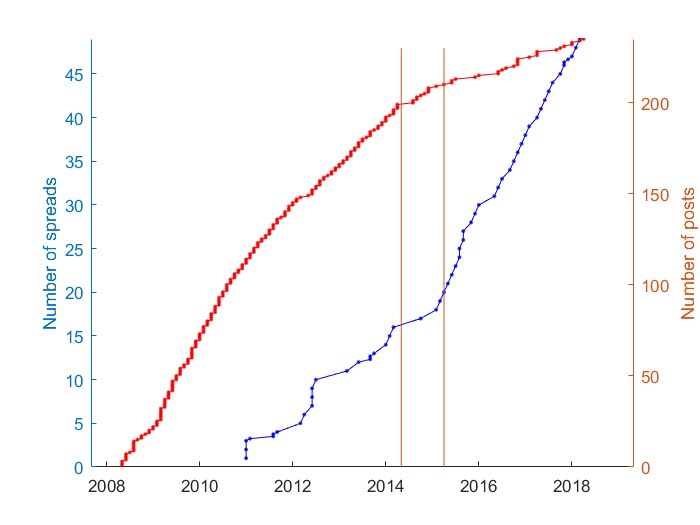
Some of you may recall that I had announced that I would spend less time blogging to have more time to work on The Book. The graph above shows the cumulative number of blog posts in red, from 0 in 2008 to 233 now (the present one excluded), as well as the cumulative number of spreads in blue, starting in 2011. A spread is a two-page account of a species, a chapter introduction, or of any topic worthy of devoting two pages to. The number of spreads started in 2011 because I had made the switch to digital painting and started collecting the slowly increasing number of spreads in an InDesign manuscript. I am at present working on the fiftieth spread, so within a short while the manuscript will have exactly 100 pages. Not bad, hey?

But did the reduction of blogging benefit The Book? The two vertical red lines indicate the post in 2014 in which I announced a temporary stop, and the one in 2015 in which I said that I would stop blogging except for the occasional post. Have a look at the rate of increase of the two lines: the total number of posts rose much slower from then on, while the number of spreads rose appreciably faster. The rate of new spreads since then is about nine spreads a year, which is less than the 12 I hoped to be able to manage. But please remember that this is not a job and that each spread takes presumably 20-30 hours to produce. I you ever write a book, do just that: write it; don't paint it! Mind you, The Book does not consist of images only: there are over 32,000 words at present, which is the length of a novella.

I always aimed at something like 125 pages, simply because comparable works have such a number of pages. At present I think the number will be more like 130, but we'll see. The good news is that I expect that the number of spreads per year will increase, so producing the remaining 15 spreads shouldn't take very long. Mind you, 'not very long' should be considered from the perspective that such a project may take a few decades...              
    
Because this is the tenth year of blogging, I also aim to write a few extra posts this year. I think I will finally write the long-awaited post 'What are toes for?' There will also be posts on equations: the Drake equation, the Seager equation and possibly the Nastrazzurro equation...

Saturday, 13 June 2015

Second part of a review of 'Demain, les animaux du futur' (Future evoluton from France II)

In my first review of the book 'Demain, les animaux du futur' I gave an overview of its contents; this second part will provide a broader view.

I have just spent a pleasant day in Paris with the authors of the book, Marc Boulay and Sébastien Steyer, mostly to talk shop. Their book is doing well, and is the best-selling book at present in the nature category in France. Accordingly, the authors are being approached to give interviews quite often. In fact, while we were at Sébastien's place of work, the Muséum National d'Histoire Naturelle (National Natural History Museum), a journalist showed up from Science et Vie. This magazine is in scope probably the closest equivalent in France to Scientific American. Some of the earlier comments on the book also touched on topics that came up in the interview, such as whether the 10 million years that passed from the present to the time depicted in the book are long enough to account for some of the profound changes in body size, shape and lifestyle to have occurred. To answer that, let's have a look at some of the changes the authors envisaged.

Click to enlarge; Copyright Éditions Belin
Ten million years from now, according to the book, giant bats have emerged from the night, so to speak. They are active in broad daylight and have lost three of their five fingers, which makes them look somewhat like pterosaurs. The wingspan of the largest species, Gigapterus tropospherus, shown above, reaches 15 meters for males. This species has dark spots on its wing that help the animal soak up sunlight during the day to use at night or at high altitude. Mind you, the text states that energy is stored through melanocytes, so this is not photosynthesis, just light and hence to a large extent also heat.

Click to enlarge; copyright Éditions Belin
Another instance of rapid evolution is Benthogyrinus giganteus, an amphibian filling the niche of present-day baleen whales. Compared to its present days amphibian cousins it is absolutely gigantic, even longer than a blue whale. It thrives in the seas, something no present amphibian does. The authors are quick to point out that past amphibians like Ichthyostega tolerated brackish water, and they quote Darwin himself, who described a Patagonian frog living in water too salty for humans to drink. But perhaps its most intriguing feature is that the animal is basically a giant tadpole, meaning it is a larva. It procreates as as larva, in contrast to normal tadpoles that have to metamorphose into adult frogs or toads to do so. This process of retaining juvenile characters in adult life, 'neoteny', certainly occurs in amphibians; the axolotl is probably the best-known example. In fact, some of the peculiar traits of Homo sapiens, that's us, also suggest neoteny: compared to adult apes, we have a large cranium, small and weak jaws and teeth, little hair, etc. To my surprise the Wikipedia article on neoteny almost exclusively deals with neoteny in man. It even suggests that Neanderthal man was less neotenic than we are, so Neanderthals represent the 'adult' version of Homo sapiens more than we do. Hmm; is Homo sapiens then in fact just an adolescent version of Man, let loose upon the world without adult supervision? That might explain a thing or two, but I digress...

So how fast can evolution proceed? Some circumstances seem conducive to quick evolution. The foremost is probably a large difference between the demands posed by an environment on an animal's (or plant's) characteristics and its actual traits. If the gap is small, the eventual changes necessary for adaptation will be small too, but we want impressive changes. The required large gap can be bridged by a series of mutations each bridging a small part of the gap, provided each step conveys an advantage by itself. As an example, consider an aquatic life form faced with an enticing new and fresh world beyond the water's surface. If there is anything to be gained from foraying on dry land, such as cheap food or finding a pool that is not drying out, then a mutation that help the animal to accomplish this task will help it to compete with its fellows. A hypothetical adventurous fish making its first clumsy steps on dry ground certainly merits an epitaph such as 'One small step for a fish, but a giant leap for fishkind'. Of course, such a fumbling fish has no advantage whatsoever if dry land is already occupied by agile predators only waiting for the intrepid fish to venture its naive adventure into their territory. The best circumstances for fast evolution may therefore be a combination of, on the one hand, a large gap between demands and capabilities, and on the other hand an empty stage to stop anything impeding runaway adaptive radiation. Those are exactly the circumstances envisaged in 'Demain'.
   The empty stage in the book is the result of the 'sixth extinction', meaning the sixth time Earth witnessed an extinction of a sizeable part of the world's life forms. All were major assaults on life, and the sixth one is is the one that some authors believe we are witnessing right now. But in contrast to previous ones, caused by natural phenomena, the sixth one is caused by Homo sapiens, going about its business with reckless, perhaps adolescent, energy.
   How large the sixth extinction will be is unknown; we are probably just at its beginnings. The authors' scenario considers it to be at least equal to the mother of all extinctions, the one at the end of the Permian. But with the decline of teleost fish and almost of not all mammals, I would guess it is larger still. A nearly complete collapse of the food chains on land and at sea might indeed provide an empty stage for remnant populations to undergo quick adaptive radiation. The remnants in the book, by the way, are not random, but were mostly taken from species with near-ubiquitous representations: birds, bats and cephalopods.
     

Click to enlarge

Above is a photograph (of poor quality, sorry) showing, from top to bottom, Sébastien Steyer, Marc Boulay, and the journalist of Science et Vie, Elsa Abdoun. The locale is the Muséum I mentioned above, and specifically a hall showing a display of present-day whales skeletons, pertinent to the discussion. But why are whales pertinent to this particular book?

Click to enlarge; copyright where appropriate Wikipedia

Whales present a nice factual example of quick evolution. The genus Pakicetus of about 50 million years ago represents a mammal group thought to be the earliest known 'whales', but here that is a cladistic term only: you would not call this mostly terrestrial animal a 'whale' and would probably not call it 'aquatic' any more than you would call a present-day tapir aquatic. But give these 'whales' some time to evolve, and you will encounter the first fully aquatic whales, basilosauridae and dorudontinae, in the seas of 41 to 35 million years ago. What this means is that whales went from terrestrial tapir analogues to fully aquatic animals in only 9 to 15 million years, similar to the 'Demain' book's 10 million years. Of course, the oceans were not empty during this time, so whale evolution might have been even faster on a truly empty stage; even with other players around, whales exploded onto the scene.

Click to enlarge; copyright Éditions Belin

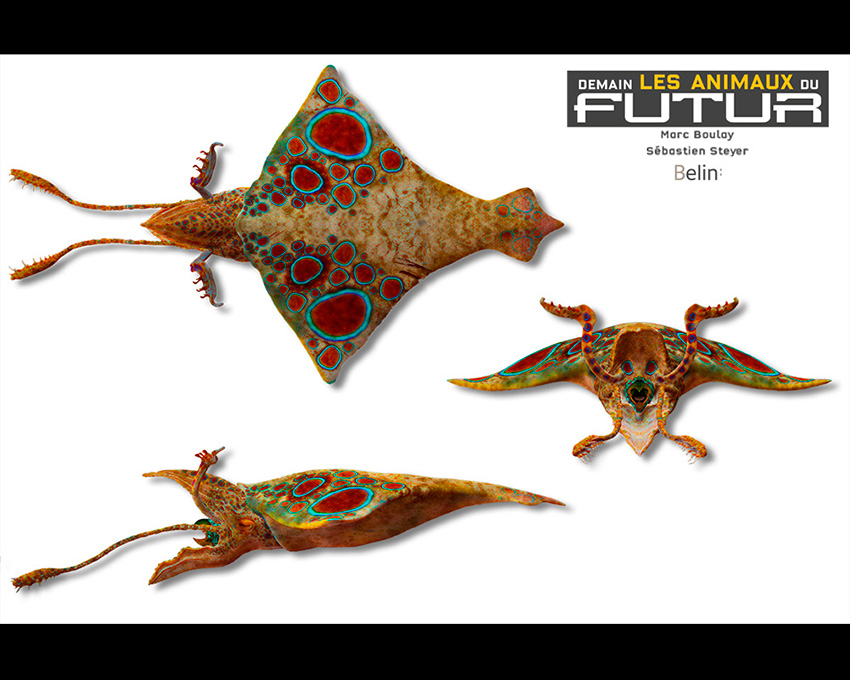
To conclude, what the book does, and does well, is to explore several biotopes. My personal preferences include what the authors did with squids, a clade also radiating to take up niches left by fish and mammals. Above is a giant one, Rhombosepia imperator. It too underwent impressive changes, including the concept that most of its tentacles fused to form false jaws, lined with suction cups. It is, as it was before, a predator, and now uses modified ink to poison its prey.
  I will not show more images from the book: it would spoil the appetite. I realise that readers would want more images, but a review should leave enough unknown for people to want to read the book (this is also the reason why I withhold new Furaha images). I really like the squid radiation, in particular the dolphin analogue 'Delphimimus jamescameroni' (Oh dear Mr Cameron, please have a look at the kind of speculative biology shown here, because it's pretty good!).

The book is not an encyclopaedia of future life; it provides no clues regarding other biotopes. That may be seen as a disadvantage; in a way it is, but I would probably have wanted more even if the book would have had three times the number of pages it has now. Knowing only too well how long it takes to produce such a work, it's perhaps just as well they stopped, to have it published as it is.
Saturday, 30 May 2015

Future evolution from France: 'Demain, les animaux du futur' Review I

Click to enlarge; copyright Éditions Belin 2015  The bird at the top is a Necropteryx, a vulture descendant. The 'helmet' is found on males only, depends on hormones and signifies rank.


Books on speculative biology are rare, so the publication of a new one is an Event. The long-awaited 'Demain. Les animaux du futur' deserves a place of honour in that small library, right next to Dougal Dixon's 'Life after man'. It's very good!


Click to enlarge. Copyright Éditions Belin 2015. I like the clever use of a fake infrared night image. What you are looking at is a confrontation between a predator and a carrion eater, both large birds. 

The book was written and illustrated in a very close collaboration between Marc Boulay, a sculptor who became a ZBrush expert, and Sébastien Steyer, a palaeontologist. As they themselves describe in the book, the artist and the scientist bounced ideas back and forth to shape their creations. The book is published by Belin and is available from Amazon (for 23 Euros, so it's not expensive). Before you all rush off to order it right now, be aware that it is in French.

The book has its own website and there is lots of other information on Marc's site too. It counts over 150 pages and contains more illustrations than text, which is how it should be. Almost all illustrations were done with ZBrush; that is a 3D sculpting programme that has very quickly become a world leader when it comes to sculpting organic forms. Marc is an expert and former beta tester of ZBrush. I knew how good he was with ZBrush, and drew attention to his ability to produce photorealistic illustrations back in 2009. Still, I was a bit hesitant, as I think photorealistic computer generated images run a risk of becoming somewhat lifeless.

Click to enlarge. Copyright Éditions Belin 2015. The image of the head of a male parrot descendent, Tyrannornis rex, shows the level of detail in feathers, skin etc. 

I should not have worried, because Marc pulls it off. In fact, I now think that at this level of artistry photorealism really comes into its own. Paintings have the unique advantages of easily provoking the viewer into imagining a world, often through not showing every detail. Here, every tiny scale, feather, hairs, wrinkle or glint in an eye is visible, and that has an effect in a way opposite to what a painting can do, but just as good. Marc manages to make all those details add life to his creatures: they are actually there.

The book has four chapters: the oceans of the future, the endless mangrove, a new continent and a 'user guide of the future', which in part describes how they designed their creatures, what the design limitations were, etc. Each of the first three chapters has a main text in which unnamed human observers relate what they see in the world around them, so we read about interactions between animals, hunts and other behavioural aspects. The text at times jumps to another perspective providing insights of the reasoning behind a shape or form. I have not read every letter yet, but the authors provide information here and there of the underlying story. This is a world 10 million years in the future. The main players we are used to have disappeared, so there are no large mammals on land, and not even bony fish seemed to have made it through the extinction event. The chapter on the oceans coolly describes that acidification of the oceans might result in the extinction of many animals that make up plankton: this could start to happen in parts of the oceans as soon as 2030. The book does not make a big thing out of this, and the reader is left to fill in the gaps: in a way the book is about  the results of our own actions shaping future life on this planet, for ever altered. The authors chose a period of 10 million years to allow the ecosystems to swing back to stable states again, and also, pragmatically, because other authors had left this particular slot open.

So which animal groups quickly evolved to fill the gaps? There are some lovely and unexpected creations here, but the main players are squid, birds and bats. I expect that this is where people may become critical, either because it is not made clear why these groups survived, or perhaps because of a feeling that 'this has been done before'. As for the latter matter, well, yes, there is truth in that, but it would not be easy to come up with totally novel 'survivor' groups. Dougal Dixon had that luxury with 'After Man', but that was in 1981, because he was the first. Work on the present book started in 2000 as far as I can tell, and in those 15 years many people became interested in speculative biology. I think that that particular term was probably not even in use at the time. Marc and Sébastien do not seem to be worried about this.

Click to enlarge. Copyright Éditions Belin 2015. A big nocturnal terrestrial bat

In fact, when presenting a blood-sucking terrestrial bat (Nosferapoda kinskii), they directly compare it to Dixon's night stalker and the 'future predator' of the television series 'primeval'. By the way, both featured in one of my earlier posts on echolocation. Marc and Sébastien write that creating a terrestrial bat can be considered a classic of speculative biology, and add detail and reasoning to their version: they explain why their 'night vampire' bears most of its weight on its hind legs, so its gait resembles that of knuckle-walking apes. I like this approach of not ignoring earlier works of speculative biology but of accepting that theirs is not the only one. Dixon's work is mentioned more than once in the book, and I am proud to say that my work is acknowledged too: there is a quadrupedal 'giraffe bird' with the species name 'Giraffornis vandijki'. I am honoured!


Click to enlarge. Copyright Éditions Belin 2015. Giraffornis vandijki... I apologise for cutting off the image at the right, but that is where the book pages meet, and I will not ruin the book merely to get a better scan. The male is on top, and a female interacts with a young at the bottom. They are preyed on by Tyrannornis, I am sorry to say.     

I expect that most readers of this blog would want me to post as many as yet unpublished images of the animals in the book as I can cram in this post. I have included very few such images and will show a few more in a second post on this book, one or two weeks from now. But I will restrain myself, as that would spoil the joy of getting your own book. I had seen images on various websites before, but seeing the large number of fresh images formed a large part of the pleasure of reading the book. I hope that others will also restrain themselves, and that Belin finds an English language publisher quickly, so you can all find out for yourselves.

Thursday, 8 January 2015

Starting up again: the future is back in France, and a Furaha talk in The Netherlands

The renovation of my house is nearly finished, meaning that life is slowly returning to normal again. One of my new year's resolution was to resume blogging, and I will. Actually, that was the only 'new' New Year's resolution; all the ones from last year had hardly been used and so were still as good as new.

The year's first post will be short and simple. Let's start with a long-awaited arrival, a book about which I have written before in 2011: 'Demain, les animaux du futur'. The literal translation is 'Tomorrow, the animals of the future'. Here are two older posts on the subject: here and here. As I wrote then, the book will be written by Jean-Sébastien Steyer and Marc Boulay. If you search my blog for their names you will find out more about them, and then you could also have a peek at their work, for instance at Marc's site. Actually, Marc's website shows some giant posters on bus stands and buildings, but that is not all. There are also some very nice images from the book on his site, so if you will simply browse through it, you will find the following images, and more besides:


Click to enlarge; copyright Marc Boulay 2000/20015
I must say I love these landscapes, particularly the bottom one, with its trees with aerial roots, suggesting heavy flooding at times. But we'll find out soon enough, in April.

Once or twice I read that people doubted the book was really on its way. Well, if anyone still thiks it is a hoax, perhaps the following link will convince you otherwise: have a look at the French Amazon site. That shows you that the book will cost 23 Euro and will be published on April 10, 2015. You can find it on the UK Amazon site too. I pre-ordered mine already! But I'll want to have it autographed too, so I will have to go to France to see the authors and toast their success...

 ----------------------------------------
 
After my Loncon adventures someone asked me why I did not give similar talks in the Netherlands. Basically I hadn't thought of that, I am sorry to say. But after that I did look around for Dutch SF conventions and contacted the organisers of one. The happy result of that is that I will present a talk on Furaha during the Imagicon meeting, on March 21, 2015, in the town of Ede in The Netherlands. The talk will be based on the London one, but it will be a bit longer; I will show paintings, including a few never published, videos, etc. The talk will obviously be in Dutch though! Dutch readers can access a bit of blurb regarding my lecture on the page reached by clicking 'programma/lezingen' (lectures).  

Saturday, 25 May 2013

Predatory penguin's evolution in Brussels' future evolution back on course.

Regular readers may have noted a predilection for incomprehensible titles, or let's say titles that need a lot of knowledge to be comprehensible. This one fits that bill, I think. The previous post dealt with models of future animals in the Brussels museum of natural history. One thing that struck me was that the model of a Neopygoscelis, a penguin descendant, differed quite a bit from the earlier published design. The feet had expanded at the cost of the flippers, an evolution that I would not have expected. The designers, Marc Boulay and Jean-Sébastien Steyer, explained that the actual models had been produced without much control by themselves, explaining the changes. Marc and Sébastien are working on a book about future evolution that will appear in 2014, as told here previously (you can read starting here or here).

My discussion of the odd 'evolution' of the Neopygoscelis model persuaded them to send me two photographs of Neopygoscelis as it will appear in the book, meaning 'Furahan Biology and Allied Matters' gets another exclusive preview of that work.

Click to enlarge
The photograph above shows clearly that the model maker had evolved the enormous hind legs of the museum model quite separately from the designers' ideas. The ratio of flipper to feet size clearly shows that the flippers are still the primary propulsion method of this animal. The feet with their long nails do look formidable though, but not as a propulsion organ. The eyes are large, so the animal does not seem that large to me; the size of 4 m as stated for tye museum model seems too large for this particular animal. Note that the nails differ in size between the two animals, so I guess that we are looking at sexual dimorphism here, with one a male and one a female. I do not know which one is which, though: Marc and Sébastien sent me the photographs, but no accompanying text. That is probably wise: always leave the reader wishing for more...

Click to enlarge
The image above shows a pair of Neopygoscelis in their habitat in photorealistic mode. A very nice addition. So there are now three versions of Neopygoscelis: the digital illustration  originally shown in the magazine, the grey model in the museum that we should probably regard as a largely 'unauthorised' version, and the one in this post, that will make it into the book. That is, unless the designers feel a last-minute need to change something before the book goes to press.

I have in the past reworked oil paintings, sometimes more than once, but doing so was a big job: it involved scraping off layers of paint before adding new ones, so the process was quite destructive. Working digitally means you can do the same thing without losing anything. Most older Furaha animals were designed for visual attraction than a coherent body plan, but I am remedying that slowly, whole keeping visual appeal intact -in fact I try to improve it-. There is always a temptation to go back and push and pull at a design some more. Obviously, the same temptation works for the designers of 'Demain: les animaux du futur', but there is one big difference: there is a publisher, so there is a deadline, and so at some point the image is finished and you cannot go back any more; what a luxury.

I can't wait for the book. When it appears I will write about it here, and perhaps earlier than that as well...  

Friday, 17 May 2013

Back to future evolution in Brussels

In 2009 I wrote about a paper in a Belgian magazine showing models of future animals in the Brussels Museum of Natural Sciences. The animals later also appeared in Darren Naish' Tetrapod Zoology blog. For me, discovering the Brussels animals had as an unforeseen effect that I got to know the makers of the models, for whom designing future animals proved to be more than a single occurrence. Marc Boulay and Jean-Sébastien Steyer have been working on a book on future evolution at least since 1999. The book will be published by Belin in 2014 (in French). There are glimpses of animals as yet unseen by others on Marc's site, by the way.

Back to the future, or back to Brussels, whatever the case may be. I have now finally visited the museum; it is quite good as Natural History museums go, and specialises in dinosaurs. There is an impressive display of nine mounted specimens of Iguanodon bernissartensis, and that alone should be worth the visit. Belgium is famous for its rich supply of Iguanodons, found around 1878 in a coal mine.

Click to enlarge

As you can see, the Iguanodons are standing upright in the tripod position favoured at the time when the skeletons were mounted in 1883, not with their vertebral columns and tails horizontally as would be the case today. This is not because the museum is not up to date; it is  as far as I can tell, so I suppose they are just wary of the cost of remounting various very large dinosaur skeletons. Or perhaps there is a risk of harming the priceless skeletons, or perhaps there is an historical continuity in keeping the Iguanodons mounted according to yesterday's ideas.

The museum has a gallery of evolution, illustrating some major events and their consequences in evolution, such as the developments of eyes, of jaws, of armour and fins. There is a nice video illustrating evolutionary branching, ending for once not with man on top but with many species at the same point in time; if any species is singled out, that is -jokingly- a penguin! At the very end of that gallery there is a small group of models, and those are the animals of the future. That part of the exhibition is rather small and has not got much in the way of explanation. There is a video showing continental drift for the next 50 years, but that is about it. There are no plaques stating what is special about these animals. In fact, I saw a group of children walk by, probably ignorant of the fact that there were fundamental differences between these displays and the multitude of stuffed animals in the museum. There was a sign saying that some items had been removed from the display because of changes being made to the room's climate system; as far as I can tell a snake and a gliding mammal (Trichopteryx dixoni -surely I do not need to explain who that animal is named after-) were missing. Perhaps this also explains the lack of explanations. In this post I will add some explanations, obtained in part from the interview with Jean-Sébastien Steyer in 2009, and to a larger extent directly from his and Marc's comments on a first draft of this post.

Click to enlarge

Corticochaeris gouldi
This is a descendant of the capybara, today's largest rodent. It has become larger, with a disproportionate growth in its teeth, head and front quarters. The magazine text states it is a forest dweller, and its colours seem quite appropriate for that, mimicking spots of light falling through a leaf cover.

I had not seen the species' part of the various names before, as these are only mentioned on small plaques in the museum. The species' names reveal something about the designer's taste in biology and illustration, so they deserve mention. The name 'gouldi' is an homage to the late Stephen Jay Gould. He is considered one of the best writers popularising science of the last century, so I am glad I the designers must have felt similarly.

Click to enlarge

Propellonectes russelli
This is a one meter long descendant of the Northern Giant Petrel, Macronectes halli. As you can see it has evolved into a large flightless swimming bird, propelling itself with its feet by way of flaps on the toes that no doubt fold back with the feet are pulled forwards and that spread out when the feet move back. 

'Russelli' denotes Dale Russell, the Canadian palaeontologist who proposed that dinosaurs might have evolved into an intelligent dinosauroid.


Click to enlarge

Neopygoscelis dentatus
This is a toothed descendant of the penguin species Pygoscelis papua, so its formal name means 'toothed new brush-tailed penguin'. The teeth are apparently not just serrations of the edge of the beak, but proper teeth: the magazine interview states that birds still have the genes for teeth, and that it is not impossible for these genes to regain their expression. Neopygoscelis is an impressive four meters long. Its feet have evolved into large paddles and its wings/flippers have decreased in size, it would seem. That is odd: current penguins have very efficient flippers, so I wonder whether their continued evolution would promote feet at the cost of flippers. The animal appears not to need to climb ashore any more, which would certainly free the feet from their current restrictions as walking appendages. That would make them susceptible to evolution in another direction, but a drive towards them serving as propulsion aids has to start with a propulsion advantage right now, not a future advantage its descendants may gain from enlarged feet. Because of that, I would expect the flippers to stay in place as near-perfect propulsion limbs, and the feet would, well, what would the feet do? Turn into rudders? Disappear altogether? Turn into sexual aids? (In zoology that can always happen...)

Click to enlarge

In the magazine, Neopygoscelis was shown in a penguin-like black-and-white coat (top), but in the museum it is an overall grey colour (bottom). With the magazine in the one hand and my photographs of the museum version in the other, it became clear that the two do not represent the same model at all! Jean-Sebastièn and Marc explained that the process of having the digital designs converted into an actual model had to be done in a hurry to get the models ready for the opening of the exhibition. The result of this was that there was unfortunately not enough opportunity for interaction with the model maker, so the museum models ended up rather different from the original designs. I suppose that that explains the 'feet vs. flipper' exchange in size, which probably reflects a choice of the local model maker. 

Click to enlarge

Helicopodus buriani
For this species and the next, there is nothing in the paper and no explanation in the museum. The model confused me a lot: I could see that it has a segmented body and jointed exoskeletal legs, so it can only be an arthropod. Still, its head looked very unfamiliar, and its eyes certainly look like camera eyes, although it is hard to be certain. Again, it appears that the design suffered from a lack of time for cooperation between the designers and the sculptor. Luckily, I had help from the creators of this odd animal: what we have here is a centipede with a flattened body allowing it to glide through the air. Now that is a neat invention; of course, animals from very diverse groups developed gliding forms, including mammals, lizards, squid and insects, so why not centipedes?

It really is a pity that the museum provides so little information, not even stating that the animal is a glider! (This is a pet peeve of mine: why do museums usually only provide meagre information at infant level? With modern media it should be possible to provide information on many levels, so visitors should be able to choose the level and extent of information they want!)      

'Buriani' refers to Zdenek Burian, whom I consider to be one of the world's best painters ever of prehistoric life forms (and I am not alone in this).

Click to enlarge

Rhombosepia gregaris
The shape and name help here: the 'communal rhomboid-shaped squid'. These are apparently  descendants of cuttlefish swimming head first instead of backwards. Drawing attention to 'swimming head first' may seem strange as it seems the normal direction; true, but squid generally swim with their tentacles trailing them, meaning that anatomically they swim backwards. In fact, many can swim either way. Swimming with the tentacles pointing the way means the tentacles have to be pressed together to form a smooth surface so as not to impede movement. As far as I remember, the thing about Rhombosepia was that its tentacles had fused. I did not check that with its inventors, but relearned that from people commenting on my own blog, who had followed links towards more information on this variant of future evolution. When I checked now, many of those links did not work any more. Those posts were only a few years old, and yet the information has been lost already. With such a quick loss of information in mind, perhaps the guardians of the Brussels museum did well in keeping their Iguanodons in their old-fashioned tripod stance. Concepts of Iguanodon stance are no older than about 125 years, but the skeletons have been underground for more than 500,000 times that length of time.

Having said that, I still find it very difficult to wait for about ONE more year for the book showing us these future animals...

Tuesday, 29 November 2011

Animals of the Future? Allons-y!

This is a short follow-up to the last post, on the project of my French friends & colleagues: 'Demain, les animaux du futur'.

Messieurs Boulay and Steyer wrote that they were quite happy to see that the post had generated numerous pertinent responses, so there.

More to the point, they decided to provide a bit more information on their website in the form of two new videos, on on the 'Demain...' project and one on the terraforming of Mars. It seems that the firm of Cossima Productions is off to a good start. Here is a direct link to the page where you can see both videos. From there, you can also click on the 'YouTube' logos under each video.


Here is the one where Boulay & Steyer explain what the project is all about. Mind you, the quality of the video on this blog is less good than the version you can see on the Cossima site or on YouTube, so if you want a higher quality, use that route or just go here directly.

Yes, it is in French; do not act surprised, it's what people in France speak. Perhaps I can be persuaded to provide a translation, but right away I haven't got the time to do so.

---------------------------------------------------------------------------
Additional text (December 2, 2011): With a bit of help by Marc in figuring out what they said I translated the text of the video. Any errors are my fault.

Sébastien Steyer:
"Marc and I both love science fiction. Every time we saw what films and other works in science fiction offered in the way of an exobiological bestiary, we had a thing or two to say about it. So, instead of criticising the work of others, we wished to create our own universe and to imagine speculative biology in Earth's future.
-----
For example, we designed a future flightless parrot, in which we envisaged a reduction of its wings up to the point where they disappeared altogether, with an accompanying lengthening and strong development of its legs. Bit by bit we came up with an animal we thought likely, ten million years from now.
---
This is no longer science fiction, it's more like 'fiction science'. It is a projection, but one taking known evolutionary, tectonic and climatological models into consideration."
---
Marc Boulay:
"Making a sculpture, regardless of whether of a past, a present or a future animal, involves an anormous amount of work in getting source material and discussions with scientists. That takes up about 90% of my time. The rest is applying that knowledge. Doing the sculpture takes up about 10% of my time. "

Saturday, 19 November 2011

A future book on future evolution from France

Click to enlarge; copyright M Boulay / JS Steyer

Yes, there will be a new book on speculative evolution, a real proper book, that you can actually hold in your hands. It will describe life on Earth 10 million years in the future, or well after man. Future evolution on Earth is a branch of speculative biology I have hardly discussed in this blog, but I thought I would make an exception for this project. Do not run to the bookstore just yet, as the book will probably be published in the second half of 2012. This means you have about a year to brush up on your French, because that is the language it will appear in.

It will be entitled 'Demain: les animaux du futur' ('Tomorrow: animals of the future'), and will be published by 'Éditions Belin'. The authors, Marc Boulay and Sébastien Steyer, told me that they are currently working on the second of what will be five chapters. Marc is a digital sculptor and Z-Brush expert, who has an extensive knowledge of animal sculpture and whose work has featured on this blog before. Does anyone remember me posting on an exposition in Brussels where future animals were shown, posted in February 2009? Well, Marc proved to have had a hand in their design, as I later found out and discussed here, here and here. Sébastien is a palaeontologist from Paris, who does not limit himself to going on fossil-hunting expeditions in Africa and writing scientific papers, but took the time to write a -very readable!- book on 'Earth before the dinosaurs'. If you like that subject, you might wish to take a look the French or Dutch versions; an English version is in the works. Together with Pierre Godlewski they have formed a firm, Cossima productions, to produce not just the book but other projects as well, probably including a television documentary as well as a book. The idea for the project began in 1999 and is completely independent of 'The Future is Wild'.

So what will be in the 'Demain' book? Obviously, we do not know yet, but you can get some glimpses at the site of Marc Boulay and of Cossima Productions. Perhaps the animals that were once shown on their sites will appear in the book. As these sites have been shut down, only some hints remain here and there, including on my own blog.


Click to enlarge; copyright M Boulay / JS Steyer

I really liked Benthogyrinus. The accompanying text says that it about the only surviving amphibian, a descendant of the frog species Xenopus. It has developed glands to expel salt and now lives in the seas. It reproduces in its larval stage and exhibits profound sexual dimorphism, i.e., males are much smaller and are shaped differently than females. For more images on this animal please read the original post.


Above is a demo reel of Diatrymimum boiseï, obtained from the links above. It is a large predatory bird, that has not just lost the power of flight but has lost its wings altogether, bones and all. It evolved from a parrot (Psittacus). As you can see the authors did their homework: whereas most people would limit their skeletal studies to some sketches, in this instance the skeleton has been worked out in full 3D detail. From then on the video shows how the body is shaped, and after that there are some colour studies. The background, with iits light to dark gray gradient, is typical for ZBrush. As a whole the demo shows what can be done with ZBrush (if you are a very accomplished 3D artist, that is!). What struck me is that the femur (the thighbone) is not horizontal as in ostriches but is oriented much more vertically, making the limb much more reminescent of that of a predatory dinosaur such as Tyrannosaurus. Such dinosaurs can afford to have their limb in this position because their tails balance the weight of the front part of the body, meaning that their centre of gravity is near the hip joints, and as long as the feet are directly underneath the centre of gravity, the animal won't keel over. Ostriches do not have heavy tails, meaning their centre of gravity is well in front of the hip joints. In order not to fall the feet still have to be underneath the centre of gravity, and the ostrich does that by having its thighs in a more horizontal position than Diatrymimus. I think Diatrymimus gets away with this by having a short and rather small body.


And this demo reel shows more of Marc's ZBrush work. There are ants, Burgess shale animals as well as dinosaurs and other Mesozoic animals, but about 40 seconds after the start there are glimpses of animals that may well be future animals, but whether they are part of the project described above, I do not know. Perhaps the authors will let us know. At any rate I will keep you informed when the book comes out, hopefully a year from now.

----------------------------------------

Additional remarks (November 12 2011)

Marc sent me an email that he was happy with the post and added a file of a much better quality video. I agree that the videos I had shown you were not very good. The problem was not the source material, which was excellent, but in getting that quality here on the blog. The Google blogger program alters videos and shrinks them to fit one and the same size. Unfortunately, I cannot therefore replace the videos above with better ones. But what I can do, and should have done, is to point out where you can find better quality ones.

Both videos can be found on Youtube: here is the Diatrymimus one, and here is the 2010 demo reel.

Marc also added some other images for you to look at:

Click to enlarge; copyright M Boulay / JS Steyer

This is D. boiseï again, this time with lots of details of the head. I suppose that readers will have noted the development of teeth-like structures, lost by its bird ancestors a long time ago? The two commenters so far drew attention to the lack of feathers. I can understand how feathers might be lost on the head for predators: many vultures have unfeathered heads. But there is as yet no explanation for the total loss of feathers elsewhere on the body. We will either have to wait for the book, or perhaps Marc or Sébastien will take the bait and write a comment...


Click to enlarge; copyright M Boulay / JS Steyer

And a new species as well! It is called 'Spatamagnalis ruber'. If memory serves me right, a 'spata' is a short or broad sword, and ruber is definitely 'red'. Apparently, there are more flightless birds in this future. And featherless too... is it the climate?

Sunday, 11 October 2009

Furaha in France 2

One week ago I had the good fortune to participate in a 'rencontre littéraire' in the city of Ganges in the South of France. I presented Furaha using Powerpoint with a variety of images, most of which are also visible on the Furaha site. I enclose a few of the slides just to satisfy your curiosity. I met a number of interesting people and had a great time.

© Gert van Dijk

Luckily, Marc Boulay and Sylvia Lorrain, who were responsible for my invitation (merçi!) and who live nearby, were kind enough to help me with the French text. Just as well, as it turned out, because one my translation of the word 'seasucker' (you will find them on the 'swimming with...'page) in its literal form turned out ot have unfortunate connotations. And no, I will no mention it here either. Doing the talk in French was quite an adventure, but I think it well fairly well.

© Gert van Dijk

During the visit Marc and Sylvia were kind enough to invite me to their home, where they demonstrated the process of designing animal shapes in ZBrush as well as texturing them. It is clear to me that this process requires considerable expertise, and also that they have mastered it. Anyone interested should keep an eye on their sites.

© Gert van Dijk

By the way, all this traveling means that I haven't had much time to work on this blog (or on anything else). Still, I am collecting material on walking with odd numbers of legs. 'Odd' here is used as the opposite of 'even'; most what you find here is odd in the other sense anyway.

Sunday, 27 September 2009

Furaha in France

The world can be very interesting: while travelling home I stopped over at one of Brussels' railway stations and leafed through the magazines at the shop. I picked one magazine up because its cover showed odd animals. The journal is available in the Netherlands (where I live) as well, but chances are very high I would not have spotted it. it is a good thing I did, as the cover had some very odd animals on it. Well, a few blog entries later (here, here and here) I am in contact with the French couple designing these great animals: Marc Boulay and Sylvia Lorrain. The next stage was that they wanted to model a Furahan animal for fun (more on that below), and the very last phase is that next week I will be holding a talk on Furaha in the city of Ganges, at a 'rencontre littéraire'. There is a slight problem in that my French is mediocre at best, so I hope the images will do the talking...

Those of you who visited the sites of Marc Boulay and Sylvia Lorrain may have noted that the bulchouk, a decidedly Furahan avian, has flown onto their sites. Just for fun I will repeat some of the images here. The bulchouk itself is only visible on my site as an illustration on a book cover, so here is a bit more of it for you to see.

Click to enlarge © Gert van Dijk

The next stage was that Marc Boulay used ZBrush to model it in 3D, resulting in images like the following:
Click to enlarge © © Marc Boulay / Sylvia Lorrain / Gert van Dijk

And then Sylvia took care of the textures and colouring and put the model against a good backdrop:
Click to enlarge
© © Marc Boulay / Sylvia Lorrain / Gert van Dijk

I am also now fooling around with Zbrush, which is fairly easy to get into. But if you want to see how it ought to be done, Marc has put a video on his site on which you can see how he modelled the bulchouk starting with a few simple spheres. Just go to his site, click 'FUN' on the menu at the top. Alternatively this will take you there directly (but you will miss the Triceratops!). Just click on the play button on the second window, and be prepared to be amazed.

Sunday, 2 August 2009

The Bulchouk in 3D

Look what happened! A good deed never goes unrewarded, some say, or unpunished, as other with a more cynical disposition would say. In this case, we're definitely dealing with the first possibility. So what happened?

Well, there I was, trying to relax a bit and not working all the time, and so I devoted one of my latest blog entries to my amateur efforts at modelling something in 3D with ZBrush. In the post, I mentioned that, in contrast to me, there are also those who really know how to do 3D modelling: the people who also featured in the 'South of Brussels' post and its sequels.

Well. Marc Boulay and Sylvia Lorrain, with whom I have had pleasant email conversations, contacted me and said they would like to have a go at one of my Furahan creatures. I of course accepted gladly, sent them a list, and they chose the bulchouk.

The 'bulchouk', in case you did not know (and how could you?) is the species depicted on the cover of the "Field Guide to Furahan Avians' (just go to the books section of my website, and you will find it. It's a tetrapterate, or a hexapod-derived flying animal with a wing pattern I wrote about a few weeks ago.

Click to enlarge
© Marc Boulay / Sylvia Lorrain / Gert van Dijk

But now, without further ado, Marc Boulay's 3D ZBrush version of the bulchouk. The next stage is hopefully that Sylvia Lorrain will texture it. I am very happy with it; isn't it great?

Monday, 13 April 2009

South of Brussels; again...

With spring and all that, there is the garden to consider, so real biology took precedence over speculative biology this Easter weekend. Then again, New Hades Publishers just announced two new books on the Furaha website (one on Epona and one on Snaiad), so don't complain!

--------------------------------------------------

Anyway, what I can do is to direct you once more to our French friends: stirred perhaps in part by the attention given to their work Marc Boulay has been working on a gallery of their future animals. Just go to his site, click on the image of the penguin-like head saying 'Creatief met Darwin' (now where did I see that picture before?) and you will have found it.

Do not worry about the French on the next page. There are four oval links at the top right. Clicking on two of the ones starting with 'ecosystème' should make you happy (the third should make you patient).

Click to enlarge

Here is an appetizer: an Arthrodon, a shark with some interesting characteristics: the row of fins looks like an atavism, but the 'moustache' is a new development: they are electric and are used to stun prey by electrocution.

I really will have to ask them one day how they obtain these nice effects on their sites. Very neat.

Saturday, 28 February 2009

Future evolution south of Brussels

So they have a Propellonectes on display in Brussels, but on the websites of the artists who designed it is a Calcitriornis.

If the previous sentence makes no sense to you whatsoever, please read the entry dealing with this subject first. In effect we are talking about an exposition in Brussels that includes some future animals. I had been using Google to find out more, but need not have bothered, as the material I was looking for is available on the websites of Marc Boulay and Sylvia Lorrain. The three sites contain largely the same material but are not identical, so it pays to visit all three.

Click to enlarge
© Marc Boulay / Sylvia Lorrain - ADAGP Paris 2000-2009
© Jean-Sébastien Steyer - CNRS 2000-2009

I will just show you some images of 'Benthogyrinus' to make you curious. What you see here is a poster-like image with some explanatory text. This states that we are looking at the very last amphibians, descended from the frog genus Xenopus. The species now is an ocean dweller, filling the niche whale sharks once lived in. The animals have developed a salt-excreting gland allowing them to cope with their salty environment. They do not actually look much like frogs, but there is a good reason for that. They are neotenous, meaning that they become sexually mature while formally still being in a larval stage. In effect, they are giant tadpoles. Very giant tadpoles, as they measure up to 20 meters. The males are two or there times smaller than the females and are shaped differently. The next two images illustrate all this nicely.

Click to enlarge
© Marc Boulay / Sylvia Lorrain - ADAGP Paris 2000-2009
© Jean-Sébastien Steyer - CNRS 2000-2009

Click to enlarge
© Marc Boulay / Sylvia Lorrain - ADAGP Paris 2000-2009
© Jean-Sébastien Steyer - CNRS 2000-2009

By the way, if you see a heading 'demos' on their websites, do click on it, as it will lead you to some 'exe' files that provide a slide show with music showcasing their work. Those are definitely worth taking a look.

Nice as all this is, it does not explain why Calcitriornis is the same as Propellonectes. Calcitriornis predates Propellonectes, as is evident from the copyright dates on the images. The answer is given in one of the interviews, and if you want to read it, there is a link on Boulay's site. Here is part one, en here is part two if you need a shortcut. The interview dates from 2006 and mentions a plan for a park on evolution, and that was to contain a section called 'Demain; les animaux du futur' ('tomorrow; the animals of the future'). The same protagonists were involved that we encountered in the Brussels expo: Steyer, Boulay and Lorrain. I do not know whether Dixon was formally involved, but the text makes it clear that they were in contact. That probably explains the traces of his 'Zoology of the future'. Unfortunately for those of us who like such things, nothing came of the plans.

That is sad, but at least it explains the history behind the Brussels' beasties: they were part of an earlier attempt to create a new future. I wonder whether we will hear and see more of the plans from this trio. I hope so.

Oh yes: Jean-Sébastien Steyer has written a book on life before dinosaurs; compared to the dinosaur era that is a time that deserves more attention, and the book looks very good. It is in French, and here is a link.