Showing posts with label odd number of legs. Show all posts

Sunday, 13 January 2013

Monopods: getting off on the wrong foot?


How many legs can animals have? That is a subject that has been discussed more than once in this blog and its comments. A first gross division of 'leggedness' could be whether the number of legs is even or odd (for odd numbers see here and here), and a second one whether the overall pattern is one of radial or bilateral symmetry. Last week Petr commented on the Xenohox Gazelle, an animal on the doubly odd side of this classification, in that in combines a radial design with an odd number of legs. For those of you who are well-versed in such things, the difference between the radial design of animals such as my tetropters and the Xenohox gazelle is that the axis of symmetry is vertical in the former and horizontal in the latter.


 Fragment from The Future is Wild

Getting back to the topic at hand, Petr asked what I thought of animals with just one leg. I realised that I had omitted walking with one leg or with no legs at all (whether the latter is possible may be a matter of semantics, but there are aspects of moving without legs that resemble those of true walking). Are there many such beasts in speculative fiction? The first one to come to mind is the 'desert hopper', an animal evolved from snails in 'The future is wild'. The DVD is easily available. There is also the Eponan springcroc; there are undoubtedly more.

What should be the proper term for this mode of locomotion? There is a choice between  Greek and Latin equivalents. Examples are the Greek 'tetrapod' and the Latin 'quadruped'. For one-leggers, the words could be 'uniped' (Latin) or 'monopod' (Greek). I prefer the rhythm of the Greek one, so let's stick to that one.      

Monopods have biomechanical problems. The first can be demonstrated easily by hopping on one leg. You will it fatiguing. One reason, but not a major one, is that one set of muscles does the work normally done by two. Fair enough, but the bigger problem has gravity as its cause. Any walk cycle has a stance phase in which the leg pushes against the ground and a swing phase in which thee leg swings forwards, free from the ground. During that swing phase the body will of course fall down, unless another leg supports it. Monopod animals, not having another leg, must deal with the tendency of the body to fall. Do not underestimate this: a normal human biped walk cycle lasts about 1 second, and each leg is off the ground for about 40% of the cycle, meaning about 0.4 seconds. In that time the other leg s supports the body, but what if there wasn't one? Under Earth gravity a time of 0.4 seconds is long enough time to fall 78 cm, much too far to catch up easily with the next step. That unsupported phase should therefore be as short as possible: for 03 second the fall will be 44 cm, for 0.2 seconds it will be 20 cm, and for 0.1 second it will be a mere 5 cm.

During running there are periods in which no leg touches the ground, resembling the monopod problem. Still, our bodies do not move down a long way during the unsupported phase: the unsupported phase does not last long because we do have two legs and because the rate of cycling is much higher than during walking; also we actually jump up enough to combat the falling tendency.
 
Let's turn the biped human into a monopod human. If you keep the leg moving at the same rate as if you were walking with two legs, the unsupported phase will be about 0.4 seconds as shown above. The only way not to fall 80 cm during that time would be to jump up in each step. This is a sizable jump, costing lots of energy. Of course, speeding up the rate of movement helps, but that calls for high acceleration and deceleration, also costing lots of energy. There is probably an optimal balance in there, minimizing the energy for forward movement. The balance would, as holds for any gait with any number of legs, depend on speed. Monopod animals might not be good at low speeds, because gravity does not allow for a slow jump.

A monopod animal is like a human on a pogo stick. 'Pogoing' (we need a verb) would cost less on a low-gravity world, so perhaps they should be sought there. There is probably an optimal mass for pogoing animals. Jumping is not a good idea for animals with a large mass, because they then need disproportionately heavy skeletons. There would be lower limits too: you might think that falling is irrelevant for animals as small as insects, as they would not hurt themselves much by doing so. Then again, the short distance means that there is no time to break the fall, and whatever your size, during a fall control of the body is lost, never a good idea.
Click to enlarge; copyright Gert van Dijk
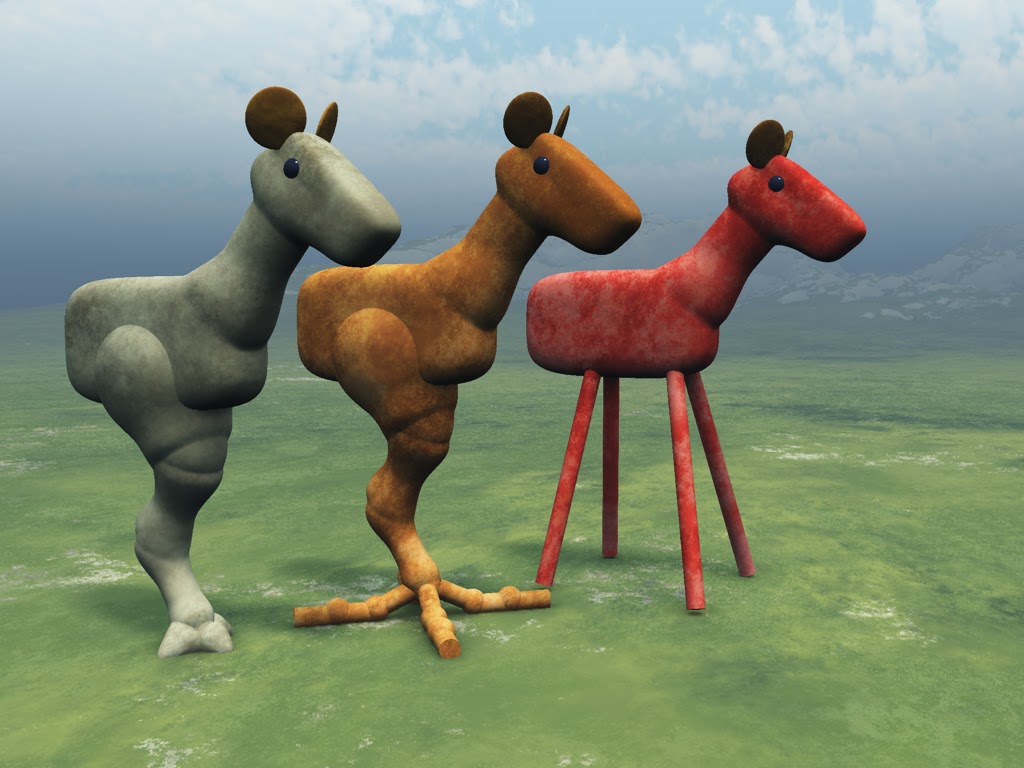
Another big problem for a monopod would be stability, as shown above. Standing on three legs or more is easy, because there is little skill involved in holding the centre of gravity over the support area on the ground, defined by the points where the feet touch the ground. Bipeds can only stand upright with a sophisticated neural control system. For a monopod such as 'Unipes disneyi', on the left,  the support area is small, requiring an even more sophisticated control system. Sideways forces would pose a very large problem for monopods. Wind is more likely to blow very small animals over than larger ones, and for insects and the like it pays to splay their legs: it produces a large support area. So, alien monopods perhaps should probably not live on planets with very dense atmospheres. The obvious way to solve that problem would be to have long toes sticking out in all directions: the middle monopod in the illustration. They would have to be very strong to counter a tendency of the body to move. In this respect the toes would probably be inferior to legs that stick out towards the same points on the ground but starting from the body, shown on the right. But if the starting point is one leg, the toes would probably be the answer. I do wonder about the body scheme of an animal with just one leg; would that preclude the presence of other paired limbs or organs?        

Finally, having one leg results in no redundancy whatsoever: a monopod with a leg injury is probably doomed, whereas a biped might limp away, and a millipede would simply continue on its way.

Click to enlarge; copyright Gert van Dijk
Are there workarounds? I am tempted to think so. Take the large-toed animal at the left above and make it stand on the tips of its toes. Evolve it a bit to get the animal at the right: the toes get bigger and the upper part of the leg shrinks. Now that animal could just swing one toe forwards while keeping the other ones on the ground. By repeating this movement for the other toes it would no longer need to jump up. But what that does, obviously, is upgrading the status of the toes to that of legs, and then the animal is no longer a monopod but a secondary tetrapod. And a very silly one at that.   

Saturday, 24 November 2012

Thomastapir’s Xenohox Gazelle

Readers who have followed my Furaha work and this blog will know that I take a strong interest in biomechanics and locomotion, resulting in studies and animations of concepts such as six-legged gallops, radial walks and tetropter flight. There is of course another drive at work, and that is the wish to create something new, something truly alien. Given the immense diversity of life of Earth I used to feel that there probably was not that much that blind evolution had not yet stumbled upon, but later I felt that the limited number of basic animal shapes on Earth does in fact pose limits on the shapes we see, varied as they are. Hence forms such as spidrids and tetropters that I consider among my most original animal schemes. But at heart I am a bit conservative, which is why I hesitate to depart from known and tested body schemes.

Luckily, not everyone lets himself be restrained in this way, and that is why I would like to draw your attention to the work of thomastapir, whose work can be seen at deviantART. Like me, he likes locomotion and biomechanics, and he has produced some truly original creatures. I will only focus on one of his aliens here, but his dinosaurs and mythical beasts are well worth an visit. I will very likely revisit his page one day to discuss the 'Moebius inside out animal'.

Click to enlarge; copyright thomastapir

Xenohox Triphidian
I should perhaps jump right in with the Xenohox gazelle, as starting there will give you the full sense of wonder, but it would need a lot of explaining at once. Starting with this forerunner, here in its original place, has the advantage that its shape can be taken in fairly easily. Now this shape is new. One way to look at body shapes is to smooth the surface of animals until the shape cannot be reduced further, revealing its topology. Limbs, as simple protrusions, disappear, and our own vertebrate shape reduces to a blob with a hole through it, i.e. a torus: our digestive tract forms the hole. Jellyfish have no such hole, and can be reduced to a blob, or probably even a sheet. Thomastapir's animal represents three half tori mashed together.

Click to enlarge; copyright Gert van Dijk
That is what you see above: the blob on the left with a hole through it represents humans and our Earth kin us reduced to our basic topology, whereas the more complex structure on the right is the triphidian. The points where the three half tori join would be natural spots to place the machinery of an animal, meaning its digestive, respiratory, cleaning and neural tracts, along with other odds and ends that need not be universal, such as spleens. The legend on the deviantART page does state that the 'bodies' indeed house the organs. One is called the head and the other the body, which is almost a pity: departing the beaten track should perhaps be accompanied by more original anatomical names as well.


Click to enlarge; copyright thomastapir


Xenohox Gazelle    
The animal above, the 'Xenohox Gazelle', has the same topology as the triphidian. To develop it, we can pull at the surface to produce extrusions, in the same way we can pull at a single torus to sculpt a human or a millipede. The result of this sculpting are three strong limbs. 

You will probably need time to work out how this animal is built, and understanding how it moves will take more study. Thomastapir's remarks on his deviantART page explain how it works. He has chosen to keep the triradial anatomy fully intact. Others -well, me at any rate, see here and here- might have decided to let two of the half tori develop into weight-bearing structures, freeing the other one for other uses such as manipulation. Thomas kept all three as equally functional locomotor limbs, which inevitably leads to the conclusion that the animal must turn along its body axis to bring each limb towards the floor in turn. That is very interesting but also very complex. You will need a good ability to visualise movement in your mind's eye to understand it. This is the task: the animal is running across your imaginary field of vision, its body spinning like a screw as it does so. Each leg rotates along with the body, and when it is pointed downward, it also moves backwards pushing at the ground. When it moves up again it also moves forward. If you manage to visualise that, add the two other legs, of course with the proper phase difference. Got it?


If you did not, never mind, as I prepared an animation to help you see how it works. I am fairly pleased how it turned out, although it seems to move more ponderously than the name 'gazelle' suggests. Perhaps I stumbled along the analogue of a heavy eland antelope instead of a slightly built gazelle. 

I do see one problem with this way of movement, and that is that it adds complexity to sensing the world around you. The eyes turn with the animal, so the visual field continually turns around as well. That cannot help vision one bit. This is very similar to the problem I encountered in 'cernuation'. There was a solution though: the head would turn against the movement keeping the eyes still (of course, after one turn the head would have to snap back to allow a new counter turn). When I mentioned the vision problem to thomastapir he answered the following:  

"On the complication of vision due to rapid rotation about the long axis--it could be a matter of, let's say it has three eyes, that each eye takes a sort of "snapshot" at specific point in its motion cycle--say, when the given eye reaches the top of its rotation.  So then a composite or gestalt image is built up sequentially from those single snapshot images, almost like a flip book or film strip.  The rate of rotation is rapid enough that it should create a fairly smooth, uninterrupted stream of visual information. And certainly it could keep one or more eyes continuously open when it's motionless or walking slowly." 

That would probably work, but is not ideal either, as visual information would be lost some of the time.

 
Anyway, above is another animation with added drama. Nice, isn't it? The topic of how such animals stand still or walk slowly also came up in our conversation, and it appears there are several solutions for this. Would evolution leave the animal this way, or would it evolve towards a simpler 'same side up' form? Would its particular set of hox analogue genes even allow such an evolution? I do not know, nor do I care much, while enjoying the creativity of the Xenohox gazelle and its mode of locomotion. 

Saturday, 1 October 2011

"Maybe if you stick on another leg at the end of the tail?"

Designing a novel way of walking for extraterrestrial animals is complicated. I tried my hand at designing gaits for large hexapodal creatures (see the main Furaha site), radial walking patterns and also explored walking with an odd number of limbs. In all such efforts the trick is to achieve something that looks interesting as well as believable. In the context of speculative biology 'believable' is balanced somewhere between 'Earth normal' and weirdness. One thing is clear though: you cannot get a believable result by assembling an animal of leftover bits and pieces, such as just sticking an extra leg on the end of a long tail.

Or can you? As usual, evolution on Earth manages to come up with designs that, if invented by a mere human, would fall in the category of unacceptable weirdness. The following video shows an insect that looks odd, but oddness by itself is fairly normal for insects. Look how it moves: most of the time insects walk with a double tripod gait: the front and hind legs on one side move in unison with the middle leg on the other side. When these three legs touch the ground they form a stable tripod. The other three legs meanwhile are lifted and swung forwards, and when they touch the ground, they will form a tripod as well. The two tripods are exactly out of phase, so when one hind leg is on the ground the other should be in the air. Now have a look at the hind legs of this interesting beastie, a trilobite beetle from Borneo. The original is here.


Its pairs of legs are in phase, a bit unexpected, but slow-moving insects can do that. But that is not all: it uses the tip of its abdomen as an additional unpaired leg. It curves its abdomen forwards, plants its 'leg' on the ground, and pushes backwards with it. Anatomically this may not be a proper leg, but functionally this animal certainly uses seven legs: it's a heptapod!


Here's another video. The beginning shows that this species can also walk with the front legs out of phase, but you do not get to see all legs that well. It is clear though that it uses the end of its abdomen as a seventh functional leg.

Why do these animals walk in this weird fashion? The gait does not look quick or agile. In fact, the animals appear to be rather slow and clumsy. A bit of research points to an answer. These 'trilobite beetles' are said to belong to the genus Duliticola, and using Google with that name results in a paper starting with the brilliantly surrealistic sentence 'There are two trilobite larva species in Singapore.' Apparently, the male and female of these species differ greatly in shape: the males look like typical beetles while the females are neotenous. Now neoteny is a condition in which sexual maturity occurs while the body is still in a larval stage. The axolotl is a famous example, and humans are sometimes thought to display neoteny as well.

But what does that mean for the strange gait of this apparently female insect? Well, it looks a bit like a regular adult insect, with a hard exoskeleton and all, but its general body shape is in fact that of a caterpillar. Caterpillars display complex gaits, not too surprising if you think about their body plan: six regular legs that will become the legs of the adult insect, a number of 'prolegs' (the knobby stumps further along a caterpillar's body), as well as final 'anal prolegs'. All of these are attached to a boneless body, providing endless opportunities of combining walking with stretching of the body. So that explains the trilobite beetle's walk: its' a caterpillar in disguise. Never underestimate insects' capability of oddness.

There is of course more to be told about caterpillar movement. In fact, at least in some species their gut moves inside their body before the outside follows up. The following video show that very nicely as well as the combination of body stretching with using legs. Perhaps there is a risk that you will learn more about caterpillar movement that you bargained for, but personally, I love details.