Showing posts with label hexapod revolution. Show all posts

Tuesday, 27 August 2024

Prober and bobbuck II

Recently, I asked readers which colour scheme they preferred regarding the reworked Prober and Bobbuck (P&B) painting, giving them three choices. The one I chose in the end was the ‘African dawn scheme’, with strong yellow and orange as the main colours. If you see such colours in photographs from Africa, you can be almost certain that the photograph was taken at dusk or dawn against the light. There is always dust in the air in a dry climate, and if you look against the sun, that dust provides the yellow-orange glow. The P&B image tries to catch that feeling, and this is also why the sun is low and we are looking into the light.

Click to enlarge; copyright Gert van Dijk

Anyway, I kept part of the prober’s colours bluish, if only to provide some contrast to the otherwise overly monochromic painting. I read a few recent papers about camouflage patterns to see whether there were new developments (here is a recent textual review without figures as examples). The major theme of that review was that many mechanisms can be combined. The P&B painting shows several mechanisms: background blending, countershading, disruptive colouration and probably a bit of motion dazzle.

Background blending is just what the words suggest, meaning an animal has colours and patterns that make it inconspicuous against the background. Countershading is simply having the underside of the body colour lighter than the top. As the belly of an animal will be shaded by the body, shade makes the light belly colour seem darker, and if all goes well, the result is that the belly is just as dark as the top of the animal. This helps with background blending and makes the animal lose its three-dimensional appearance. Disruptive colouration  means an animal has patches of colour that make the overall shape of the animal more difficult to discern. This works best when the colours of the various patches also appear in the background. Many of these effects work best when an animal is motionless, but apparently some also work when an animal is in motion. In fact, ‘motion dazzle’ describes the effect that the motion of patterned objects is more difficult to judge than that of bland, unpatterned objects.  (tis is not the same as motion camouflage).  

Click to enlarge; copyright Gert van Dijk
 

Back to Furaha and to the P&B painting. The prober and the bobbuck both show multiple camouflage features. Countershading should be obvious in both. Without thinking much about it, I made the belies of both animal an even light colour, whereas I could simply have continued the patterns on the rest of the animal but in lighter colours. Apparently, this occurs in Earth biology a lot too (from where I had unconsciously picked it up). The bobbuck’s horizontal stripes mimick the low hills and patches of low vegetation in the plains where it lives and may also help provide motion dazzle. The stripes are broken, both to break up the outlines of the legs and to increase the resemblance with natural features. The prober has a combination of stripes and spots that again help to break up its outlines. You may note that the stripes are largely at right angles to the animal’s contours. By the way, when stalking and in its initial attack run, the prober holds its ‘raptorial appendages’ (its graspers) back and down, closer to the centre of gravity. Its bright undersides are then not visible from the front. Probers only bring the graspers forwards to the attack position when the hunt is on, when camouflage is no longer an issue.    

Does it all work? You may have noticed that I changed the header of the blog to reflect the updated P&B. Somewhat to my surprise, the shape of the animals is not immediately obvious on such a small picture. That may be because of their fairly unearthly shapes, motion blurring and camouflage. I like it myself, but perhaps I overdid it.          

Was there anything else? Let’s see… Oh yes, both animals of course show features of the Great Hexapod Revolution (here and here), with their kinked distal and proximal necks. You may also note that the functions of the vertical (upper and lower ) jaws are separate from those of the horizontal (left and right) jaws. You will not find advanced hexapods in whom all four legs come together to catch prey; doing so poses overly complex demands on how teeth should work together, so the lateral jaws evolved into food gathering aids. If you look closely, you can see that the prober’s oesophagus runs alongside the proximal and distal necks, and not underneath the joints. You may have to wait for The Book to see that level of detail though.

Speaking of The Book, there is progress. Amazon’s self-publishing scheme makes it difficult to predict colours and shades on the printed page. The only way to get a useful result seems to be to change the colours beforehand, in expectation of then the printers will do with them. Or to them. As this takes trial and error using proofs, I am now at the fourth round of adapting colours, saturation, and brightness, among other things. On screen the results now look garish and cheap, but the proofs are slowly approaching how I wish them to look.       

Sunday, 10 September 2023

What's a head? Or a neck...

Yes, it's a silly title. Isn't a head, rather obviously, that part of an animal where vision and hearing are gathered, along with their associated neural processing units, as well as air and food intakes, along with whichever specialised organs that takes? For air intake, you could read 'nose', and for 'food intake' there is the whole complex assembly of jaws, teeth, a tongue as well as an oesophagus. 

That seems right for humans and other terrestrial vertebrates, but a few moments' thought reveals that 'obviously' does not belong in this 'definition'. Fish have heads but take in water, not air, so the 'air intake' should become an 'inlet for gas exchange'. The hearing organs of many arthropods are not in their heads, and so the associated bits of brain need not be in the head either. The description supposes that the rest of the animal is distinct from the head. But in octopuses there is no distinction between head and body, with the limbs ('arms' that are not accompanied by 'legs') attached directly to the head/body unit. For spiders a similar point can be made that the head is merged with part of the body. 

I could go on, but the point is that a 'head' is not as clear an entity as you might think. A 'head' is the result of 'cephalisation', described by Wikipedia as 'an evolutionary trend in which... the mouth, sense organs, and nerve ganglia become concentrated at the front end of an animal, producing a head region.' I like 'head region': it provides the looseness we apparently need to describe what a head is. 

Furahan 'Scalates' certainly underwent cephalisation, and their heads definitely contain eyes (four of them) and ears, in terrestrial forms (also four) along with enough brain to do the heavy duty processing these organs require. But the 'intake for gas exchange' is not in the head at all. The intake for food is there, with jaws (originally six, later four) at the front of the animal, so clearly these are in the head. Well, that depends... 

Click to enlarge; copyright Gert van Dijk

A clade of Furahan Fishes ('Fishes V') developed a 'neck' in the form of a two-bone articulated connection between the body and the 'head region', allowing the latter considerable freedom of movement relative to the body. The thing is that a similar 'neck' also evolved between the 'head part' housing eyes and ears, and the mouth region. Are there then two heads, or is the entire region one head? 

The two necks, usually called the proximal (closest to the body) and distal (farthest from the body) neck, each consist of two long bones with a joint in between. The two 'heads' are the 'sensocranium' and the 'orocranium'. The image above shows a fragment of a painting showing a species of Fishes V with just that arrangement. You cannot see the joints in the necks clearly in these streamlined Fishes, but they are there. Those long neck bones form a big difference from the kind of vertebral columns we are used to, with their string of many small bones. Early Scalates never had a central string of small bones for evolution to play with; instead, they had a 'ladder'. The resulting neck movements look rather like those of a vertebrate arm or leg, with sharp angles, not at all like the curves of a lizard tail or a giraffe or sauropod neck. But that ungainly look need not be a functional handicap; despite the sticklike nature of human arms, baseball and darts players manage to land small objects with incredible precision quite a distance away. Of course, the trick is having a good brain in control.

We now only need to discuss bending of other organs in those necks, such as the oesophagus. An oesophagus relies on peristalsis making it flexible and elastic, so the structure itself should be able to withstand folding for a while. The nerves and arteries in our shoulders and elbows have to withstand bending too and usually do so fine. (Admittedly, if you spend too long in one position local pressure may pinch blood vessels, so people occasionally find that an arm or a leg, or just one nerve, has 'gone to sleep'.) If the oesophagus would be folded, it would probably be incapable of propelling food. If so, the distal neck has to be straightened between bites to allow the animal to swallow which is not a problem and looks interesting. Perhaps a different problem is that the length of the oesophagus may have to vary with neck position. If the oesophagus lies in front of or below the neck bones, as it does in humans, bending the neck backwards and upwards requires the oesophagus to lengthen. It has to be elastic anyway, so some degree of lengthening should not be a problem. 

Click to enlarge; copyright Katrina van Grauw

There is another solution though. In birds, the trachea (windpipe) and oesophagus do not commonly lie in front of the neck vertebrae, but to one side. This is not the exception but the rule, in fact, as shown by this paper. Most often the trachea and oesophagus lie toon the right side, but that can differ between individuals, with recorded examples on the trachea on one side and the oesophagus on the other. If birds bending their generally long necks, the oesophagus does not have to follow the bones. The oesophagus literally cuts corners. 

Click to enlarge; source here

The two images above show this odd anatomy very clearly, with a heron as an example. One is from the excellent work 'The unfeathered bird' by Katrina van Grauw, and the other is from the paper mentioned above. The oesophagus runs almost in a straight line when the neck is curved, which also means that the oesophagus is then much shorter than when the neck is fully extended. It has to be very elastic. The explanation for this arrangement is that the trachea and oesophagus can move so freely because they are not restrained by muscles as is the case in mammals. Some birds can swallow enormous prey (herons again) which also requires that the oesophagus has freedom of movement. 

Click to enlarge; copyright Gert van Dijk

I am revising an older image of a herd of large hexapods thundering into view. To get a better idea of their heads, I sculpted one in Zbrush. 

Click to enlarge; copyright Gert van Dijk

 
Click to enlarge; copyright Gert van Dijk
 

As you can see, I played with a lateral position of the oesophagus. The oesophagus forms a distinct bulge on the left side of the distal neck, cutting corners in bird fashion. The sensocranium sports shields and horns to impress others of its own species. When the animals start bashing one another's heads and necks, the necks should be protected too, so the middle joint of the proximal neck also bears some shields. So here is the somewhat baroque Latifrons augustus ('elevated broad-brow').

Saturday, 26 February 2022

Tabulae Mortuae V (Archives XV): Digital paintings die too...

 Every now and again I show an image from the Creature Vaults, those hidden domains where old sketches, failed paintings and discarded designs find their final resting place. 'Final', unless they are dragged out to be presented to the world, usually for the first time.

Click to enlarge; copyright Gert van Dijk

This image is one such, and it is the first to come from a vault without physical form. Other vaults consist of large cardboard folders, or of stacks of oil paintings carelessly stacked against the back wall of a closet. This vault is digital.

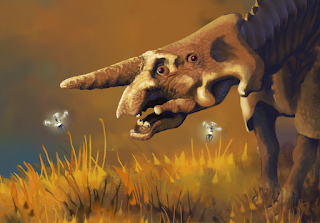
I started the conversion of the Furaha project from oil paintings to digital art some 11 years ago. The project, now nearly done, changes as time passes. The Great Hexapod Revolution had as a result that legs, heads and jaws or earlier hexapods no longer followed my self-imposed rules. The changes were too large to be solved with moderate cosmetic changes (I tried), so many paintings are now seeing a 'Mark II". In fact, some started as oil paintings (MkI), were later redone as digital paintings (MkII), and are now revisited to become MkIII. Mind you, most paintings these days are entirely new.

Click to enlarge; copyright Gert van Dijk

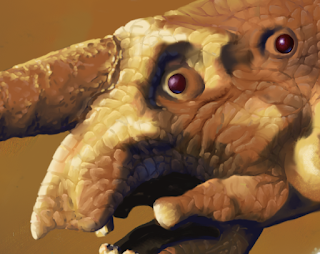
Here is some more detail of the head of this now defunct animal. It is a pity that I had to discard it, as I rather like the painting. But I kept the overall design and colour scheme for the MkIII version, which is nearly finished, and looks just as well or better, I think.

The animal is a 'thresher', with the Latin name 'Ira tarda'. That means 'slow anger', a name that was inspired by memories of an old teacher of mine. Threshers are solitary, grumpy and are best left to their own devices. They do have to meet from time to time, in view of the perpetuation of the species, but their behaviour at such times gives little indication of a mood upswing. Best not talk about it, really.