Sunday, 24 April 2011

Three years on

More than once in the three years I have been writing this blog I thought there were no more interesting speculative biology projects to be found on the internet, but each time I was wrong. Will the supply dry up? Perhaps not: there are more and more exquisitely detailed Z-Brush monsters, but mostly those are orcs, dragons and the like. In other words: they are not very interesting from a biological point of view. The reverse situation can also be found: well-thought out projects with artwork that does not do it justice. I guess I will simply have to wait and see how much content I can find to fill the 'allied matters' component of the blog. The number of page views slowly went up over time, which is rewarding.

So how about the 'Furahan biology' component? There is progress, if you account for the glacier-like advance of a very large project that you do not really have time for. Then again, in the last three years I got to grips with InDesign, Photoshop, Painter and XBrush (not that I am proficient in any). The most noteworthy skill I am trying to acquire is digital painting, which is the most needed one. I think I need to do some 10 additional illustrations of the "It's a fish" type, and then I will have some 15 two-page spreads to show to potential publishers. An example of those can be found in the New Hades book shop on the Furaha site: got to the brand new 'Living World Series' and you will find the 'Encyclopaedia of Furahan Wildlife' (also shown here). I aim to use that lay-out to present the book to publishers.


Rough tetropter animation; copyright Gert van Dijk

It is not difficult to think up many new animals or plants; many forms that I have now could do with some adaptive radiation. But my interest is mostly aroused by more complex puzzles. As an example I will explain the struggle to produce a good tetropter flight animation. The basic principles have been outlined before (start here to work back in time), but for good measure I have repeated an old animation above. As you can see the animal is shown from below, and the four wings move to and fro while rotating. They also move through one another, because the animation uses stiff planes for the wings: it is not good enough. I want a better one firstly, because I am curious: I wish to see what a spotted farfalloid looks like, when its beating wing reveal electric blue surfaces at one point in their cling and flap cycle, and bright orange ones the next! The second reason is that I would like to paint a variety of tetropters -talk about infinite variety-, and getting the perspective right of four warped surfaces in complex motion can be done by hand, but would be easier to manipulate by computer. I will break the problem into pieces:


Problem 1: defining movement
The wings can easily be modelled as surfaces in Matlab. These move through the wing cycle, meaning there are different requisitions for movement around the x- y and z-axes. To control them I wrote editing programs, now nearly done. The surfaces cannot remain simple planes throughout the movement cycle, but will have to be bent and warped. The animation above shows where I am now, meaning at the phase where all the 'warp factors' have to be tweaked to get it right. What you see here represents 'untweaked warping' though!

Problem 2: exporting the wings
The 3D program I am most familiar with is Vue Infinite. I had already written a program to convert Matlab patches to obj. files, which helps. But I then stumbled upon a new program, ad that was the imported wings for successive frames did not end up at the same spot in the scene. Apparently Vue calculates the mean of all x-, y- and z-coordinates to calculate the centre of an object, and if the object changes shape so does it centre. Well, I can counter that by shifting the object each frame to compensate. This needs work...

Click to enlarge; copyright Gert van Dijk

Problem 3: texturing the wings
Obviously, the wings will need interesting patterns on them as well as partial transparency. That, as well as bump maps, proved to be in the obj. definition and could be manipulated.
Here is a rough example of a warped wing with transparency and all in Vue.


So now you may understand why it has taken such a long time to put up a 'Flying with...' page, along the 'Walking with..' and 'Swimming with...' pages: the tetropter flight animation has to be ready first, and that is a big job.

Saturday, 9 April 2011

"A Venusian Bestiary", in Which Greg Broadmore Illustrates Monsters Before They Are Gracefully Slaughtered

"By golly, that's a splendid specimen! Blast its head off so we can turn its legs into umbrella stands, what?!"

This is not a literal quote from Lord Coxswain, but it might perhaps be one, suggesting a somewhat utilitarian and egocentric attitude. Lord Coxswain is a character from the 'Dr Grordbort' universe, in which Victorian style people (well, men, really) travel to Venus and have a jolly good time, helped by rayguns designed by 'socially inept boffins'.


Here is a short video to set the atmosphere: "Venus is doomed part II" (also found on YouTube or on the Dr. Grordbort page. As you can see, Lord Coxswain's attitude is that the last surviving animals of a species had best be bagged quickly, lest some other fellow acquire it for a foreign museum, and that wouldn't do, would it? Hence, Coxswain and his fellows -good chums all- take a healthy pleasure in shooting anything alive, animals, natives, whatever.

The person behind this yarn-ripping steampunkish universe is Greg Broadmore: a painter, creature and prop designer working for Weta in New Zealand. If neither 'Weta' nor 'Greg Broadmore' rings a bell, let me remind you of the dinosaurs and other creatures in King Kong, District 9 and other Weta work. Absolutely brilliant illustrations. In fact, Mr. Broadmore's work has featured twice before on this blog: once as a riddle animal (also here) and once when the King Kong book was discussed. He now develops the 'Dr Grordbort' universe, which has already yielded two books, rayguns you can buy (really!) as well as some stuffed Venusian insect-analogues that you can hang on your wall (really! Here's one and another).

I think his creatures are fascinatingly creative; he does dinosaurs, insectoids and various other stuff, and all of it so lively and so extremely well painted. There is also quite a lot of his material to be found on the internet. The 'Dr Grordbort' pages show that particular universe, and besides that he has his own website with a few galleries of work. If that is not enough he was interviewed at some length (part one and part two) on a website on creature design that most of you will probably like a lot even without Mr Broadmore's work on it.

In fact, those links should be enough to make this post worthwhile, but let me add a fairly large series of paintings on Venusian wildlife (these are not all). In time-honoured fashion I shall present my ramblings on what I think of their anatomy. The images were all taken from the sites mentioned above and are presented at a nicely large size, so be certain to enjoy them as best you can.


Click to enlarge: copyright Stardog

The shallow-beaked grogan's four columnar legs suggesting a large size (Venus' gravity is about that of earth, so relationships between body mass and leg diameter should resemble those on Earth, assuming bones of equal strength. I like the neck design: like limbs, necks could consist of a few large segments instead of a larger series of small ones. The 'biramous' (split) design of the front legs is also interesting, and is a basic characteristic of Earth arthropod limbs. Having part of the limbs fused must call for some dextrous motor programming, as I wrote earlier.


Click to enlarge: copyright Stardog

I cannot immediately think of a purpose for the sail on the back of this thingy, and in such cases sex is always something to keep in mind; perhaps the sail is a prop to impress its mates. The arms functioning as jaws are rather nice. Again, such designs work well in Earth's arthropods, and there is no reason to assume they would not work on bigger animals. But are there no eyes? Or are the spots arranged in a row along the head all eyes?


Click to enlarge: copyright Stardog

A large knuckle-walker with switch-blades for toes; is it a predator or are those for defence? It does not look particularly fast, so to be a a predator its prey should be very slow. The other Venusian beasties look quite athletic, so I would guess it's a herbiore or omnivore. There are more 'headarms' here, and I think there are eyes. lots of them.


Click to enlarge: copyright Stardog

Now this one needs some explaining. Its body is slung low, and the legs zigzag a lot and are splayed, meaning that this stance calls for lots of energy. It could be a jumper, but it looks very large for an ambush predator. The whole front looks like a giant mouth, with the four black prongs resembling canines. This time I really see nothing looking like eyes. Not having eyes is probably a very unlikely event in animal evolution. Eyes seem to evolve so easily and must convey such advantages that it is hard to think of a reason to stop them evolving. All you need to start is some light sensitive tissue, some movement ability and the most basic of nervous systems, and you are off (unless there is total darkness).


Click to enlarge: copyright Stardog

Ooh, another jumper: Unwin's double-backed shrovel. The viewpoint does not suggest great size, and the Grodbort pages show it to reach knee height. It is wonderfully alien.

Click to enlarge: copyright Stardog

This one reminds me a bit of an okapi: that must be the sloping back and the colour pattern. I wonder why there is a segment of both the hind and front legs that cannot do much mechanical work as depicted, because these segment more or less double up against the next segment. Then again, perhaps that is the point: these segment don't do anything in their current stance and are not supposed to. Once unfolded, they might be used to advantage, and this is just their 'fold after use' aspect. Well, if it isn't true, please admit that it is a nice idea.
Again, no eyes, I think. Barlowe tried animals without eyes (Darwin IV in Expedition), and I thought that that was a mistake, particularly if you do have bioluminescence.


Click to enlarge: copyright Stardog

Ha, some action! Coxswain in motion against the dimple backed vroxel! As I said, the feet, once divulged of bones and cleaned of flesh, do make excellent umbrella stands gracing any home.


Click to enlarge: copyright Greg Broadmore

More action! But just wait a minute... That's not a Furahan rusp, is it? (rusps are on the land page or directly here). It might be; it could be! What! We cannot have people like Coxswain murdering Furahan animals left and right!? That's no way to behave! Is he mad? The murderous swine! Stay off my planet!

Saturday, 26 March 2011

Swimming in Sand III: real and robotic sandswimmers

The previous two blog entries on sandswimming animals (here and here) made it clear that those who wish to populate their fictional worlds with animals swimming in sand will either have to restrain their fantasy or choose to forgo realism. Sand is not a forgiving medium; a 400 m sandworm, as in Dune, must shift millions of tons of sand to move, which is simply too unlikely to consider. While that reasoning argued against giant sandswimmers, the fact that any sandswimmer must lift all the sand above its body restricted the choices even more: sandswimmer cannot dive deeply. Facts can and often do spoil beautiful fantasies; sorry, but that can't be helped. This leaves sandswimmers as fairly small animals that swim just beneath the surface. Not surprisingly, this describes real sandswimmers quite succinctly. There appear to be several: there are various lizards and at least one mammal, the African golden mole rat.

http://www.nordicphotos.com/en/details/1350398

Here is an image of such a mole rat: Eremitalpa granti. There do not appear to be many studies focusing on how mole rates 'sandswim', but what there is reveals some interesting facts. Apparently someone has already measured how much energy it costs: sandswimming costs 80 times as much energy as running on the surface! That is a heavy price to pay, but sandswimming is still much less costly in energy terms than burrowing, i.e. scraping at the soil and carrying it away to create a tunnel that will last for a while. Of course, you can use a tunnel many times, meaning its cost decreases as you use it more often, in contrast to sandswimming: each trip is as expensive as the next. Unfortunately I could not find any video material of a mole rat sandswimming, so I cannot show you that (the main -but not only!- reason being that such a video might show some sand moving, but not the mole rat underneath...). But if you wish to know more about them, there is at least one nice entry on them in Darren Naish' justly famous Tetrapod Zoology blog.

I did find something else that is interesting for those who wish to design sandswimming animals: how do they breathe? There are two problems here; if breathing involves expanding the chest against the outside world, the sandswimmer is in trouble, as that would require some additional shifting of sand. So you had better design an air pump that only shifts volumes within the body, keeping the external volume unchanged. The second problem is whether the poor sandswimmer can extract enough oxygen from the air between the grains of sand; if it then breathes out, does the air circulate fast enough to get fresh air with the next breath? Perhaps it should suck in air at one end of its body and exhale it at the other (that is what Furahan hexapods do, but not to enable sandswimming). Problems, problems...

You had better make the animal small and give it a low metabolism, so it will not need that much oxygen. Well, someone studied how mole rats breathe (Seymour & Seeley. J Arid Environments 1996; 32: 453-461). The authors did some mathematical modeling and concluded that mammals weighing up to 200 grams could comfortably exist completely encased in loose sand. Mole rats are a lot smaller than that, at 15-40 grams, but that upper limit of about 200 grams does not exactly allow for an impressively large sandworm. Before anyone corrects me, I am aware that Dune's sandworms are supposed to produce oxygen, not use it. But if anyone wishes to create a sandswimmer with a more conventional type of metabolism, this is something to reckon with.


Sandfish disappearing under the surface
Baumgartner et al PLoS One 3(10): e3309. doi:10.1371/journal.pone.0003309


Click to enlarge; Baumgartner et al PLoS One 3(10): e3309. doi:10.1371/journal.pone.0003309

There is much more research going on concerning sandswimming lizards (perhaps they are easier to keep in a terrarium). One species is even called the 'sandfish' (Scincus scincus). Over the last few years people have studied their mechanics and came up with a few interesting results, the main one being how they actually swim. At first there was a notion that they used their small legs to loosen the sand to make it more fluid, allowing them to swim through it by undulating their bodies. These researchers used nuclear magnetic resonance to take a look through the sand. The image above shows such an NMR of a sandfish beneath the surface. As the legend says, the legs are sticking out; but is it at rest or actively moving?


Click to enlarge; Maladen et al. Science 2009; 325: 314-318

Afterwards other researchers went one further and used high-speed x-ray imaging. While diving the animal does use its legs, but while sandswimming it keeps its legs close to its body. Here are some images of how it does so. Above the surface its legs stick out in typical reptilian fashion (C) but they are held back when the animal is swimming (E). The body goes through very pronounced sideways movements in order to move forward a bit; it does not look like an effective means of propulsion at all.


You might think that that is the end of the story, but not so. People actually built a sandswimming robot that undulates just like the sandfish does. That is what the video above shows, along with some more footage of an actual sandfish. There is a nice page at PhysicsCentral with some more data on this particular study.

Compared to a 400 m Sandworm of Dune a 40 gram mole rat or a sandfish lizard are less imposing. Then again, they are real, and I personally find the scientific story of how sandswimming really works just as exciting -in a different way- as a good science fiction story. I can't wait to find out what's next.

Sunday, 13 March 2011

Hot Summer on Furaha

While thinking of new posts, I finally took some scenes I had prepared much earlier and assembled them. I have tried my hand at making animations before (here and here), but will stop doing so for a while. The program I used to to define plants (XFrog), does not allow for a full wind animation, and without that you cannot really animate natural scenes well. Vue Infinite, the program I used to render scenes, can in fact take care of moving foliage quite well, but its plant editor is sadly not open enough to allow me to define interesting alien plants. That is the main reason that this scene depicts a hot day: there is no wind at all. For fairly obvious reasons there are no animals to speak of, or at least none galloping through the landscape. You will need your imagination for that, I am afraid.

When an animation is lacking in movement it cannot work very well. Then again, I did like the way the 'time lapse' scenes came out, particularly the one in which you see the planet spinning during the night. The direction of movement of the stars (straight up) tells you that we are near the equator.

[Later addition: I guess I did not pay enough attention to logic. In the last scene you see the sun setting at a fairly low angle. If we would really have been near the equator, as suggested by the movement of the stars at night, the sun should dive towards the horizon at a more or less right angle...]


Anyway, here it is. There is a large ballont passing by, and look out, or rather, keep an ear out for splatterbugs at sunset.

There is a larger version on YouTube.


Sunday, 6 March 2011

The Creatures of Bobby Chiu

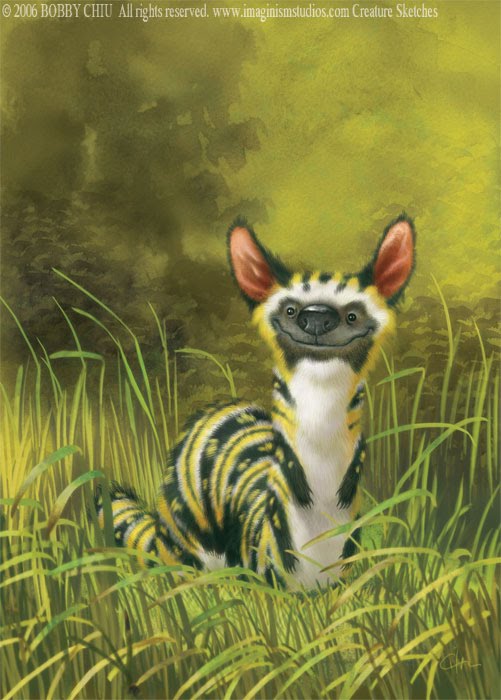
It is quite possible that just about everyone with an active interest in paintings of fantastic animals has already seen the work of Bobby Chiu. If not, well, then I am happy to introduce his work to you. It does not really fit that well with what I normally discuss on this blog: I like a hefty dose of science in my creatures, and Mr Chiu's work does not provide that. But I have made exceptions in the past before (for instance here and here). On looking back at the exceptions I realised that I am never much impressed by fire-breathing dragons and aggressive mean-looking monsters. There are plenty of those to be found on covers of books or on Deviant Art, so it is not a lack of availability. Instead, a sense of humour is more important to me, and Mr Chiu's painting have that in abundance. If you wish to have a closer look, here is his own site, and you will also find him on Deviant Art and on the CG society. Or just try 'Bobby Chiu' on Google.

Click to enlarge; copyright Bobby Chiu

Did I mention that he is an incredibly good painter? Just look at the composition of this one. You really have to know what you are doing in order to lay out your subject in this way.


Click to enlarge; copyright Bobby Chiu

A 'Kangamolerat bunny'. I guess the name says a all: bits of kangaroo, naked molerat and bunny. I do not think I have to point to this cutie's dark side. I love the way the light strikes the rock wall behind the bunny.


Click to enlarge; copyright Bobby Chiu

A Baterpillar Farret. What else?

Click to enlarge; copyright Bobby Chiu

And a 'Big Bad Bunny Eater'. Mind you, there is some serious biology here: the real bunnies are obviously attracted by the fake one, so this is a nice example of 'aggressive mimicry'. Mimicry describes the situation where one living species resembles another one for some purpose. It is not camouflage, in which an animal merely tries to blend in with its environment. In defensive mimicry animals may look like more dangerous ones, which stops them from being attacked. But in aggressive mimicry the predator does the trickery, usually by mimicking something the prey is interested in. In this case, you wonder what it is about the fake bunny that so mesmerises the real bunnies? Could it be sexual attraction? It wouldn't be the first time a pair of pretty eyes led a man/bunny to his doom.

Click to enlarge; copyright Gert van Dijk

All this reminded me that I had once also painted a fictional animal displaying aggressive mimicry. The painting was done when I was about 20, and now, some decades later, it is lost; all I have is a poor black and white image. That is just as well in a way, as I would not dare to compare my painting skills with those of Mr Chiu. But the subject matter does lend itself well to a comparison: somewhat dumb herbivores are lured to a sinister fate by a predator with a cunning plan.

Oddly, both Mr Chiu's predator and mine seem to take a perverse delight in what they are doing. Perhaps there is 'aggressive mimicry' going on at different levels here: the humour hides something sinister, creeping through...

Sunday, 20 February 2011

Swimming in Sand II: some facts, more fiction ('Tremors' & 'Primeval')

The previous post and the appendix dealt with Dune's sandworms, and how difficult it would be to getting millions of tons of sand out of the way to make such animals move. While the hard-boiled scientist in me rejected them as utterly impossible, the somewhat more romantic SF fan, also inside me, decided not to care one bit.

The size argument probably means that any real sandswimmers, by which I mean those on earth and in serious speculative biology projects, had better be small. Are there any other limitations on what they can do? Can sandswimmers dive as deep as they like?

I searched for an answer by looking at the physics of soils. Not surprisingly, the pressure in sand or another type of soil gets deeper the deeper you get, the same as pressure increases with depth in water. Typical soils contain not just grains of sand, but water as well. That complicates matters because there are separate pressures of the grains and the water between them. Luckily we can forget the water component as we are dealing with pure, dry sand. Comparing the effects of depth in water and sand reveals that sand isn't really a fluid.. They have in common that pressures increases with depth, and more so in sand, as it is heavier. But in water the extreme pressure at the bottom of an ocean trench does not stop fish from moving at all, whereas I imagine that movement is impossible under even two (maybe even one) meters of sand. While this seems intuitive, I found no readily available physical explanation. I suppose it has to do with the internal friction between grains of sand.


Click to enlarge. From: Baumgartner et al. Investigating the Locomotion of the Sandfish in Desert Sand Using NMR-Imaging. PLoS ONE 3(10): e3309. doi:10.1371/journal.pone.0003309

Loosely packed sand can be shaken, and then it sort of acts like a fluid. The image above is in fact from a study on sandswimming lizards, in which the authors speculated that decompacting sand might make it more fluid.

Click to enlarge. Copyright Gert van Dijk

But simply adding more sand on top would cause the sand to become impacted, and then no amount of shaking is going to create spare room. That is what is shown here. If something (a sandswimmer!) starts pushing a number of grains upwards, an entire column of sand above needs needs to be shifted. In fact, initially that column might look more like a cone, until the grains start shifting. At any rate this is real work.

What all this suggests is that pressure limits swimming in sand to superficial layers. A consequence of that would be that you would see the surface move when the swimmer is passing. It does not seem likely that sandswimmers can swim up to a potential victim without that victim being aware of the sand apparently moving of its own accord. Obviously, if the sandswimmer is a herbivore, any plants it is creeping up on wouldn't notice that. But sandswimming predators that wish to devour surface-walking prey had better do so from an ambush. Having said that, let's have a look at more fictional sandswimmers.


'Tremors' is a film about monsters ('graboids') that beleaguer a small community in a desert environment. The graboids swim under the sand at an amazing speed. As you can see from the video clip, they do break the soil above them, so the filmmakers gain some points for that. The speed at which they move is ludicrous, I am sorry to say. I couldn't see how the animals move: no bristles or legs or anything else I could find. The scene in which the graboid crashes into a concrete wall is wonderful from a story-telling point of view, but less so from a biomechanical point of view. It's not that the animal wouldn't get hurt, hitting concrete at that speed, but that the packed sand it moves through with ease would in reality provide a similarly unyielding obstacle. Anyone who ever took a failed dive and belly-flopped on water knows how hard water can be when struck at some speed. Now take the same dive on sand: there wouldn't even be a dent in it. The same principle is at work with sand sacks: they stop bullets. So I am sorry once again, but graboids are not feasible as shown. As was the case for Dune, I do not think that this harms the enjoyment of the film in any way. Apparently, the needs of fiction outweigh the needs of facts (Mr. Spock might have said that, but I did). Luckily 'Tremors' has a lot of humour in it, so I feel the same about it as I did with Dune.


The scene above is from a British television series called 'Primeval' in which time portals come into life now and again, allowing past and future wildlife to blunder through and run amok in England. In this scene a villain has captured some Silurian scorpions and uses them to terrorise a beach. The scorpions are a lot bigger than they were in reality and are supposed to be excellent sandswimmers, with lots of long limbs sticking sideways. Hmm; that can't really help their sandswimming abilities. When they approach, sometimes you see the sand move, particularly when the scene require drama to be built up, while at other times the scorpions strike without causing as much as a ripple on the sand.

There is a delectable irony in the Primeval scene. A man has been buried in the sand by his children. This is what people do at beaches, and if you search Google or YouTube, you will soon find examples of people being unable to free themselves, especially when the tide comes in: one wave of water can undo a minute or two of frantic digging by bystanders. In the Primeval scene, the buried man cannot free himself, and through this nicely illustrates that humans are very poor at sandswimming. And then the scorpion swims in, from deep beneath the ripples, and sucks the poor man under. Unfortunately, there is nothing about a man-sized scorpion that would make it a better sandswimmer than its victim. I guess the reasoning was once again that "The needs of fiction outweigh the needs of facts".

Saturday, 12 February 2011

Swimming in Sand 1a: Dune appendix

Strictly speaking this post has no exobiology in it, so has no place here. But I could not resist digging up the only painting I ever did of an existing work of SF, and that was Dune, the subject of the previous post. So here it is. The painting is (shockingly) old, but the lettering is all new.

(Until now New Hades Publishers specialised in nature books -have a look at the Furaha site-, so this must be a new approach for them.)


Click to enlarge; copyright Gert van Dijk

Why no sandworms? As I said before, for me Dune was about people foremost, and sandworms second.