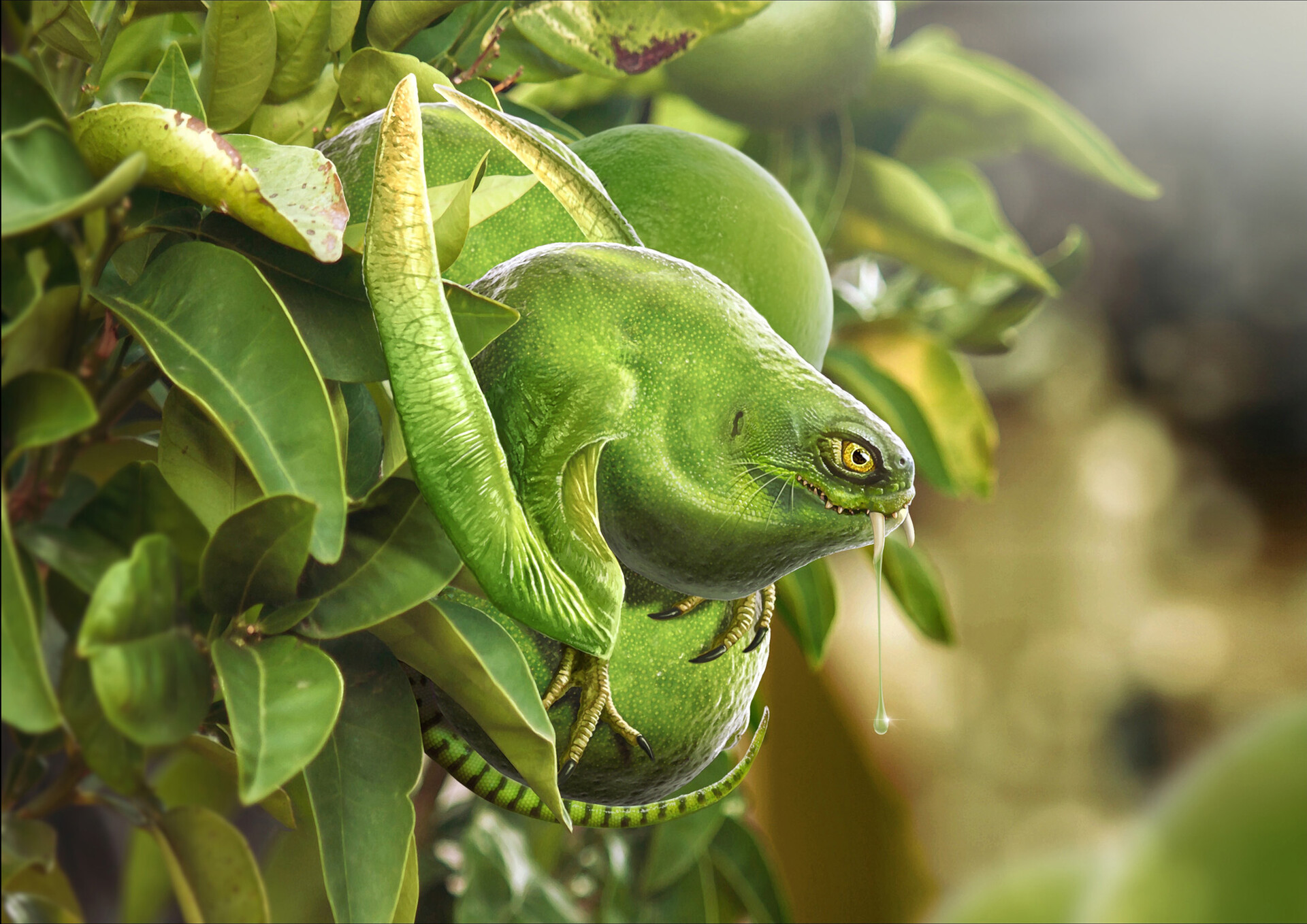
Showing posts with label Dragons. Show all posts

Sunday, 24 July 2022

The Dragons of Wales

Dragons have featured a few times on this blog already, even though I have no particularly strong interest in them; well, no more than in other fantastical or unusual animals. Earlier posts are here, here and also here. The last times 'dragons' popped up in this blog had to do with how the prototypical dragon has two wings as well as four legs, not exactly typical for Earth animals. The most common Earth 'wing plus legs' combinations must be 'six legs plus four wings' (insects) and 'two legs plus two wings' (vertebrates: birds, bats, pterosaurs). As dragons are typically large, let’s forget about insects as dragons; even 'dragonflies' are dragon-like 'flies', not fly-like dragons, so they don’t count. Adding extra limbs to vertebrates to form dragons is not at all likely to happen naturally. Of course, three pairs of limbs are the norm for large Furahan animals, so dragon-type flying animals merely requires turning one or two pairs of limbs into wings, which is exactly what happened on Furaha. 

Copyright Andy Frazer; click to enlarge

Back to the dragons of today's post; they live on Earth, in Wales to be precise, and have two wings and two wings. They do therefore not need magic at all, or perhaps it is best to say they did not at first. Just read on… 

The 'Dragons of Wales' are called that because their creator lives in Wales, where dragons are part of national mythology: the Welsh flag even has a nice red dragon on it. I came across these Welsh dragons by accident and immediately liked them. I am surprised I had not seen them earlier, as Andy Frazer, their creator, does his best to make them visible. Andy has produced several books on dragons already, using Kickstarter to get the funds to do so. 

So, what kind of animal are these dragons? The book cover above provides a clue; the animal is small, covered with fuzz and has two wings and two legs. The skeleton drawing reveals that the wing is supported by just one finger, so it definitely a pterosaur. Andy confirmed that his dragons were from the start indeed small evolved pterosaurs, descendants of a group that luckily did not die out at the end of the Cretaceous. Andy speculates that their ancestors survived because of their small size and because their specialisation allowed them not to be outperformed by birds, and, much later, by bats. 


Copyright Andy Frazer; click to enlarge

Copyright Andy Frazer; click to enlarge

These two magnificent specimens show that Andy manages to produce very attractive and also realistic minidragons. Both sport interesting crests. Before you object that no flying animal should have such ridiculously large crests, have a look at some real-life pterosaurs, such as Nyctosaurus. Nyctosaurs are the kind of real animal that no designer of fantasy animals would dare produce because no-one would believe that such animals could exist. I like the way the colours are used to associate the animals with real animals. Here, the images evoke butterflies and bats. Parts of the animal are not standard pterosaur stock, though; the grasping tail is a nice original development, even though a flying animal might not need an anchor, as falling out of a tree won’t harm a flying animal much. 


Copyright Andy Frazer; click to enlarge

Copyright Andy Frazer; click to enlarge

Andy is definitely not afraid to use colour. The red-banded dragon looks like a poisonous snake, with its high-contrast bands shouting 'danger'. The green one uses colour in the exact opposite way, to hide itself. It probably does not do so to hide from its predators, but from its prey, making it a nice example of aggressive mimicry. I love its toad-like demeanour, and wonder whether it is filled with air, as a massive animal would have difficulty becoming airborne. 

Copyright Andy Frazer; click to enlarge

Copyright Andy Frazer; click to enlarge

These dragons look a bit menacing. They occur in the book 'Dragons of the Dark Woods'. The darker atmosphere is by design and is most obvious in the other example above. This dragon bears sticky worm-like tentacles on its face, something no pterosaur is likely to have ever had. It is here we see that Andy is abandoning the pterosaur ancestry to a degree. I asked him why, and he replied that the change was deliberate. He wished to increase appeal by producing darker designs. His project is, after all, not a pure artistic scientific endeavour but a commercial project too. In fact, quite a few of the dragons originated as suggestions by backers of the Kickstarter campaigns, which necessitated a degree of compromise. One day, Andy wrote, he would like to take things in the opposite direction and produce a book of wholly believable creatures with accurate pterosaur anatomy, probably based on Anurognathes (I'll buy it!). 


Copyright Andy Frazer; click to enlarge

Andy has recently started a new Kickstarter campaign: Dragons of Deep Time. The overall theme is again moving away from palaeontology, but in another, more mystical, direction: these dragons live so long that they gradually blend with rock and wood. 

The illustrations in these books are excellent. Andy told me he starts with a pencil drawing, which he then photographs. He draws over the photograph digitally, using Procreate for iPad. He adds photographic textures to add detail to key areas. The backgrounds are likewise produced using photographs. Many people, including well-known dinosaur illustrators, also mixing paintings with photographs. While that sounds easy, it really isn’t, as you often see a visual clash between the various parts of an image. Andy obviously manages to avoid such clashes. He uses a final layer of digital painting to bring the dragon and its environment together, including cast shadows etc. 

I hope that readers will like the Dragons of Wales as much as I do. Many images are readily visible on social media, so if you want to see more Dragons of Wales, simply copy and follow the various leads below. You will not be disappointed. 

https://twitter.com/dragonsofwales
https://www.patreon.com/dragonsofwales
https://www.instagram.com/dragonsofwales/
https://www.kickstarter.com/projects/dragonsofwales/dragons-of-deep-time?ref=project_link
https://www.facebook.com/dragonsofwales
https://www.etsy.com/uk/shop/DragonsofWales
https://web.marcelforart.com/dragonsofwales/
https://www.artstation.com/dragonsofwales
https://www.behance.net/gallery/125113787/Portfolio 

------------------------------

 PS 1. I apologise for being late with this post. The reason is that I am preparing to move house, which takes a lot of time. 

PS 2. A selection of Furahan paintings will feature in the Art Route Leiden ('Kunstroute Leiden'), 24-25 September 2022, Leiden, The Netherlands. Many have never been seen outside my home. The plans include me being there to explain some of the ideas behind the work, and there will be a chance to buy high-quality prints for the first time too. More news is to follow. 


Sunday, 24 April 2022

14 Years on (and one million views later)

The first post of this blog was published on 22 April 2008. It was an experiment, and I had no idea how long I would continue to keep writing posts. I still don't,  but the fact that the blog is still here after 14 years, was not something I foresaw at the time and for now I shall continue. Let's start this post  update with an overview of past results, as per 23 April 2022:

Number of posts: 278 (not counting this one)
Number of comments: 2485
Number of followers at present: 220
Number of views: 1,001,012

This means that each posts generates an average of 9.8 comments. I like the idea that the number of views surpassed 1 million but have no idea how many of these views represent people taking an active interest, and how many 'views' in fact represent bots.

Which posts attracted the most interest?

Swimming in sand 1: the sandworms of Dune                                             10,100  
The anatomy of giants in 'Game of Thrones'; did they get it right?                9,500
A future book on future evolution from France                                             6,470
Avatar's "Walking with hexapods" or "Don't walk this way"                        6,380
Warren Fahy's "Fragment"                                                                             4,340
More future evolution in Japan                                                                      4,250
Alternate future evolution in Japan                                                                3,890
Future evolution from France: "Demain, les animaux du futur" Review I   3,340
A century of thoats                                                                                        3,070
The future is wild... and it is Manga!                                                            3,030

Comparing the list with earlier ones show that the top 10 hasn't really changed that much. The lesson is the same as before: if I would want to maximise the number of views, I should write about popular films, TV series and books. I largely stopped doing that, which explains why the top 10 is stable.


Click to enlarge

It is interesting that the attraction of posts can differ much over time. For instance, the sandworm post attracted a great deal of interest in the beginning, followed by a steady trickle of about 20 to 100 views per day. In contrast, the two posts with Japan in the title showed a comeback in 2020 and 2021.  

Just another dragon

A post without any new material or thoughts is at best mildly interesting, so here is a minor illustration showing a schamtic view of a 'Megadraco' taking off. This is a species of the clade Dialata, discussed here.

Click to enlarge; copyright Gert van Dijk

This animal is much larger than Earth's birds, so how does it fly? Well, readers will realise that pterosaurs grew much larger than birds. pterosaurs definitely flew, so how did they outsmart birds in this respect? Well, you may remember that lift is proportional not only to wing area but also to the square of air velocity. In other words, doubling velocity has the same effect on lift as a fourfold increase in wing area. Speed pays to remain airborne. The problem is how to get to such a speed from a start on the ground (jumping off a branch or a cliff is a much easier way to achieve speed) . The problem is more difficult for larger animals; if you have seen a swan or heavy goose take off, you may realise just how difficult it can be for a heavy bird to achieve that all-important speed.

The idea is that pterosaurs achieved high starting speed in a radically different way: they jumped into the air, powered not just by their hind legs, but also by their much more powerful front legs: the wings! That quadrupedal launch should be enough to get them high enough in the air for a first powerful downwards wing stroke, and from then on, they were in business. 

I like that idea and thought that evolution might well do its familiar 'parallel' trick again. If your basic body plan involves six limbs, of which the middle pair are wings, you have four legs left to propel yourself up into the air. That should help! Of course, once in the air, those four limbs weigh something but do not contribute to flight, so perhaps the resulting animals do not grow as large as the biggest pterosaurs. But even so, with a quadrupedal launch and a clap-and-fling first wing beat, these Furahan dragons get up fast enough to fly, large as they are.          

The future


The 'Great Hexapod Revolution' means that the anatomy of various animals in various already finished paintings was no longer correct. Sadly, these paintings were therefore instantly no longer 'finished'. I am working my way through them, changing legs and heads left and right. I have only about 5 more of such reviews to do, and after that I will make only two or three completely new paintings. Meanwhile, I will work on some additional material such as a Glossary, and then the manuscript of The Book is all done. I expect to achieve that goal this year, but will also move from one house to another, which always takes more time than you think, even if you take that into consideration.

And then there is the matter of finding a publisher. That is an open question. I wonder what the post '15 years on' will have to say on that subject...   

Monday, 1 November 2021

Are there dragons on Furaha?

 No, of course not!

Dragons are mythological beings, usually shown as very large scaly reptilian animals with four legs and two batlike wings. Did I mention that they breath fire and that some of them can talk? Of course, there are no such creatures on Furaha, but the human citizens of the planet did not shed their myths when they relocated to another planet, so they brought stories and depictions of dragons with them.

The citizen-scientists duly observed, with great interest, that six-legged beasties had taken to the skies and now had evolved into excellent flyers (‘not long’ should be taken literally: the animals flew around the spacers’ heads the moment they stepped out of their ship). Closer inspection revealed that some of these animals had four wings (and two legs) while others had two wings (with four legs). 

Click to enlarge; copyright Gert van Dijk

Later speculation suggested that both groups, the Quadrialata and the Dialata, had separately evolved from animals using membranes between all six legs to glide down from one tree to another. In one group, the middle pair of limbs had increased quickly in size, whereas the front and middle pair of limbs turned into wings in the other group.

While the scientists started studying mechanisms of lift and anatomical adaptations to flight, classifying everything meticulously, the general public took one glance at the four-legged two-winged avians and shouted ‘They’re DRAGONS!’. Now, scientists generally dislike lay people interfering with their subject matter, and protested that the animals were not dragons at all; they were ‘Dialata’, not dragons, and dragons did not exist anyway.

Of course, this resistance was futile, and the concept of ‘Furahan dragons’ was quickly assimilated by everyone except the scientists in question.                 

------------------------------


So much for the ‘in universe’ version of dragon lore. What happened is that the ‘Great Hexapod Revolution’ is in full swing, and I am now working on flying hexapods. The good news, by the way, is that I now think that I only need to do about four of five new paintings to finish The Book. I am aiming at some 140 pages, so you will get your money’s worth (if I find a publisher, that is).  

The unfeathered bird by Katrina van Grouw


I am working on my first painting of a Dialate flyer. I took the revamped general hexapod body scheme and thought about how it would need to be modified to become a successful flyer (also see here). Beautiful examples of such anatomical adaptations can be found in the book ‘The unfeathered bird’ by Katrina van Grouw. The image above was taken from that book, and shows the extent of anatomical  modifications.

The elongated hexapod body would have to go, to keep the mass centred. That meant that the frame of the animal had to be shortened, with the hind and front legs bending down towards the middle of the animal. These walking legs also became small and slender, whereas the wings, the middle limbs, increased in mass. The wing skeleton resembles the ‘bat mode’ more than the ‘bird model’, as it has  intact ‘finger’ bones. Of course the toe/finger pattern is not as nicely radial as in Earth’s vertebrates, but flows a Devonian branching pattern instead. The wings themselves are only partly membranous, so they do not really resemble bat wings that much.  


Click to enlarge; copyright Gert van Dijk

Here is a simple model done with Zbrush. People can achieve amazing results with Zbrush, but I am definitely not one of them (and I am not alone in disliking its complex convoluted completely counter-intuitive interface). The body and walking legs are sculpted and show the by now general zag-zig-zag basic hexapod pattern.  The wings are only shown as a sort of scaffolding (‘Zspheres’). Their Devonian branching is obvious. 

Click to enlarge; copyright Gert van Dijk


Here I have given up on making the sculpt follow the scaffolding, so you only see the scaffolding. The scaffolding is NOT the animal’s skeleton, but just a shape placeholder (the bumps on the body just indicate its size). Notice how the walking legs are tucked away against the body. 

Click to enlarge; copyright Gert van Dijk

And here is the same animal (Draco umbraferens), clinging on to a reed or stem, looking down to see if here is anything in the water it might eat. It unfolded one wing to provide shade, either to lure animals to the shade, to see better underwater, or both.

I liked that pose, so I developed it further. I am not going to show the painting, which isn’t finished yet anyway, but thought you might wish to see part of it. The Draco will be sitting on a reed in a marsh in bright sunshine. I used Vue Infinite as I often do to compose the scene to help with lighting and perspective, but only roughly. 

Click to enlarge; copyright Gert van Dijk

The scene provided a challenge, as it deals with reflections, transparency and shadows. The image above shows a detail of the future painting: a background plant. Panel A shows the shadow the plant casts on the marsh bottom; B shows the part of the plant that is underwater; C shows the shadow the above-water parts of the plant casts on the water surface; D shows the part of the plant that is above water, and E shows the reflections of that part on the water surface. Finally, panel F shown all parts together, with transparency adjusted to provide a realistic image; or I hope so anyway. The Draco and the reed it sits on will be constructed similarly.


That's it; the next post will probably be about hexapod gaits, and will include the sounds of some gaits, including a hexapodal gallop…      


Tuesday, 15 December 2020

The evolutionary origin of dragon flight

Perhaps some of you know the ‘dragon’ series of books by Marie Brennan. They are very enjoyable fantasy novels, describing the consecutive adventures of a woman in a fictional world resembling late 19-century Earth quite a bit. There are of course disparities, such as the existence of dragons. 

The protagonist is a young woman, or she is at the start of the first book; in later volumes she is older. She wishes to study Natural History, not at all a proper endeavour for a young woman in her rather Victorian world. To find out more about her and her adventures, you should read the books for yourself, because this post mostly deals with the cover art of one the books: 'Within the sanctuary of wings'. 

You can have a look at all the covers on the site of the artist, Todd Lockwood, where you can also buy prints and have a better look at the covers. 


Click to enlarge; copyright Todd Lockwood

Here is the cover in question. I think you can guess why it caught my interest, well, other than this being creative and high-quality art. The four creatures form an obvious succession, starting with a six-legged dog-lizard wingless beastie in front. The distance between its hind and middle legs is larger than between the middle and front legs, which is interesting, but the really important detail is the little membrane connecting the hind part of the middle leg to the torso. 

In the next stage, that membrane is a lot larger, and that second 'protodraco' seems to be gliding as much as it is running. The middle legs stick out sideways a bit; do they even hit the ground? The third stage has undeniable wings, and the fourth stage is all about wings. That one is a proper dragon, with four walking legs and two wings. I think this cover is a diagram of the evolutionary history of flight in dragons. 

The covers of all these books betray an obvious biological interest, which is completely in keeping with the content of the books: the heroine builds her career on the scientific study of dragons, and the readers get to hear interesting snippets here and there. When I saw the cover, I was curious whether this apparent evolutionary history also featured on the books, but I did not find that there. 

Would this progression from a running hexapod with six walking legs to a clade with four walking legs and two wings work? Regular readers will know that Furahan hexapods gave rise to flying forms as well, so I had to devise an evolutionary background for them, just as had been done for these dragons. Actually, hexapods did not only gave rise to the four-winged tetrapterates, but also to two-winged bipterates. On paper there is even a third flying clade, but I haven't worked much on that one yet. 

A basic concept in evolution is that an organ or feature will not develop just because some future descendent, a few million times removed, may make good use of whatever the organ does. That structure must convey some advantage in its early stage, or why would it be there? That advantage is unlikely to be true flight. But the future wing could help in gliding down from a tree or a cliff, or it could help the animal to jump higher and longer, or to run better. If you read about the evolution of flight in pterosaurs, birds and bats, you will find such explanations. I think that the winglets in the 'protodracones' on the cover show that, in dragons, flight evolved 'from the ground up', starting with more efficient running. 

Click to enlarge; copyright Gert van Dijk

At present, that is not how Furahan tetrapterates or bipterates got into the air. They took the 'down towards the ground' route. The rough sketch above was my first try at finding a shape for such animals. This is an arboreal species with folding leg flaps on all six of its legs. They crawl up into trees and then jump out of them and glide away, somewhat clumsily. 

Once the evolution of such gliders is jump-started (sorry for that one), the next stage is likely to involve optimization. The animals will probably not be very good at flying in the beginning, so it may pay for them to have an aerodynamically stable body plan. A stable flight scheme would make them less maneuverable, but at least it should keep them airborne without sophisticated neural control. The easiest way to achieve a stable shape would be to have the centre of lift directly above the centre of gravity, and in turn the easiest way to get there is probably to use the middle limbs as the main or only wings. 

There are intriguing other possibilities though, because the hexapod Bauplan in principle allows  not just one, but two or even all three pairs of limbs to be used for flight. With less than three pairs the next question is which pairs of limbs should be used for that? Any such design must also look into how the remaining legs must be adapted, so the animal will make aerodynamic sense while also being able to move about on the ground. 

Such things might be good material for another post, but I would not be surprised if readers run away with these and better ideas long before I will ever get around to writing that post.