Saturday, 26 March 2011

Swimming in Sand III: real and robotic sandswimmers

The previous two blog entries on sandswimming animals (here and here) made it clear that those who wish to populate their fictional worlds with animals swimming in sand will either have to restrain their fantasy or choose to forgo realism. Sand is not a forgiving medium; a 400 m sandworm, as in Dune, must shift millions of tons of sand to move, which is simply too unlikely to consider. While that reasoning argued against giant sandswimmers, the fact that any sandswimmer must lift all the sand above its body restricted the choices even more: sandswimmer cannot dive deeply. Facts can and often do spoil beautiful fantasies; sorry, but that can't be helped. This leaves sandswimmers as fairly small animals that swim just beneath the surface. Not surprisingly, this describes real sandswimmers quite succinctly. There appear to be several: there are various lizards and at least one mammal, the African golden mole rat.

http://www.nordicphotos.com/en/details/1350398

Here is an image of such a mole rat: Eremitalpa granti. There do not appear to be many studies focusing on how mole rates 'sandswim', but what there is reveals some interesting facts. Apparently someone has already measured how much energy it costs: sandswimming costs 80 times as much energy as running on the surface! That is a heavy price to pay, but sandswimming is still much less costly in energy terms than burrowing, i.e. scraping at the soil and carrying it away to create a tunnel that will last for a while. Of course, you can use a tunnel many times, meaning its cost decreases as you use it more often, in contrast to sandswimming: each trip is as expensive as the next. Unfortunately I could not find any video material of a mole rat sandswimming, so I cannot show you that (the main -but not only!- reason being that such a video might show some sand moving, but not the mole rat underneath...). But if you wish to know more about them, there is at least one nice entry on them in Darren Naish' justly famous Tetrapod Zoology blog.

I did find something else that is interesting for those who wish to design sandswimming animals: how do they breathe? There are two problems here; if breathing involves expanding the chest against the outside world, the sandswimmer is in trouble, as that would require some additional shifting of sand. So you had better design an air pump that only shifts volumes within the body, keeping the external volume unchanged. The second problem is whether the poor sandswimmer can extract enough oxygen from the air between the grains of sand; if it then breathes out, does the air circulate fast enough to get fresh air with the next breath? Perhaps it should suck in air at one end of its body and exhale it at the other (that is what Furahan hexapods do, but not to enable sandswimming). Problems, problems...

You had better make the animal small and give it a low metabolism, so it will not need that much oxygen. Well, someone studied how mole rats breathe (Seymour & Seeley. J Arid Environments 1996; 32: 453-461). The authors did some mathematical modeling and concluded that mammals weighing up to 200 grams could comfortably exist completely encased in loose sand. Mole rats are a lot smaller than that, at 15-40 grams, but that upper limit of about 200 grams does not exactly allow for an impressively large sandworm. Before anyone corrects me, I am aware that Dune's sandworms are supposed to produce oxygen, not use it. But if anyone wishes to create a sandswimmer with a more conventional type of metabolism, this is something to reckon with.


Sandfish disappearing under the surface
Baumgartner et al PLoS One 3(10): e3309. doi:10.1371/journal.pone.0003309


Click to enlarge; Baumgartner et al PLoS One 3(10): e3309. doi:10.1371/journal.pone.0003309

There is much more research going on concerning sandswimming lizards (perhaps they are easier to keep in a terrarium). One species is even called the 'sandfish' (Scincus scincus). Over the last few years people have studied their mechanics and came up with a few interesting results, the main one being how they actually swim. At first there was a notion that they used their small legs to loosen the sand to make it more fluid, allowing them to swim through it by undulating their bodies. These researchers used nuclear magnetic resonance to take a look through the sand. The image above shows such an NMR of a sandfish beneath the surface. As the legend says, the legs are sticking out; but is it at rest or actively moving?


Click to enlarge; Maladen et al. Science 2009; 325: 314-318

Afterwards other researchers went one further and used high-speed x-ray imaging. While diving the animal does use its legs, but while sandswimming it keeps its legs close to its body. Here are some images of how it does so. Above the surface its legs stick out in typical reptilian fashion (C) but they are held back when the animal is swimming (E). The body goes through very pronounced sideways movements in order to move forward a bit; it does not look like an effective means of propulsion at all.


You might think that that is the end of the story, but not so. People actually built a sandswimming robot that undulates just like the sandfish does. That is what the video above shows, along with some more footage of an actual sandfish. There is a nice page at PhysicsCentral with some more data on this particular study.

Compared to a 400 m Sandworm of Dune a 40 gram mole rat or a sandfish lizard are less imposing. Then again, they are real, and I personally find the scientific story of how sandswimming really works just as exciting -in a different way- as a good science fiction story. I can't wait to find out what's next.

Sunday, 13 March 2011

Hot Summer on Furaha

While thinking of new posts, I finally took some scenes I had prepared much earlier and assembled them. I have tried my hand at making animations before (here and here), but will stop doing so for a while. The program I used to to define plants (XFrog), does not allow for a full wind animation, and without that you cannot really animate natural scenes well. Vue Infinite, the program I used to render scenes, can in fact take care of moving foliage quite well, but its plant editor is sadly not open enough to allow me to define interesting alien plants. That is the main reason that this scene depicts a hot day: there is no wind at all. For fairly obvious reasons there are no animals to speak of, or at least none galloping through the landscape. You will need your imagination for that, I am afraid.

When an animation is lacking in movement it cannot work very well. Then again, I did like the way the 'time lapse' scenes came out, particularly the one in which you see the planet spinning during the night. The direction of movement of the stars (straight up) tells you that we are near the equator.

[Later addition: I guess I did not pay enough attention to logic. In the last scene you see the sun setting at a fairly low angle. If we would really have been near the equator, as suggested by the movement of the stars at night, the sun should dive towards the horizon at a more or less right angle...]


Anyway, here it is. There is a large ballont passing by, and look out, or rather, keep an ear out for splatterbugs at sunset.

There is a larger version on YouTube.


Sunday, 6 March 2011

The Creatures of Bobby Chiu

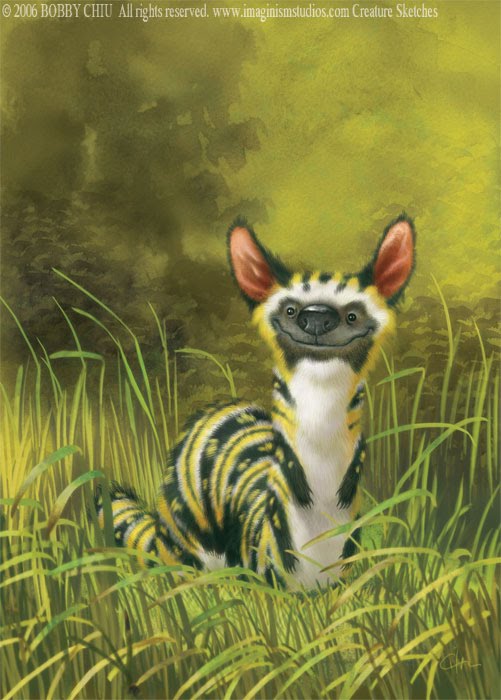
It is quite possible that just about everyone with an active interest in paintings of fantastic animals has already seen the work of Bobby Chiu. If not, well, then I am happy to introduce his work to you. It does not really fit that well with what I normally discuss on this blog: I like a hefty dose of science in my creatures, and Mr Chiu's work does not provide that. But I have made exceptions in the past before (for instance here and here). On looking back at the exceptions I realised that I am never much impressed by fire-breathing dragons and aggressive mean-looking monsters. There are plenty of those to be found on covers of books or on Deviant Art, so it is not a lack of availability. Instead, a sense of humour is more important to me, and Mr Chiu's painting have that in abundance. If you wish to have a closer look, here is his own site, and you will also find him on Deviant Art and on the CG society. Or just try 'Bobby Chiu' on Google.

Click to enlarge; copyright Bobby Chiu

Did I mention that he is an incredibly good painter? Just look at the composition of this one. You really have to know what you are doing in order to lay out your subject in this way.


Click to enlarge; copyright Bobby Chiu

A 'Kangamolerat bunny'. I guess the name says a all: bits of kangaroo, naked molerat and bunny. I do not think I have to point to this cutie's dark side. I love the way the light strikes the rock wall behind the bunny.


Click to enlarge; copyright Bobby Chiu

A Baterpillar Farret. What else?

Click to enlarge; copyright Bobby Chiu

And a 'Big Bad Bunny Eater'. Mind you, there is some serious biology here: the real bunnies are obviously attracted by the fake one, so this is a nice example of 'aggressive mimicry'. Mimicry describes the situation where one living species resembles another one for some purpose. It is not camouflage, in which an animal merely tries to blend in with its environment. In defensive mimicry animals may look like more dangerous ones, which stops them from being attacked. But in aggressive mimicry the predator does the trickery, usually by mimicking something the prey is interested in. In this case, you wonder what it is about the fake bunny that so mesmerises the real bunnies? Could it be sexual attraction? It wouldn't be the first time a pair of pretty eyes led a man/bunny to his doom.

Click to enlarge; copyright Gert van Dijk

All this reminded me that I had once also painted a fictional animal displaying aggressive mimicry. The painting was done when I was about 20, and now, some decades later, it is lost; all I have is a poor black and white image. That is just as well in a way, as I would not dare to compare my painting skills with those of Mr Chiu. But the subject matter does lend itself well to a comparison: somewhat dumb herbivores are lured to a sinister fate by a predator with a cunning plan.

Oddly, both Mr Chiu's predator and mine seem to take a perverse delight in what they are doing. Perhaps there is 'aggressive mimicry' going on at different levels here: the humour hides something sinister, creeping through...

Sunday, 20 February 2011

Swimming in Sand II: some facts, more fiction ('Tremors' & 'Primeval')

The previous post and the appendix dealt with Dune's sandworms, and how difficult it would be to getting millions of tons of sand out of the way to make such animals move. While the hard-boiled scientist in me rejected them as utterly impossible, the somewhat more romantic SF fan, also inside me, decided not to care one bit.

The size argument probably means that any real sandswimmers, by which I mean those on earth and in serious speculative biology projects, had better be small. Are there any other limitations on what they can do? Can sandswimmers dive as deep as they like?

I searched for an answer by looking at the physics of soils. Not surprisingly, the pressure in sand or another type of soil gets deeper the deeper you get, the same as pressure increases with depth in water. Typical soils contain not just grains of sand, but water as well. That complicates matters because there are separate pressures of the grains and the water between them. Luckily we can forget the water component as we are dealing with pure, dry sand. Comparing the effects of depth in water and sand reveals that sand isn't really a fluid.. They have in common that pressures increases with depth, and more so in sand, as it is heavier. But in water the extreme pressure at the bottom of an ocean trench does not stop fish from moving at all, whereas I imagine that movement is impossible under even two (maybe even one) meters of sand. While this seems intuitive, I found no readily available physical explanation. I suppose it has to do with the internal friction between grains of sand.


Click to enlarge. From: Baumgartner et al. Investigating the Locomotion of the Sandfish in Desert Sand Using NMR-Imaging. PLoS ONE 3(10): e3309. doi:10.1371/journal.pone.0003309

Loosely packed sand can be shaken, and then it sort of acts like a fluid. The image above is in fact from a study on sandswimming lizards, in which the authors speculated that decompacting sand might make it more fluid.

Click to enlarge. Copyright Gert van Dijk

But simply adding more sand on top would cause the sand to become impacted, and then no amount of shaking is going to create spare room. That is what is shown here. If something (a sandswimmer!) starts pushing a number of grains upwards, an entire column of sand above needs needs to be shifted. In fact, initially that column might look more like a cone, until the grains start shifting. At any rate this is real work.

What all this suggests is that pressure limits swimming in sand to superficial layers. A consequence of that would be that you would see the surface move when the swimmer is passing. It does not seem likely that sandswimmers can swim up to a potential victim without that victim being aware of the sand apparently moving of its own accord. Obviously, if the sandswimmer is a herbivore, any plants it is creeping up on wouldn't notice that. But sandswimming predators that wish to devour surface-walking prey had better do so from an ambush. Having said that, let's have a look at more fictional sandswimmers.


'Tremors' is a film about monsters ('graboids') that beleaguer a small community in a desert environment. The graboids swim under the sand at an amazing speed. As you can see from the video clip, they do break the soil above them, so the filmmakers gain some points for that. The speed at which they move is ludicrous, I am sorry to say. I couldn't see how the animals move: no bristles or legs or anything else I could find. The scene in which the graboid crashes into a concrete wall is wonderful from a story-telling point of view, but less so from a biomechanical point of view. It's not that the animal wouldn't get hurt, hitting concrete at that speed, but that the packed sand it moves through with ease would in reality provide a similarly unyielding obstacle. Anyone who ever took a failed dive and belly-flopped on water knows how hard water can be when struck at some speed. Now take the same dive on sand: there wouldn't even be a dent in it. The same principle is at work with sand sacks: they stop bullets. So I am sorry once again, but graboids are not feasible as shown. As was the case for Dune, I do not think that this harms the enjoyment of the film in any way. Apparently, the needs of fiction outweigh the needs of facts (Mr. Spock might have said that, but I did). Luckily 'Tremors' has a lot of humour in it, so I feel the same about it as I did with Dune.


The scene above is from a British television series called 'Primeval' in which time portals come into life now and again, allowing past and future wildlife to blunder through and run amok in England. In this scene a villain has captured some Silurian scorpions and uses them to terrorise a beach. The scorpions are a lot bigger than they were in reality and are supposed to be excellent sandswimmers, with lots of long limbs sticking sideways. Hmm; that can't really help their sandswimming abilities. When they approach, sometimes you see the sand move, particularly when the scene require drama to be built up, while at other times the scorpions strike without causing as much as a ripple on the sand.

There is a delectable irony in the Primeval scene. A man has been buried in the sand by his children. This is what people do at beaches, and if you search Google or YouTube, you will soon find examples of people being unable to free themselves, especially when the tide comes in: one wave of water can undo a minute or two of frantic digging by bystanders. In the Primeval scene, the buried man cannot free himself, and through this nicely illustrates that humans are very poor at sandswimming. And then the scorpion swims in, from deep beneath the ripples, and sucks the poor man under. Unfortunately, there is nothing about a man-sized scorpion that would make it a better sandswimmer than its victim. I guess the reasoning was once again that "The needs of fiction outweigh the needs of facts".

Saturday, 12 February 2011

Swimming in Sand 1a: Dune appendix

Strictly speaking this post has no exobiology in it, so has no place here. But I could not resist digging up the only painting I ever did of an existing work of SF, and that was Dune, the subject of the previous post. So here it is. The painting is (shockingly) old, but the lettering is all new.

(Until now New Hades Publishers specialised in nature books -have a look at the Furaha site-, so this must be a new approach for them.)


Click to enlarge; copyright Gert van Dijk

Why no sandworms? As I said before, for me Dune was about people foremost, and sandworms second.

Saturday, 5 February 2011

Swimming in Sand 1: the Sandworms of Dune

Sand is an odd material. In some ways it is like a fluid, as you can scoop up a handful of it and let it run through your fingers. Still, hills and dunes of sand will hold their shape, which water cannot do. You also cannot stand on it, and if you are buried underneath even a few decimetres of it on a beach, you will find it is much more resistant to movement than water is. Some animals 'swim' in it though, both real and fictional ones. There seems to be enough material for more than post, so this one is just the first. To start, let's begin with SF's biggest sand swimmer.


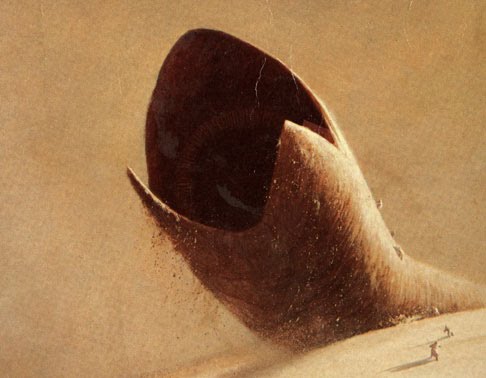
Click to enlarge; painting by John Schoenherr

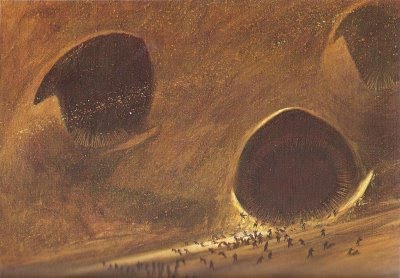
Click to enlarge; painting by John Schoenherr

This is Shai-Hulud, the sandworm of Arrakis, the spice planet! These paintings are by John Schoenherr, a brilliant SF illustrator who died in 2010. Sandworms started life in Frank Herberts's Dune, an SF classic. I loved it when I first read it, several decades ago. I think I read the original novel more than once, but cannot say the same for the sequels, of which I may have read two, or perhaps even three (I tend to dislike trilogies with more than three volumes).

Much has been written about just about any aspect of the Dune books, and the sandworms are no exception. In fact, there is an entire book devoted to 'the Science of Dune', and one chapter was devoted to 'The Biology of the Sandworm'. You can download that chapter for 1 US $ here. I liked it, as it explored sandworm biology by comparing it with Earth biology. Sybille Hechtel, the author of the essay, had this to say about sandworm movement: "Herbert never describes precisely how the worm moves, only that it looks like a fish that 'swims' just under the surface. He frequently describes the worm’s motion in sand as 'a cresting of sand,' or mentions the 'burrow mound of a worm'. The worm primarily comes above the surface when it’s eating a ’thopter or crawler, or when the Fremen catch one and put their hooks in its scales to drive it up out of the sand." Well, that means there is no information whatsoever in Dune about how sandworms move. Starting with the word 'worm' there seem to be two major Earth modes of movement to compare it with.


Earthworm movement; click to enlarge; copyright Gert van Dijk

The first are earthworms. These move in an ingenious way, as the segments of their bodies can change shape: when they are short and wide, they press against the soil and anchor themselves to the soil. Any segments behind them that are long but narrow can be pulled up by shortening them in turn. The beauty of the system is that any segments in front can be pushed forwards by narrowing them. In this way, shortened segments function as anchors for thinner segments in front and behind. I have no idea whether or not sandworms are supposed to move like this, but one thing is certain: to move forward, earthworms have to force the soil aside to make room for their body.

Undulation; click to enlarge; copyright Gert van Dijk

The second way is by undulation, that way snakes, eels, and lots of Earth fishes move. the body moves in bends, and each bend pushes against the material around it. Those forces have sideways (blue) and backwards (red) components. The reaction forces of the material push the animal forward. Again, one thing is certain: whether in water or soil, the animal has to push that material aside to make room for its body in front of it.

So however sandworms move, they have to make room for their bodies. There are only two ways to do that: if the stuff around you is compressible, you can compress it, and otherwise you have to shift it. Water is almost not compressible at all, and sand doesn't compress well either. That leaves shifting it, and the only direction to shift it in is upwards, which sounds like a lot of work. Moving aside water is fairly easy; the fact that the largest animals on Earth, whales, live in water proves this. But the energy costs of shifting sand upwards are probably much higher, something that will probably recur in future posts.


Sandworm scale; click to enlarge

One thing is certain: more sand means more work. So how much sand must a sandworm shift? Well, the biggest sandworms are supposed to be 400 m long with a 80 m diameter. That is big. Very big. In fact, that is longer than a US aircraft carrier (only 333 m) and in the same league as the biggest super oil tankers (458 m). The Wikipedia page on tankers had a very nice scale drawing showing that tanker as well as some of the world's largest buildings, to which I added two sandworms: a puny 200m one and a fully grown 400 m one.


The clip above (taken from YouTube) is from the 1984 film adaptation, and nicely conveys the scale of the worm. Also look back at the paintings and look at the humans, giving a sense of scale. If such an animal is to move one body length forward, it will have to displace the volume of its body in sand. Assuming a completely cylindrical body, the volume of a 400 m sandworm comes out at a bit over 2 million cubic meters. I found figures for the mass of various forms of sand. The lowest density concerned loose sand, so let's use that. One cubic m of loose sand has a mass of 1442 kg, so the mass of the sandworm's volume in sand is 2884 million kg.

I hope these numbers convey the nerve Herbert had in thinking up such a monster. I must say that they impressed me. Regardless of whether a sandworm moves like an earthworm or undulates, displacing all that sand is serious work! Aircraft carriers run on nuclear reactors, and supertankers take ages to turn around. That is in water, a much more forgiving medium than sand. Simply pushing against sand with big muscles isn't going to do the trick. In this respect it is intriguing than no illustration of a sandworm I've ever seen shows anything in the way of a propulsion system. No limbs, no bristles, no segmental thinning, nothing. That goes for paintings well as the film and TV adaptations. Perhaps there are workarounds...

  • One solution would be to give Arrakis, the sandworm's planet, a very low gravity: moving the sand would still require overcoming its inertia, but at least it would weigh a lot less. But reducing gravity has other effects: humans on Arrakis could jump around a lot, but the story doesn't mention that, so that's off.
  • Perhaps the sand could be made lighter? The website I mentioned above states the density of lots of materials. Powdered carbon only masses 80 kg per cubic meter, and pulverised kaolin (china clay) weighs in at only 352 kg. Better, but still...
  • Perhaps the friction between grains of sand can be reduced, but you wonder whether that is possible while still allowing people to walk around on sand.
  • Are sandworms hollow cylinders? If so, then the sand inside their bodies could more or less stay in place. That would reduce the volume needed to shove aside. Perhaps their large size is a way to enlarge area without necessitating a large volume; who knows. It would not do wonders for friction though.
I am afraid that the only way out is to use a lot of 'handwavium', which basically means not worrying about the impossibility of sandworm movement. After all, suspension of disbelief is what keeps SF going. Does this make Dune a silly book? Not really, I think. I liked it very much when I first read it, and countless others did and still do. I only get irritated when authors or film makers pretend to be accurate and then blatantly are not. It is like the difference between someone who says he can bend spoons with psychic powers and someone who won't tell you how he does his tricks but acknowledges that they are tricks. Sandworm movement is such a trick...

Saturday, 22 January 2011

It's a 'Fish'!

One of my good intentions for this year was to cut back on blogging. I did have my doubts whether this was really a good idea, as I like writing. Still, blogging keeps me from painting, and I had been postponing that for too long. I had decided to switch from brushes and artists' oils to digital painting about a year ago, but my first attempts proved a shock: I was used to applying paint where I saw the tip of the brush, and now there was a large distance between the graphics tablet and the screen. There were other mishaps as well. Even after changing Photoshop for Painter (more on that here) I still procrastinated, until I put aside enough time to really play with the brushes. Once I managed to forget what I was doing, my visual and motor skills, such as they are, met again and renewed their friendship. To make a long story short, here is my first digital painting I feel I can show the outside world. It's a fish. Sort of.


Click to enlarge; copyright Gert van Dijk

To be more precise, it is a Fusus rostrauctus of the Clade Fishes IV (Proculcapiti). I may have to check naming conventions here though. Anyway, I revealed a glimpse of Fish evolution previously, which I will not repeat. You may observe the typical traits of the Clade, but I will focus on artistic matters here (just as well, as there were some sudden changes in their anatomy compared to the rough sketch in the earlier post!). Having done a fairly large number of full paintings in oils for the eventual Book, I felt I needed additional illustrations, highlighting individual species, cladograms, things like that. This is the first of those. I wished to keep the painting style more or less the same as that of my previous oil paintings, and think I managed. After messing about with Painter's very large assortment of brushes, I settled on just two, and used those throughout (for those in the know, I used a detail oil brush and a blender, but tweaked size, opacity, 'resaturation' and 'bleed' continuously).

Just for fun I will show some layers of the final painting. The nice thing with digital painting is that you can use layers of colour that stay separate, so you can go back to a deep layer even after you painted others over it. In a 'real' painting ('physical' painting?) the only way to correct a deep layer is to scrape it, and everything on top of it, away altogether.


Click to enlarge; copyright Gert van Dijk

So here is the start of my project (it's not a tutorial: I'm not good enough for that). I started with a rough sketch and simply changed lines and shapes until the concept became more or less ready; that is the image on the left. I then drew a much neater line drawing on another layer, and used that as a guide for the painting job: the one on the right. In old times, I would have done exactly the same, but using various sheets of paper for the sketches on the left and one sheet of transparent paper for the one on the right.


Click to enlarge; copyright Gert van Dijk

After that you start painting. In this case I chose flat colours to start with. With oils, this basic colour layer would have obscured the line drawing on the board. Digitally, things are different: you can paint underneath your sketch, so that stays visible. Very odd at first, but extremely useful. The base colours are on the left, but without the line drawing. After that, another layer was added (on the right), and that is where it becomes interesting: that one modifies the base colours with shadows and highlights, as well as with some subtler colour changes here and there.


Click to enlarge; copyright Gert van Dijk

After that I decided to add another colour layer (I should have done that before, but, as I said, I am new at this). The rest comprises adding some reflections, details, some final shadows etc., and there we are. Mind you, the original is almost 7 times bigger, so some detail is lost. Anyway, here's my first digital painting. I hope you like it.